


GEONET COMPOSITE
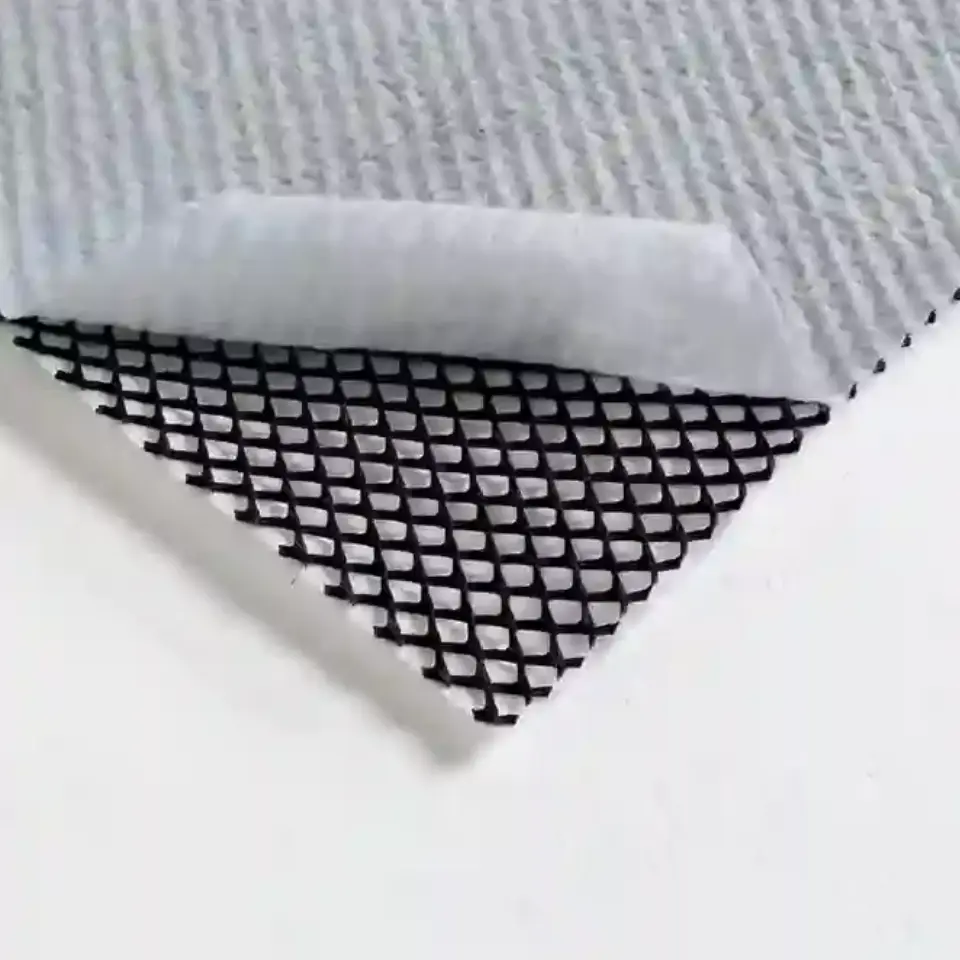
Geonet composite (also called a drainage geocomposite) is a geosynthetic consisting of a three-dimensional HDPE geonet core covered with non-woven geotextile on one or both sides.
The geonet core forms channels that carry water or gas quickly along its plane. The geotextile layer acts as a filter that holds back soil particles so they do not clog the geonet channels.
At only a few millimeters thick, a geonet composite can replace a gravel or sand drainage layer tens of centimeters thick. The result: faster installation, a lighter structural load, and savings on material and transport costs.

Functions
FUNCTIONS OF GEONET COMPOSITE
Geonet composite functions include:
- Drainage: the geonet carries seepage water horizontally and vertically with a high flow capacity (transmissivity).
- Filtration: the geotextile holds back soil particles so the drainage channels stay clean and keep working long term.
- Pore water pressure relief: the geonet helps reduce hydrostatic pressure behind retaining walls, basements and slopes.
- Aggregate layer replacement: with its high permeability, the geonet can replace gravel/sand drainage layers, saving space, time and cost.
- Protection: geonet composite also protects geomembranes or waterproof layers from punctures and damage.
- Gas venting: the geonet can vent gas from under cover layers.
Applications
GEONET COMPOSITE APPLICATIONS
Geonet composite can be used in many construction applications that need drainage, including:
- Retaining walls: drainage behind the wall to prevent excess water pressure.
- Basements and underground structures: vertical drainage along basement and tunnel walls.
- Roof gardens: a lightweight drainage layer under the planting medium.
- Landfills: a leachate collection layer and gas venting in the cover system.
- Roads, railways and sports fields: drainage under the pavement layer to prevent water damage.
- Ponds, mines and wastewater ponds: a leak detection and drainage layer under the geomembrane.
Types
TYPES OF GEONET COMPOSITE
Geonet composites are distinguished by the number of geotextile layers and the structure of the geonet core.
| Type | Construction |
| Single-sided | Geonet + geotextile on one side |
| Double-sided | Geotextile on both sides of the geonet |
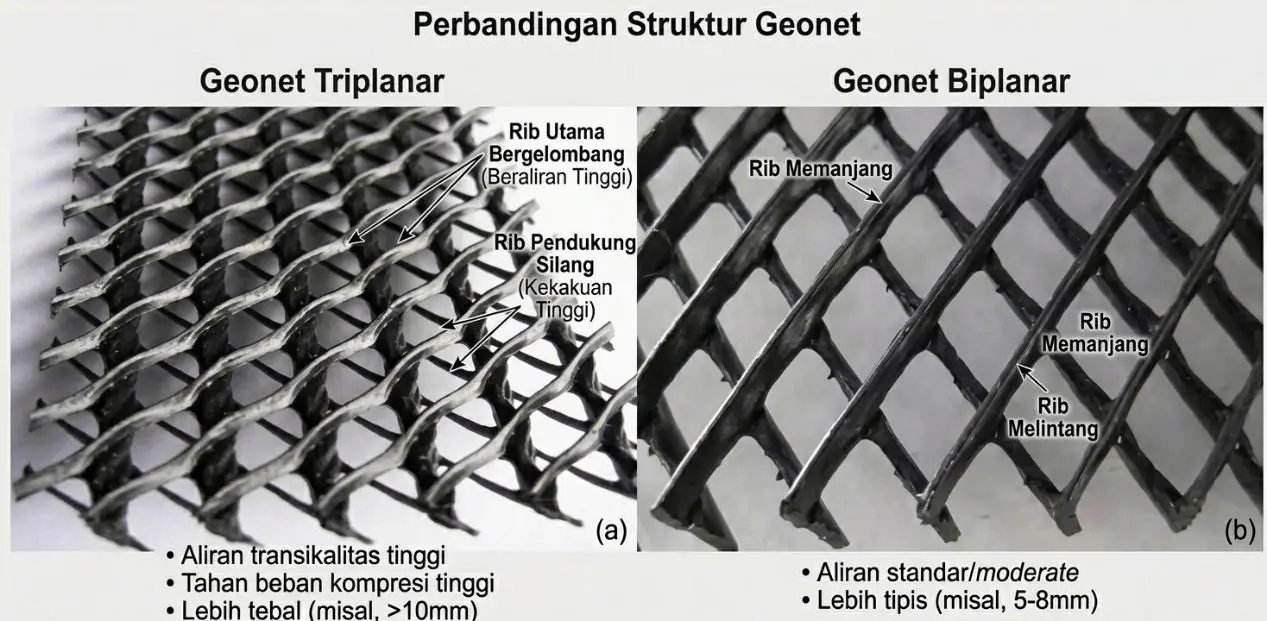
| Bi-planar | Geonet core with two layers of crossing ribs |
| Tri-planar | Geonet core with three layers of ribs, the middle rib running in the flow direction |
Specifications
GEONET COMPOSITE SPECIFICATIONS
Vironet geonet composite is designed to make sure drainage and filtration work as intended. To achieve this, Vironet geonet goes through a series of strict QC processes during manufacturing.
| SPECIFICATION | DETAILS |
| Brand | Vironet |
| Geonet Core Material | HDPE (High Density Polyethylene) |
| Size | 3.95 m x 30 m or Customizable |
| Thickness | 5 mm ; 6 mm ; or By request |
| Geotextile Material | Polyester |
| Geotextile Weight | 200 g/m2 |
| Geonet composite type | single side / double side |
| Geonet type | Biplanar/ Triplanar |
| Typical Joint | Overlap and Cable Ties |
| Standard | ASTM / GB |
FAQ
GEONET COMPOSITE FAQ
What is the difference between geonet composite and drainage cell?
Both are used for drainage. Geonet composite is thinner and more flexible, and performs better for drainage on sloped or vertical surfaces and under high soil loads. Drainage cell is thicker and commonly used for roof gardens and landscaping.
Can geonet composite replace a gravel layer?
Yes. With equivalent transmissivity, a geonet composite just a few millimeters thick can replace a much thicker and heavier gravel drainage layer.
Should I choose single-sided or double-sided?
Use single-sided when one side is against a geomembrane or concrete wall. Use double-sided when both sides are in contact with soil.
How are the rolls joined?
The rolls are overlapped and the geonet cores are tied with plastic ties. The top geotextile is joined by sewing or heat welding.
How much does geonet composite cost?
The price depends on the type, thickness, geotextile weight and order volume. Contact our team for a quote and technical recommendations for your project.
Visit our complete catalog
for more detailed product descriptions!
