


GEOCOMPOSITE
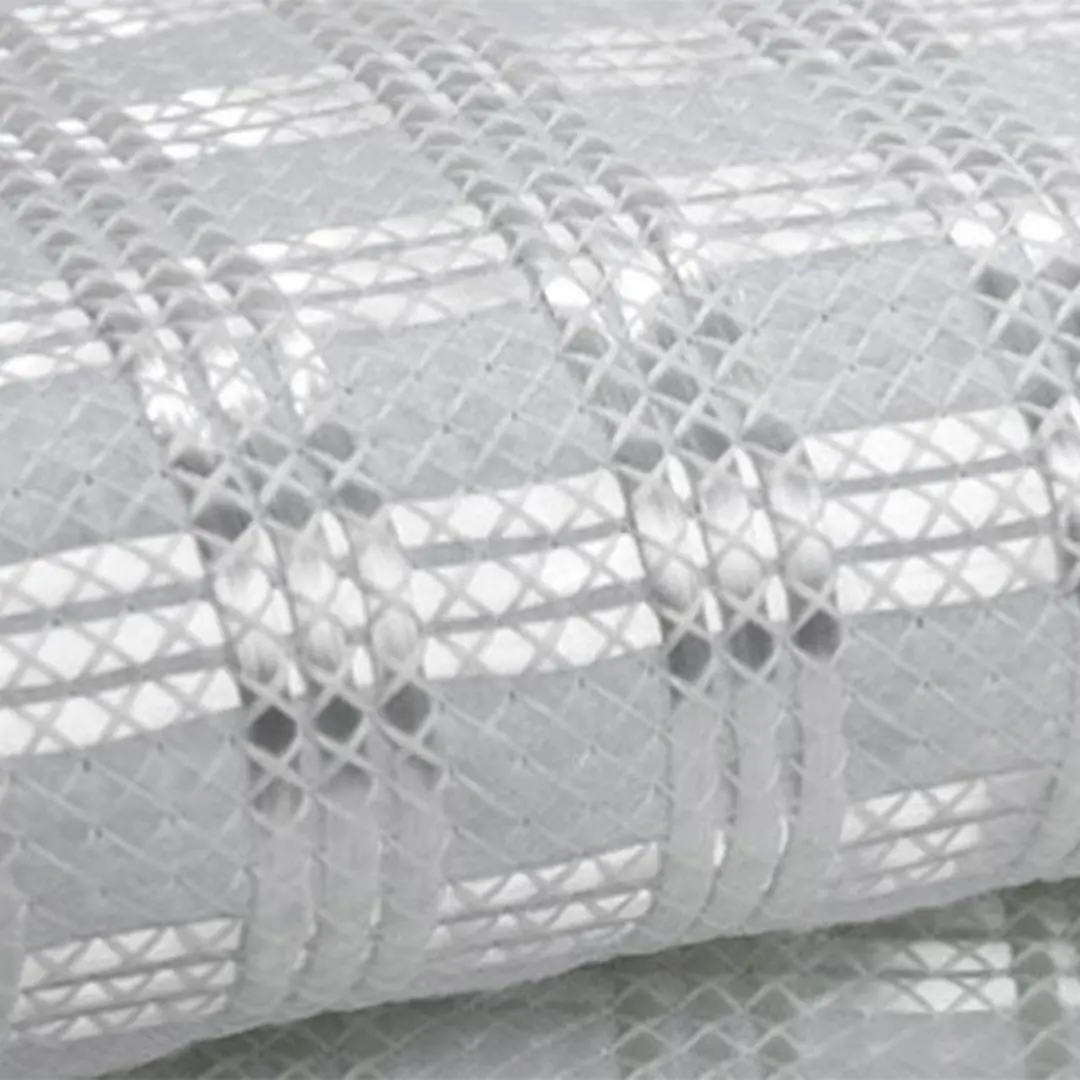
Geocomposite combines polyester (PET) filament yarns with non-woven geotextile, creating a material with very high tensile strength and good permeability.
- Polyester (PET) Filament Yarns: The main structural element, with a very high modulus of elasticity, good creep resistance, and a large tensile load capacity at low strain.
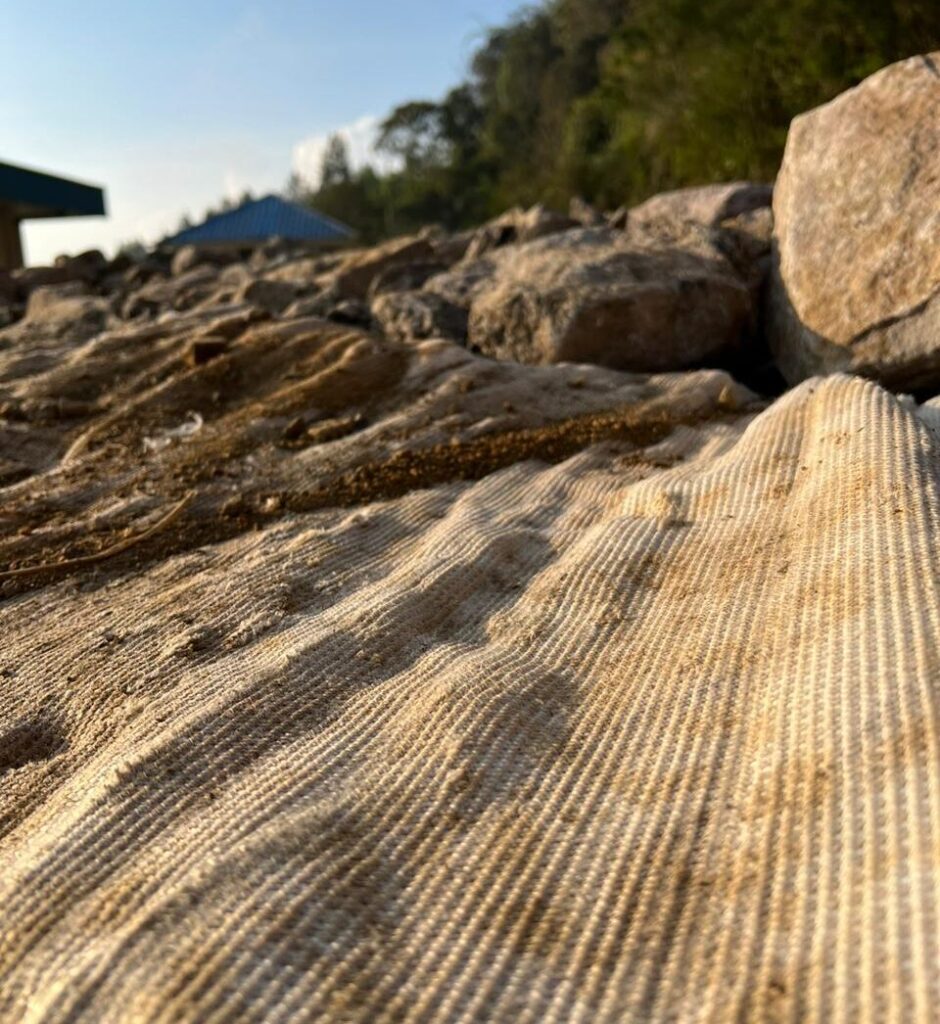
- Non-woven geotextile: Acts as a protective, filtering and separating layer. It is usually made from polypropylene (PP) or polyester (PET), bonded mechanically through a needle-punch process to produce a flexible, permeable sheet.

Functions
FUNCTIONS OF GEOCOMPOSITE
The main advantage of this geocomposite is that it performs three functions at once:
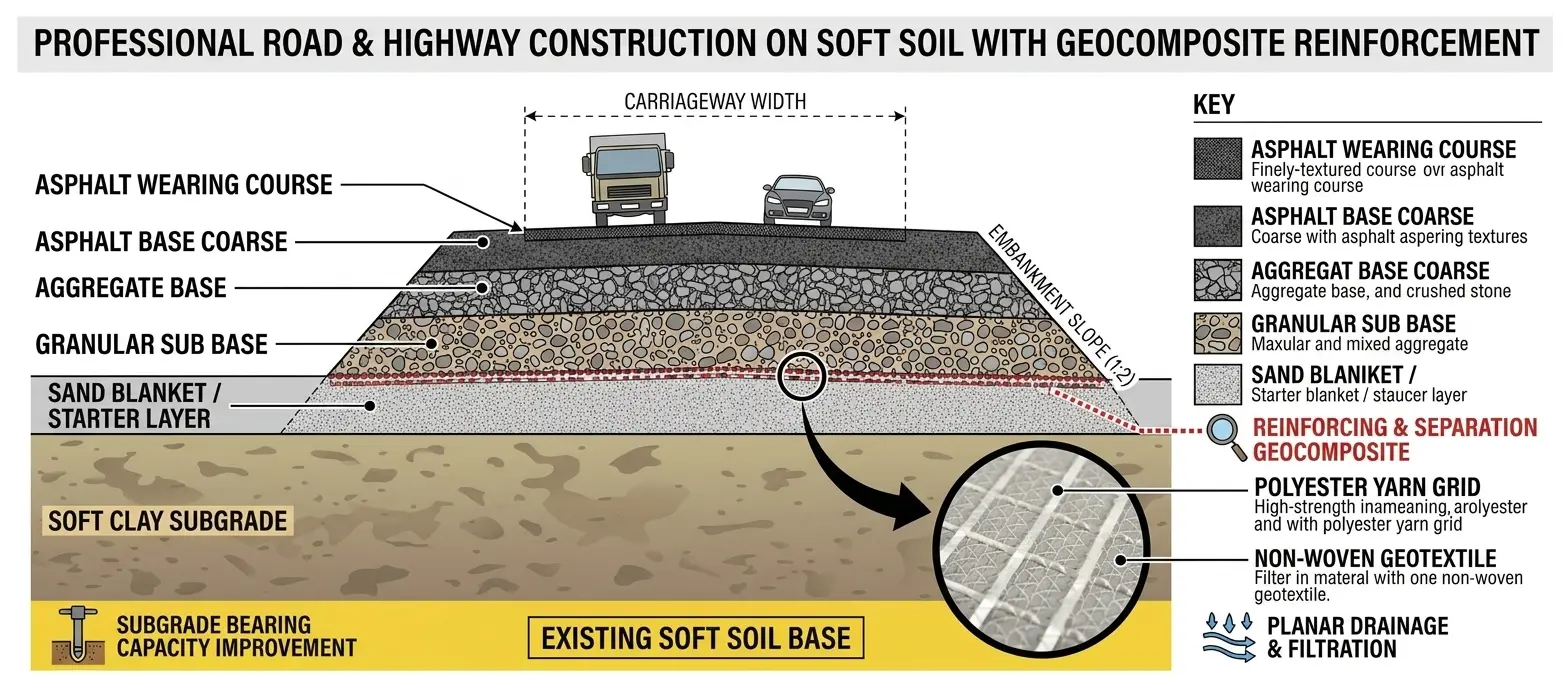
- Separation: The non-woven layer of the geocomposite acts as an effective physical barrier between soft or clay subgrade and the selected aggregate layer (subbase/base course). It prevents coarse aggregate from being pushed into the soft soil under traffic loads, so the pavement structure stays intact.
- Filtration: The pore structure of the non-woven geotextile is designed with a precise apparent opening size (AOS). This lets water flow freely from the soil into the drainage system without fine soil particles migrating or eroding (piping), while maintaining long-term permeability.
- Reinforcement: The PET filament yarns provide high uniaxial or biaxial tensile strength. They absorb shear stress, spread concentrated loads over a wider area, and prevent lateral deformation (soil movement) in embankments.
Applications
GEOCOMPOSITE APPLICATIONS
The combination of separation, filtration and reinforcement makes this geocomposite ideal for:
- Embankments on Soft Soils
Used as a basal layer for road or railway embankments on soft ground (such as soft clay or swamp soil). The polyester yarns carry the embankment load to prevent bearing capacity failure, while the non-woven layer keeps groundwater filtration stable. - Steep Slopes & Reinforced Soil Slopes
Used as the main reinforcement element in steep slopes or MSE walls (Mechanically Stabilized Earth). The layers bind the backfill so the slope stays stable both internally and externally. - Pavement Subgrade Reinforcement for Roads & Car Parks
Installed under the road foundation (base/subbase course) to spread heavy traffic loads, reduce deformation and rutting, and extend the service life of pavements on low-bearing subgrades. - Riprap Underlayer (Bank, Coastal & Channel Protection)
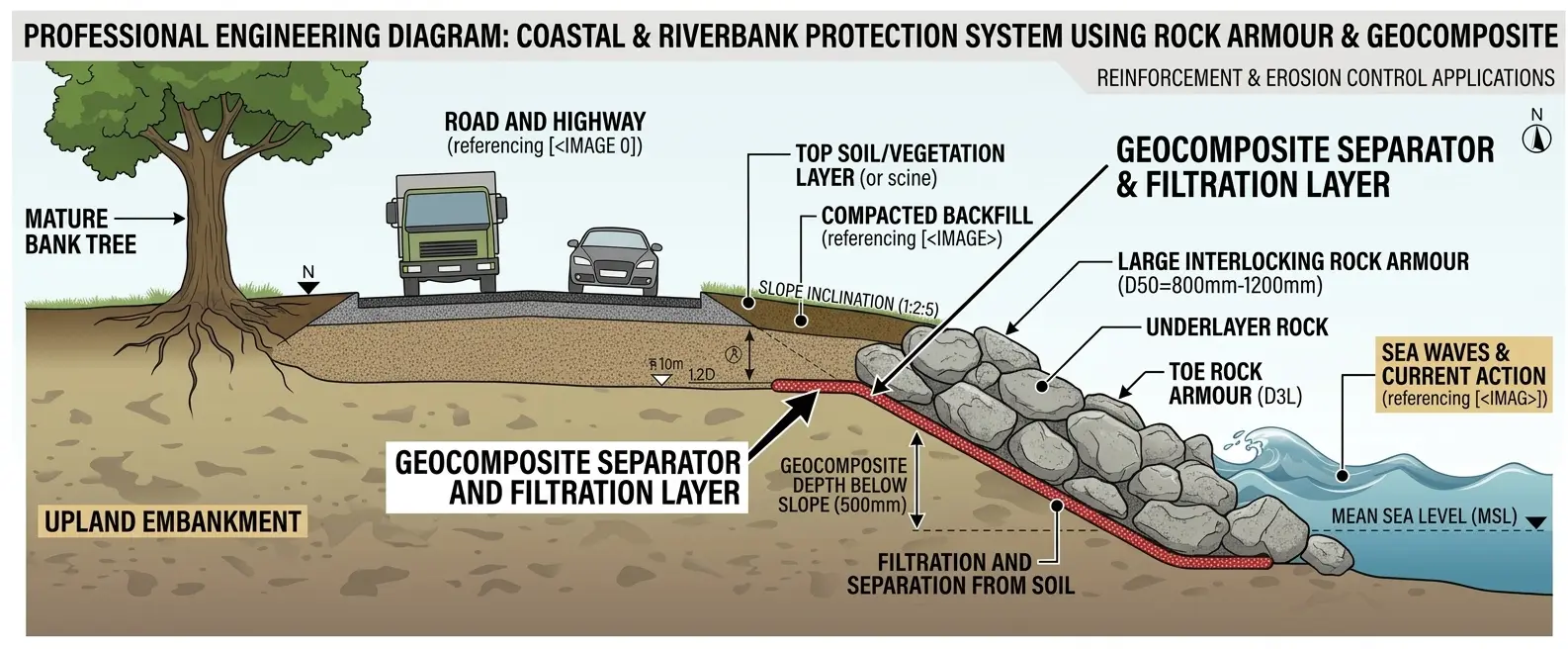
Used for riverbank, coastal and channel protection, where the polyester yarns give structural stability on steep slopes while the non-woven layer works as a separator and filter under the riprap stone.


Types
TYPES OF GEOCOMPOSITE
Geocomposite comes in 2 types, based on the direction of its tensile strength and the structure of its filament yarns:
- Uniaxial geocomposite: tensile strength is dominant in one main direction, suitable for applications that rely on strength in one direction. Examples: Geocomposite 50/15; 75/15; 100/15; and 200/15.
- Biaxial geocomposite: balanced tensile strength in both the longitudinal (Machine Direction) and transverse (Cross Direction) directions. This allows the geocomposite to withstand multi-directional stresses from dynamic heavy vehicle loads on soft ground. Examples: Geocomposite 50/50; 100/100; 150/150; and 200/200.
Specifications
GEOCOMPOSITE SPECIFICATIONS
| Brand | VIROCOMPOSITE |
| Material | Polyester (PET) and Polypropylene (PP) |
| Tensile Strength | Uniaxial: 50/15 kN/m; 75/15 kN/m; 100/15 kN/m Biaxial: 50/50 kN/m; 75/75 kN/m; 100/100 kN/m |
| Type | Uniaxial Composite; Biaxial Composite |
| Width | 5.2 m |
| Length | 100 m |
| Standard | ISO / ASTM |

FAQ
GEOCOMPOSITE FAQ
What is the recommended method for joining this type of geocomposite on site?
For reinforcement: the joint must be able to transfer tensile loads between sections. The main methods are mechanical overlapping with a specified overlap length and sewing with thread.
What is the basic difference between geocomposite, woven geotextile and non-woven geotextile?
- Woven Geotextile: Mainly for reinforcement, with high tensile strength, but very limited filtration and drainage because the woven pattern clogs easily.
- Non-woven Geotextile: Mainly for filtration, separation and drainage, but with very high elongation (> 50%), so it cannot work as soil reinforcement.
- Geocomposite (PET filament + non-woven): Combines the advantages of both in 1 product, providing high bearing capacity and tensile strength from the PET filaments plus immediate filtration, drainage and separation from the non-woven layer.
Why is geocomposite better than ordinary woven geotextile for very soft subgrades (clay/peat)?
Soft soil with a high water content needs fast dissipation of pore water pressure when it is loaded with fill. Woven geotextile does not let water through quickly, so pore pressure can build up and cause the embankment to slide or slip. Geocomposite immediately absorbs pore water and drains it away through its non-woven layer.
Visit our complete catalog
for more detailed product descriptions!
