


Geotextile: Key Material for Roads and Building Foundations

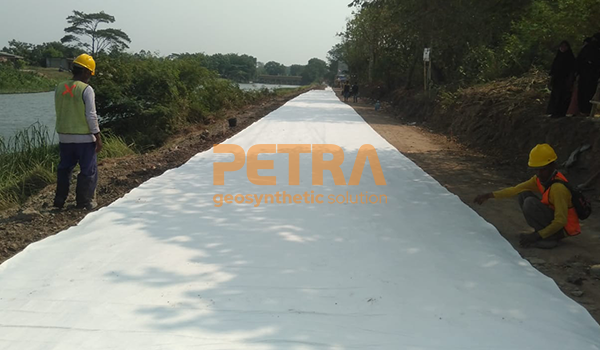
Geotextile is a sheet-form liner material used in various civil engineering projects such as road construction, building foundations, railways and ponds. Made from synthetic yarn, it comes in two main types: woven geotextile and non-woven geotextile. Below we explain the main geotextile functions and types.
According to the ASTM D4439 standard, geotextile is a permeable geosynthetic that reinforces soil layers, improves foundation durability and prevents soil materials from mixing. Because it is strong and durable, geotextile is an efficient solution for modern infrastructure projects.

1. As a Filter (Filtration)
Non-woven geotextile works as a filter that holds back fine particles from water flow without disturbing the soil structure. With its high permeability, water flows freely while soil particles stay in place. The material has been used since the 1960s in Europe, especially in the Netherlands, as an effective soil and water filtration solution.
2. As a Separator
Geotextile separators play an important role in separating two types of soil so that they don’t mix. They keep embankments stable and prevent loss of soil material. Both woven and non-woven geotextile can be used, depending on the project’s needs. Separators are especially important in areas with soft soil, because they withstand seepage forces and maintain the strength of the pavement layers.
3. As a Soil Stabilizer
Besides separation, geotextile also works as a stabilizer that strengthens the soil structure. The material has high tensile strength, so it spreads loads evenly and increases soil bearing capacity during filling.
Types of Geotextile
Woven Geotextile
-
Made from Polypropylene (PP) or Polyester (PET).
-
Produced with modern weaving technology, resembling a woven fabric.
-
Has high tensile strength and is UV resistant.
-
Suitable as a separator and filter between soft soil and embankment fill.
-
Ideal for highway, railway and building foundation projects.
Non-Woven Geotextile
-
Also known as filter fabric.
-
Made using the needle punch method and high-tech heat treatment.
-
Made from Polyester (PET) or Polypropylene (PP).
-
Provides filtration and drainage, letting water flow without carrying soil particles.
-
Suitable for drainage, pond and soil stabilization projects.
Benefits of Geotextile in Infrastructure
-
Longer construction life by preventing damage caused by soil mixing.
-
Lower maintenance costs because the structure is more stable and durable.
-
Construction efficiency because geotextile installation is relatively quick and easy.
-
Environmentally friendly because it reduces the use of additional materials such as stone or sand.
-
Versatile across many types of civil projects, from highways to dams.
Examples of Geotextile Applications in Indonesia
-
Trans-Java Toll Road: uses geotextile as a separator to strengthen soft soil.
-
Jakarta–Bandung High-Speed Railway Project: uses woven geotextile for soil stabilization.
-
North Jakarta Coastal Reclamation: uses non-woven geotextile for filtration and stabilization.
-
Jatigede Dam Construction: geotextile is used to strengthen embankments and prevent erosion.
Affordable Geotextile Prices from a Trusted Supplier
If you are looking for a woven and non-woven geotextile supplier with affordable prices and the best quality, PT. Petra Nusa Elshada is the right choice. We are the largest geotextile distributor in Indonesia, supplying a range of sizes and specifications to suit your construction project.
✅ High-quality products
✅ Competitive prices
✅ Fast delivery throughout Indonesia
✅ Free technical consultation for choosing the right geotextile
For more information and orders, please contact PT. Petra Nusa Elshada
Other Articles

10 Tips for Choosing a Fish Pond Geomembrane
Besides acting as a protective waterproof layer, a fish pond geomembrane also offers a number of other important benefits. One of them is better water quality control. With its ability to form a solid, long-lasting waterproof layer, geomembrane brings benefits, efficiency and sustainability to fish pond operations. Using this material has many advantages. Read on […]

What Is Geocell and How Is It Used?
What is geocell? Geocell is a geosynthetic material made by joining strips into a cellular structure, designed to be filled with soil. Geocell is also known for its good durability and environmental friendliness, making it well suited to infrastructure and other civil engineering projects. Geocell relies on the confinement provided by each of its cells, […]