


HDPE Pipe: Leak-Proof Clean Water Pipe Solution
Have you ever been annoyed when the water bill at your home or project suddenly skyrocketed? After checking, the problem turns out to be a classic one: a pipe leaked or burst because it couldn’t withstand the water pressure. Piping problems are often taken lightly, yet their impact can be a real headache.
If you are looking for a piping system that is strong and has a long service life, you need to get to know HDPE Pipe. In modern construction, this type of HDPE pipe has become a go-to choice. It is not only used for large projects, but is also ideal for residential needs.
In this article, Petrane takes a thorough look at everything about this black pipe, from its definition and advantages to why you should switch to HDPE right now. Let’s dive in!
What Is an HDPE Pipe?
Let’s start with the basics. HDPE stands for High Density Polyethylene. As the name suggests, this pipe is made of high-density polyethylene. This material is a petroleum-derived product with a special characteristic: very strong bonds between its molecules.
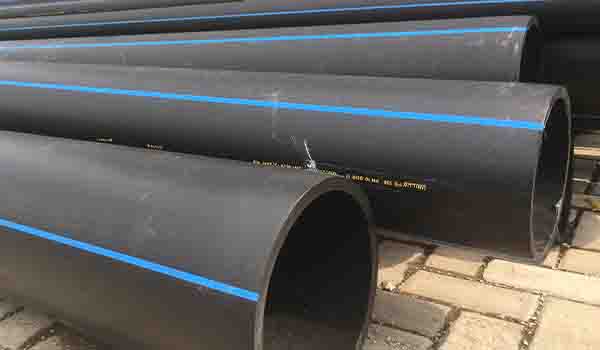
If you see a black pipe with a long blue stripe along its side, it is most likely an HDPE pipe. The black color isn’t just any color. Carbon black pigment is added to make it resistant to ultraviolet (UV) exposure. So the pipe won’t easily become brittle or crack, even when left under Indonesia’s hot sun.
On the market, this pipe is also often called PE-100 pipe. Why? Because the material has a Minimum Required Strength (MRS) of 10 MPa. In short, it is a plastic pipe, but not ordinary “bucket” plastic.
Why Choose HDPE Pipe? Here Are Its Advantages!
You may be wondering, “Why bother switching to HDPE when there are PVC or steel pipes?” Good question! Here is why HDPE pipe deserves to be your long-term investment:
- High Flexibility
Unlike rigid steel or PVC pipes, HDPE is highly elastic. It can be bent to a certain radius without breaking. This is a very important feature, especially if you live in an area with uneven, hilly or earthquake-prone terrain. When the ground moves, rigid pipes can snap, but HDPE bends along with the soil movement. - Rust-Proof and Chemical Resistant
The main enemy of steel pipes is rust. HDPE pipe is 100% corrosion-proof. You don’t need to worry about the pipe corroding with age or contaminating the water with rust. It is also resistant to a wide range of acidic and alkaline chemicals. That’s why, besides clean water, this pipe is often used in mining areas and waste disposal. - Food Grade Standard
This is the most important point if you care about health. HDPE pipe is non-toxic and does not change the taste, smell or color of water. The material has been tested as safe for conveying drinking water (clean water). So the water that reaches your tap stays hygienic. - Service Life of Up to 50 Years
When installed correctly according to standards, this pipe can last up to 50 years! Imagine paying for installation only once for decades to come. Very cost-effective, isn’t it? - Fused Joints
HDPE jointing uses heating/melting, so the joints fuse together perfectly. No more stories of glue coming loose or stripped threads. The joint is as strong as the pipe body itself.
Understanding Pressure Classes (PN) of HDPE Pipe
When you want to buy an HDPE pipe, you will surely be asked, “Which PN are you looking for?” Don’t be confused. Besides consulting our team of experts, it helps to know the basics yourself.
PN stands for Pressure Nominal, which is the pipe’s ability to withstand internal water pressure. The higher the PN number, the thicker the pipe wall and the stronger it withstands the pressure of your water pump.
Here is a quick guide:
- PN 6.3: For gravity water flow or very low pressure.
- PN 8: Suitable for low-pressure clean water lines (ordinary households).
- PN 10: The most standard and best-selling class. Suitable for PDAM (regional water utility) networks or mid-sized residential water distribution.
- PN 12.5: For lines that need higher pressure, for example in areas with rising and falling contours.
- PN 16: Thick-walled pipe for high pressure, usually used for the main line (trunk main) or industrial areas using high pressure pumps.
Choosing the right PN is very important. If your pump pressure is high but you use a pipe with a low PN, the pipe can burst. Conversely, using a high PN for low pressure is very inefficient because it costs more.
Jointing Methods: Don’t Just Use Glue!
Remember, HDPE pipe cannot be joined with ordinary pipe glue. Because its surface is slippery and chemically resistant, glue won’t bond firmly. There are three correct jointing methods:
- Compression Joint
This is the easiest and most popular method for small pipe sizes (20mm to 110mm). You don’t need an electric welding machine. Just use special fittings with threads and a clamping ring (rubber ring). Simply tighten by hand or with a pipe wrench and the joint is sealed. Perfect for repairs at home. - Butt Fusion
This method is for pipes with a diameter of 63mm and above. The ends of both pipes are heated with a welding machine (heater plate) until they melt, then pushed together until they fuse. Once cooled, the two pipes become one solid unit. The joint is very strong, often even stronger than the pipe itself. - Electrofusion
This is a more advanced and precise method, usually used for gas pipes or areas that are hard for a Butt Fusion machine to reach. The fitting has an electric coil inside. When current is applied with a special device, the coil heats up and melts the plastic from the inside, fusing the pipe and fitting perfectly.
HDPE Pipe Applications in Various Industries
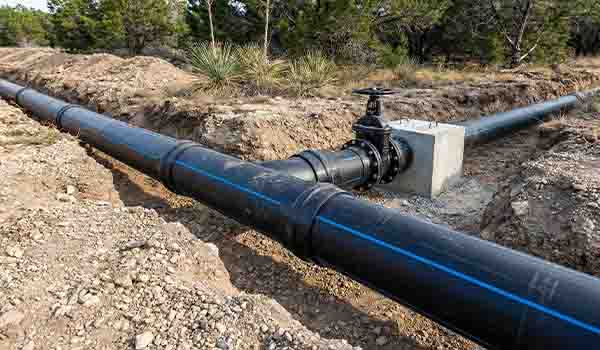
Although it is best known as a clean water pipe, HDPE has a very wide range of uses. You can find this pipe in many sectors:
- Clean Water Networks (PDAM/PAM)
This is its main use. Almost all modern drinking water projects are switching to HDPE. - Mining
Because it is resistant to abrasion and impact, HDPE is used to convey slurry (mining mud) or dewatering water. - Gas Networks
Yellow HDPE pipes are usually used to distribute natural gas to homes because they are leak-proof. - Cable Protection
Ever seen black pipes for optical cables along the roadside? Those are HDPE sub-ducts that protect telecommunication cables from physical damage. - Agricultural Irrigation
Modern farmers use HDPE because it resists chemical fertilizers and extreme weather in the fields.
Quick Comparison: HDPE vs PVC
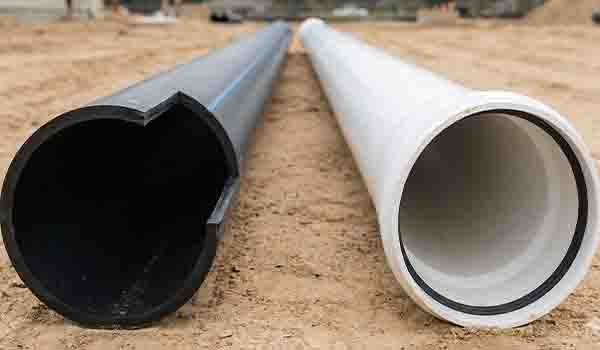
To make you even more confident, let’s do a simple head-to-head comparison:
- Impact Resistance
PVC breaks easily when hit or crushed by heavy objects. HDPE is very tough and impact resistant. - Pipe Length
PVC is generally sold in lengths (4 meters). HDPE is available in coils (rolls) of up to 100 meters (for small sizes). This means far fewer joints with HDPE, so the potential for leaks at joints drops drastically. - Installation
PVC needs a lot of glue and fittings. Small HDPE pipes can be bent, saving on elbow fittings.
Conclusion
Switching to HDPE Pipe is a smart long-term decision. Although its initial price may look slightly higher than conventional pipes, once you factor in near-zero maintenance costs and a much longer service life, HDPE ends up far cheaper.
Whether you are building your dream home, renovating water lines or handling an infrastructure project, make sure your water flow has a strong foundation with HDPE. Smooth water flow, peace of mind!
Need a Consultation for Your Project?
Ready to replace your old pipes or start a new HDPE pipe installation? Don’t hesitate to consult us about your piping needs.
Feel free to consult us about your geosynthetic material needs. We supply a wide range of high-quality geosynthetics ready to ship throughout Indonesia. Let’s discuss your project needs now!
Check our catalog: Click here
Chat on WhatsApp Now: Click here
Remember Geosynthetics, Remember Petra!
Other Articles

Geomembrane Benefits for Road Construction
What Is Geomembrane? Geomembrane is a type of geosynthetic in the form of a thin sheet made from high-grade polyethylene blended with carbon black, antioxidants, anti-ageing and anti-UV additives. The material resists a wide range of chemical liquids, waste and microorganisms, and has low permeability and excellent UV resistance. HDPE geomembrane is also very strong […]

Geogrid for Soil Reinforcement and Stabilization
Geogrid is a geosynthetic product with a regular grid structure that can be connected to other geogrids. Because its apertures are larger than 6.35 mm, the soil, the geogrid and the surrounding stone can interlock, making geogrid soil reinforcement highly effective. Geogrid is a material used for reinforcement, for example of slopes, road embankments and […]