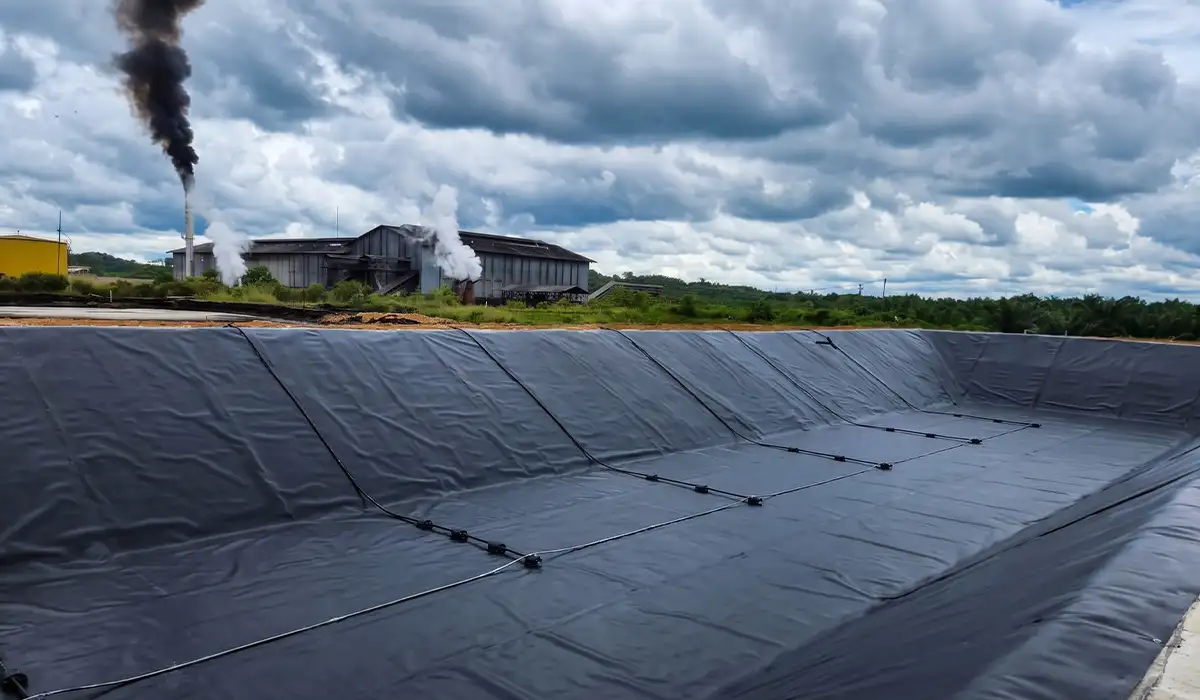
Artificial Lake Geomembrane Repair in Bali

Project Background: The Challenge of Constantly Disappearing Water
The artificial lake that was meant to be the main attraction and relaxing centerpiece of this property suffered from severe infiltration (seepage). The soil at the bottom of the lake could not hold the volume of water, so water kept seeping back into the ground (groundwater). Relining it with an artificial lake geomembrane became the answer.
This condition triggered a very costly domino effect. First, the management had to run the water pumps continuously to maintain the water level, which immediately drove up the operational electricity bill. Second, the seepage slowly pulled sediment and fine silt particles up from the subgrade. The result? Lake water that should have been clear blue turned murky brown, damaging the overall aesthetic value of the property. After several minor fixes failed to solve the problem, a complete repair of the lake bed became the only way out.
Material Solution: Why Choose a 1mm Artificial Lake Geomembrane?
Faced with massive infiltration, the best technical solution applied in this project was relining the lake using 1mm thick HDPE Geomembrane.
Why specifically 1mm? A 1mm High-Density Polyethylene (HDPE) sheet offers the most ideal technical balance for an artificial lake. It is thick enough to provide very high puncture resistance against small stones and hydrostatic water pressure, yet still has good flexibility (elongation) to adapt to the curved contours of the lake bed.
Applying this material immediately delivered four crucial functions:
- Reducing water loss from infiltration into the ground: Geomembrane is 100% impermeable, completely cutting off seepage paths into the soil.
- Keeping the lake water level stable: The water system works less hard because water no longer leaks downward.
- Maintaining water clarity for aesthetics: It acts as a mechanical barrier that stops silt and subgrade soil from rising and mixing with the lake water.
- Lowering maintenance costs: It saves electricity from constantly running pumps, extends filter life and reduces daily maintenance hours.
Technical Field Execution: Geomembrane Installation Standards
The key to a successful geomembrane is not just the material, but the precision of its installation. Repairing an existing lake demands extra care. Here are the details of the geomembrane installation we carried out in Bali:
- Subgrade Preparation Before the new material is laid, the lake must be completely drained. The field team cleaned the entire bed of algae residue, biofilm (organic slime) and leftover wet sediment. The most important step here is re-leveling the subgrade and making sure it is free of sharp objects such as rock fragments or roots. Because the weight of the lake water is very heavy, hollow soil was re-compacted to prevent sudden localized settlement that could later pull on the geomembrane.
- Deploying the Geomembrane Panels The 1mm geomembrane was laid out slowly to cover the contours of the lake bed. Deployment took into account the material’s thermal expansion and contraction. Panels were not pulled too tight, so that when temperatures drop, tension in the material does not cause stress cracking.
- A Precise Welding Process The most critical part is seaming. In this project, technicians used two high-specification welding methods:
- Hot Wedge Fusion Welding: This method was used to join the long main panels. The hot wedge machine applies precise heat (at 220°C – 280°C) while pressing both sides of the geomembrane together with rollers. The result is a double track seam that fuses the joint at the molecular level.
- Extrusion Welding: For complex corners, around mechanical pipe penetrations (pipe boots) or patched areas, an extrusion machine was used. As a technical repair standard, every patch is cut with rounded corners (no sharp corners) and given an overlap of at least 15 cm to minimize the risk of peeling underwater.
- Seam Quality Testing (Quality Control) We never close a project based on visual assumptions alone. Every long weld seam is tested with an Air Pressure Test, injecting high-pressure air into the channel of the double track seam. For extrusion patches, the team uses a Vacuum Box Test. Soapy liquid is applied over the weld, then a vacuum box draws out the air above it. If the pressure holds and no soap bubbles appear, the area is officially declared 100% leak-free.
- Anchoring at the Edges (Anchor Trenching) As the final step, the outer edges of the geomembrane at the lake rim must be locked in place so they do not slide down under gravity or on slippery mud. We dug an anchor trench around the upper edge of the lake. The panel ends were placed in this trench, then backfilled and re-compacted. This anchoring system transfers tensile loads to the ground, keeping the geomembrane firmly locked for its entire service life.
The Result: Attractive and Efficient Operations
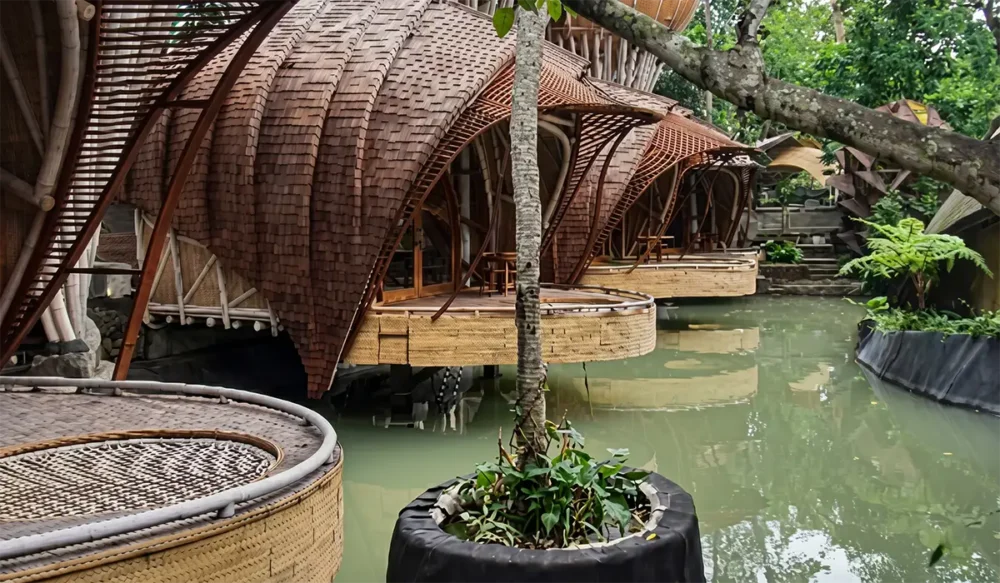
Once the repair was finished and the lake refilled, the difference was immediate. Post-project evaluation showed that water loss had dropped sharply to normal levels, with the remaining loss caused purely by natural evaporation from the sun.
The lake water level stays consistent, and its clarity is once again a pleasure to look at because the soil sediment is now fully isolated from the water above it. This successful geomembrane installation cut routine repair costs, drastically reduced pump operating bills and restored the artificial lake’s aesthetics to its original design intent.
Conclusion
Managing water in an artificial lake landscape does require serious technical planning. This repair case study in Bali proves that even a high-spec 1mm HDPE Geomembrane will only perform at its best when combined with proper subgrade preparation, high-quality fusion welding and anchoring that meets engineering standards. If you are planning to revitalize a lake or water storage pond in your project, make sure the geomembrane installation is handled with precise calculations so your infrastructure investment lasts for decades!