


POME Wastewater Pond Lining in East Kalimantan
Background
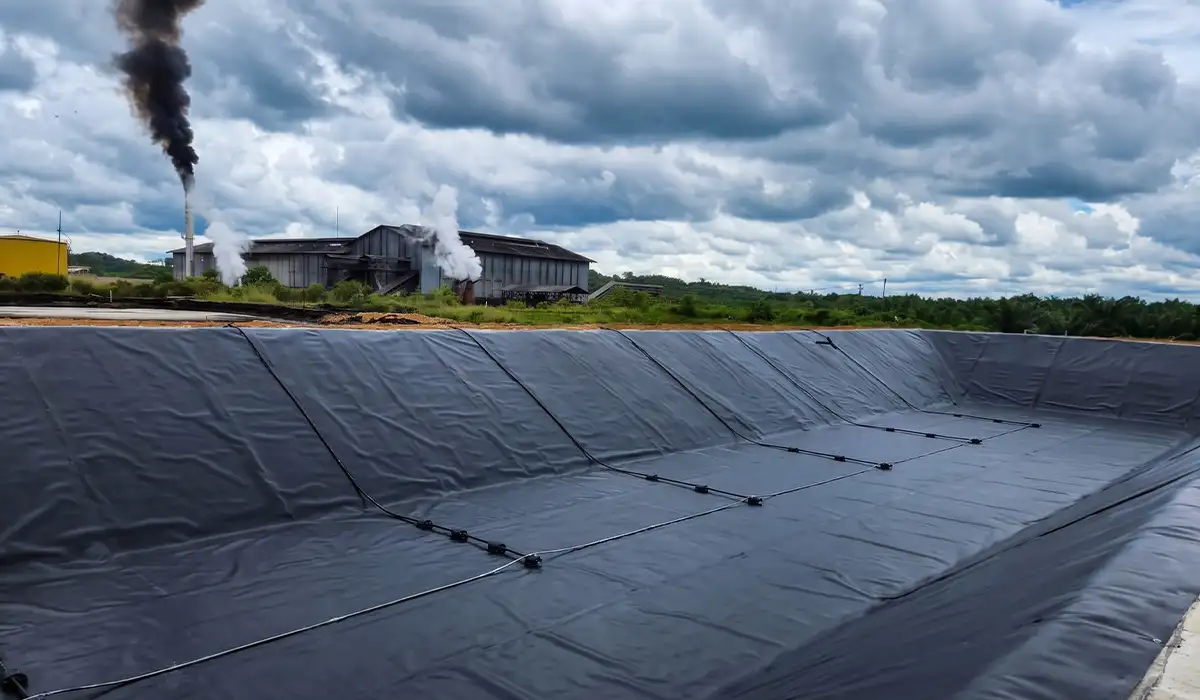
POME (palm oil mill effluent) is an organic liquid waste with high acidity and extremely high Biochemical Oxygen Demand (BOD) and Chemical Oxygen Demand (COD). At a PKS (palm oil mill) facility in East Kalimantan, the mill needed a new wastewater pond lining for a holding pond of ± 4,410 m².
The pond was designed not just for storage but also as an anaerobic degradation area, where the waste is treated before it can be safely discharged or further used to generate biogas. The question is: what material can hold such an aggressive liquid for more than a decade without leaking at all?
Challenge: The Threat of Groundwater Pollution
The challenges on site were far from simple. Soil in East Kalimantan has distinctive moisture and movement characteristics. Several major threats had to be solved in this project:
- Pollution Risk: Preventing the mill’s liquid waste from seeping out and damaging groundwater quality around the mill.
- Puncture by Coarse Material: The subgrade often still contains gravel or root remnants that could tear the waterproof layer once the pond is full and carrying thousands of tons of liquid.
- Slope Stability: Keeping the pond slopes from sliding due to scouring by incoming effluent or movement of the subgrade.
Main Material Specifications

To meet these challenges, the technical team decided to combine two crucial protective geosynthetic materials.
1. Non-Woven Geotextile 250 gsm
The first material laid on the subgrade was Non-Woven Geotextile 250 gsm. Why is it important? Although it is best known for filtration and separation, in this wastewater pond the geotextile has a very important secondary function as a protective layer (cushioning). With the thickness and tensile strength of its non-woven fibers, the material distributes the static pressure of the liquid above and protects the main waterproof layer from puncture by sharp objects from the ground. The geotextile also helps keep the slopes and pond bottom stable so they do not shift easily.
2. HDPE Geomembrane 1.5 mm
On top of the geotextile layer, the star of the system was deployed: Geomembrane 1.5 mm (made of High-Density Polyethylene / HDPE). The 1.5 mm thickness was chosen because the volume of waste is very large and highly corrosive. The geomembrane acts as the main 100% waterproof barrier. HDPE has excellent resistance to aggressive chemicals and intense UV radiation and does not stretch easily, making it ideal for long-term installation in open palm oil mill ponds.
Wastewater Pond Lining Installation Method
The success of a pond lining project depends not only on the material but also on how it is executed. These were the technical steps carried out across the 4,410 m² area:
- Subgrade Preparation: The team ensured the pond bottom and slopes were properly compacted. The area had to be cleared of large rocks, wood and sharp debris to make it as level as possible.
- Geotextile Deployment: Sheets of Non-Woven Geotextile 250 gsm were laid over the entire 4,410 m² with a standard overlap so that no soil was left exposed.
- Geomembrane Deployment: Sheets of 1.5 mm Geomembrane were pulled and laid precisely over the geotextile. The team accounted for material tension due to day and night temperature changes to avoid bridging (tension at the pond corners).
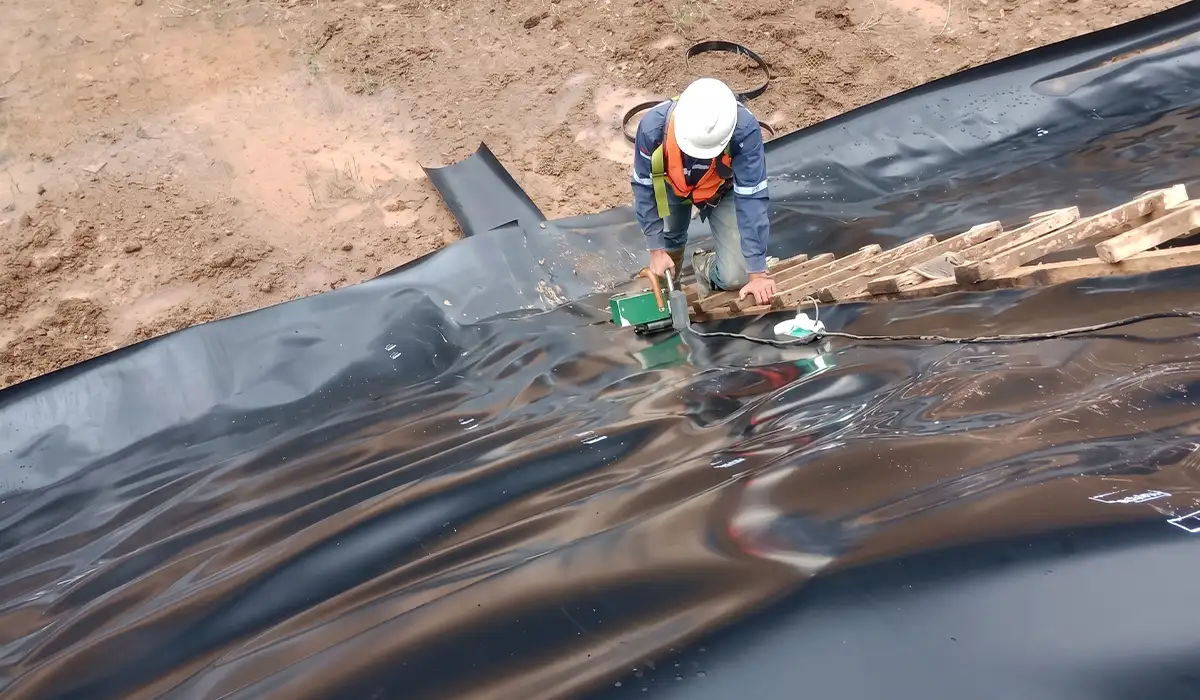
- Welding (Seaming): This is the most critical stage. Our technicians used automatic Double Hot Wedge welders to join the geomembrane sheets. The machine produces a double weld track with an air channel in between, which is later used for testing. For corners and pipes (pipe boots), the Extrusion welding method was used.
- Quality Control (Air Pressure Test): Every double-track seam was tested with an air pump (air pressure test). The air channel between the two weld tracks is pressurized and held for a set duration. If the pressure does not drop, the seam is 100% watertight with no leaks at all.
Final Result: Safe & Long-Lasting Operation
After installation, this palm oil mill wastewater pond in East Kalimantan is operating successfully with maximum environmental safety. The main goal of preventing liquid waste from leaking into the groundwater was achieved 100%. The pond slopes and bottom have also proven stable thanks to the Non-Woven Geotextile 250 gsm. The mill can now treat its POME with confidence, meet the applicable environmental regulations (AMDAL, Indonesia’s environmental impact assessment), and is ready to move on to biogas optimization in the future.
If you are planning an industrial wastewater pond, aquaculture pond or other infrastructure project, choosing the right geosynthetic materials and installation services is the best investment in your project’s future.
Other Articles
Geomembrane Drilling Pond: 53,000 m2 HDPE Lining in Dieng
Background: Challenges at Dieng’s High Altitude The Dieng area has mountainous terrain with extreme temperatures and fairly high rainfall. During the drilling preparation phase (usually for geothermal exploitation), the contractor needs a very large water supply and a safe place to contain fluids or drilling mud, which is where a geomembrane drilling pond comes in. […]

Shrimp Farm Success with 0.3mm Viroline Geomembrane
Project Background and Challenges The Tegal coast has outstanding potential for shrimp farming. However, this 14,000 m² shrimp farm project, which ended up using 0.3mm geomembrane, initially faced the classic problems of conventional earthen ponds. Traditional ponds that rely only on clay have unpredictable porosity. The main challenges facing the farm owner were: Seepage and […]

Rooftop Lining: Menara Tendean Case Study
The Problem: Why a Concrete Roof Slab Alone Is Not Enough You might wonder: isn’t concrete a very solid material? To the naked eye, yes. But in civil engineering terms, concrete is porous and highly prone to expansion and contraction caused by extreme temperature changes. On the rooftop of a tall building such as Menara […]