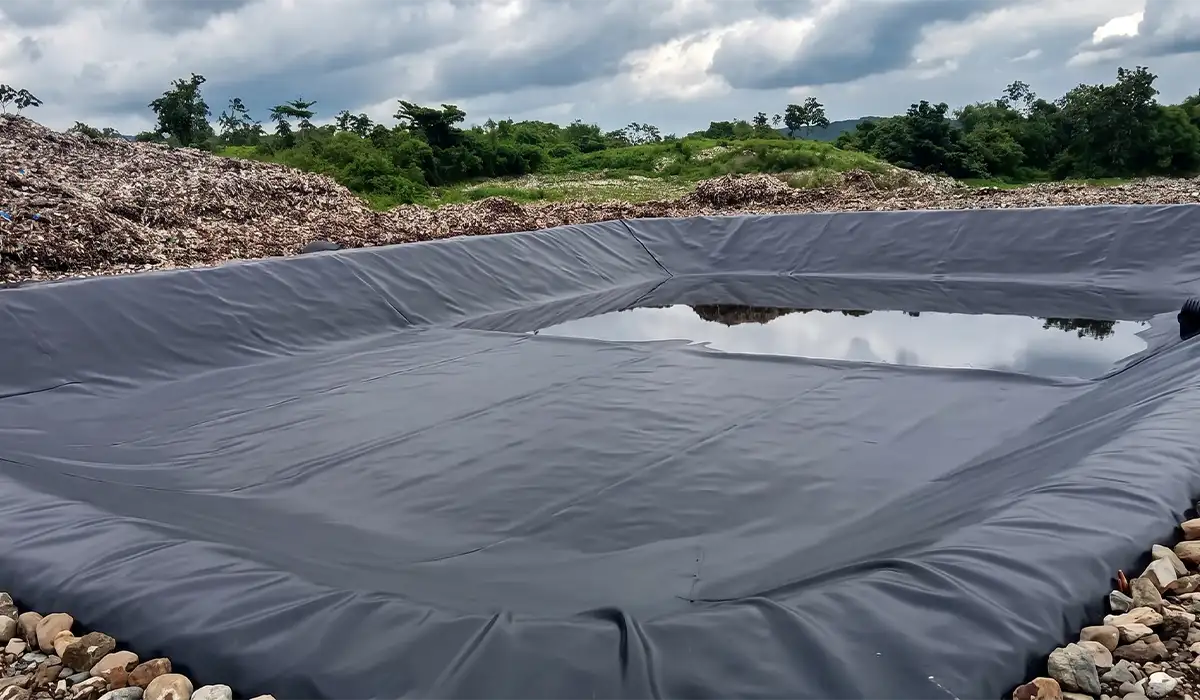
0.75mm Geomembrane for a Reservoir Project in Cianjur

Project Background: The Classic Challenge of an Embung (Small Retention Reservoir)
This project is located in Cianjur, West Java, an area that relies heavily on water availability for agriculture and plantations. The main need was to build an embung, or retention pond, that could hold as much rainwater and surface runoff as possible, making a reservoir geomembrane an essential part of the design.
However, there was one looming technical problem: a high rate of soil infiltration on site. If the reservoir were left as bare natural soil (without a lining), water would constantly seep back into the ground. In addition, erosion of the pond walls could cause massive silting. Left unchecked, the storage volume would shrink drastically in a short time, and the remaining water would become very murky from mixing with mud on the bottom.
To overcome this challenge, the team decided that a waterproof layer, or geosynthetic liner, was the only real solution. The choice fell on 0.75mm thick Geomembrane.
Why Choose a 0.75mm Reservoir Geomembrane?
In geosynthetics, choosing the right material thickness is crucial. A 0.75mm geomembrane was chosen for this Cianjur project because it offers the sweet spot between material flexibility and mechanical resistance.
For a medium-depth reservoir exposed to tropical UV, a 0.75mm thickness is more than adequate. The material is flexible enough to follow uneven ground contours, yet tough enough to withstand the hydrostatic pressure of the stored water and resist potential punctures from small gravel.
Installation Technical Details: Step by Step
Installing a geomembrane is not simply a matter of “rolling out a carpet”. It requires precision and strict technical procedures so the geomembrane can hold back 100% of the water. These were the installation phases at the Cianjur project site:
1. Subgrade Preparation
The first step before the geomembrane touches the ground is preparing the subgrade. The reservoir surface must be compacted and cleared of sharp objects such as tree roots, stones or debris. The project team made sure the ground was leveled with heavy equipment to avoid voids beneath the geomembrane that could cause uneven stress (differential settlement).
2. Digging the Anchor Trench (Anchor Trench)
To keep the geomembrane from sliding down to the bottom when the pond is filled, an anchor trench was dug around the rim of the reservoir. The edges of the geomembrane sheets were placed in this trench, about 50×50 cm in size, then backfilled with soil and compacted. This locks the material in place permanently.
3. Panel Deployment (Deployment)
The 0.75mm geomembrane rolls were deployed using heavy equipment and manual labor. Because the sheets are produced in wide rolls, the panels have to be joined together. The team made sure each sheet had an overlap of about 10-15 cm in preparation for welding.
4. Welding Technique (Welding Process)
This is the most crucial phase. Leaks usually occur not in the material itself but at the seams. This project used two internationally standard welding methods:
- Hot Wedge Welding: An automatic welding machine travels along the panel overlap, heating both sides of the material and pressing them together until they fuse at the molecular level. This method produces a double track weld with an air channel in the middle (the test channel).
- Extrusion Welding: Used for complex detail areas, such as the corners of the reservoir or connections with outlet/inlet water pipes.
After welding, the team performed an Air Pressure Test by pumping air into the channel between the double track welds to make sure there was no pressure drop indicating a pinhole leak.
Functions and Final Results of the Installation
Once the Cianjur reservoir was lined with 0.75mm Geomembrane and began operating, a range of measurable benefits were felt immediately. These are the main functions successfully delivered in this project:
- Reducing Water Loss from Infiltration: This is the biggest win. The waterproof nature of the geomembrane cuts the infiltration rate into the ground to almost 0%.
- Preventing Leaks and Maintaining the Water Level: Because water no longer seeps down, the water level in the reservoir stays stable and only drops through natural evaporation.
- Maintaining Storage Capacity: With no erosion from the pond walls, the reservoir bed stays free of sedimentation. Water storage capacity remains at the maximum of the original design.
- Reducing Mud and Fine Particles Entering the Water: The geomembrane completely separates the water from the subgrade, so no soil particles are stirred up.
- Reducing Water Turbidity: As a knock-on effect of the previous point, the stored water is much clearer and can be used directly for irrigation.
- Preventing Contamination: Besides keeping water in, the liner also prevents pollutants from the surrounding soil (if any) from contaminating the reservoir water.
- Extending the Reservoir’s Service Life: With the soil structure protected from water scouring, the stability of the reservoir slopes is fully maintained. The service life of this infrastructure increases dramatically, to several decades.
Conclusion
If you are planning a retention pond, mini reservoir or artificial lake, this Cianjur reservoir project proves one thing: investing in a waterproof liner is not optional, it is a technical necessity. Using 0.75mm HDPE Geomembrane is a smart, efficient engineering solution that has been proven to save every precious drop of water.