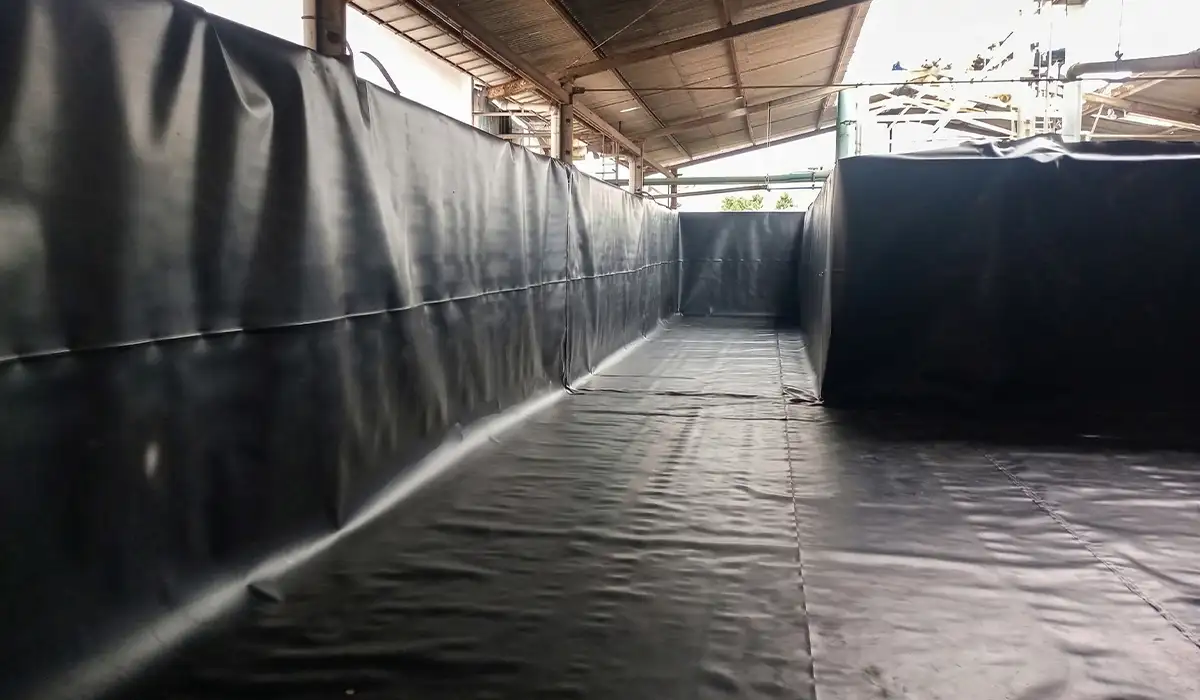
Water Storage Pond Liner with HDPE Geomembrane

Project Background: The Challenge of Retaining Water
The need for a stable water supply for various industrial and utility purposes in Padang requires a reliable storage facility. However, building one involves more than simply digging a huge hole and filling it with water: it needs a dependable water storage pond liner.
The main challenge is the permeability of natural soil. If the pond is left without a liner, water will continually seep below the surface. This not only wastes valuable water reserves but can also damage the surrounding soil structure, trigger internal erosion, and even risk contaminating groundwater if the stored water contains certain substances.
The client therefore needed an impermeable liner that was 100% watertight, durable, tear resistant, and able to withstand the intense tropical sun of Sumatra.
Technical Solution: Why Use a 1 mm Water Storage Pond Liner?
Among the many waterproofing material options, why was a High-Density Polyethylene (HDPE) Geomembrane selected? The answer lies in the material’s technical profile.
For this 2,170 m² project, a 1mm HDPE geomembrane offers the ideal balance between cost efficiency and structural reliability. The material provides:
- High Impermeability: It has nearly zero permeability, ensuring that the water remains inside the pond.
- Exceptional UV Resistance: The HDPE geomembrane is formulated with Carbon Black, antioxidants, and stabilizers that enable it to withstand decades of solar UV exposure without becoming brittle.
- Chemical Resistance: It is highly resistant to a wide range of water pH conditions and chemical compounds.
- Tensile Strength: It can accommodate minor ground movement without tearing.
On-Site Execution: A Precise Installation Process

Good material alone is not enough if the installation is careless. To ensure maximum performance, the team had to complete several highly controlled technical stages:
1. Subgrade Preparation
Before the geomembrane sheets were deployed, the subgrade had to be compacted to a specified density. No sharp rocks, tree roots, or debris were allowed in this area. Why? Because even the smallest sharp object beneath the liner could cause a puncture when the pond was filled and the hydrostatic load increased sharply.
2. Deployment
The 2,170 m² geomembrane was deployed systematically according to a previously designed panel layout . The deployment direction was arranged to minimize the number of seams and avoid cross seams on slope areas that bear the greatest tensile loads.
3. Certified Welding
This is the most critical stage. How are the geomembrane rolls joined to form one continuous watertight barrier?
- Hot Wedge Welding
For straight longitudinal seams, the team used a hot wedge welder with a double track. The machine melts the surfaces of the two overlapping sheets and immediately presses them together. The result is a double seam with an air channel in the middle that can later be used for pressure testing. - Extrusion Welding
For detailed areas, complex corners, or connections to concrete pipes, extrusion welding (adding molten HDPE resin rod) was used to create a completely secure seal.
4. Quality Control and Testing
You may wonder, “How can we know the seams do not leak before filling the pond?” This is where Quality Control comes in. Every hot wedge weld was inspected using an Air Pressure Test (injecting air pressure into the double-seam channel to check for a pressure drop). For extrusion welds, the team used a Vacuum Box Test with soapy water to detect even the smallest air bubbles.
5. Anchoring (Anchor Trench)
The upper edge of the geomembrane was not simply left in place. It was embedded in an anchor trench around the pond perimeter and backfilled with compacted soil. This prevents the geomembrane from sliding downward when pulled by the weight of the water.