


Geogrid Retaining Wall Project in South Sumatra
Project Background
Infrastructure development in South Sumatra often has to deal with subgrade dominated by soft soil or swamp areas. On this embankment project, the contractor faced a tight deadline to build access and loading areas that required a high, solid retaining wall, and a geogrid retaining wall proved to be the answer.
Conventional retaining methods, such as reinforced concrete gravity walls, were considered less efficient in terms of time and budget. In addition, rigid concrete walls risk cracking or structural failure under differential settlement, which is common in Sumatra’s dynamic soils. That is why a reinforced soil approach became the most rational option.
Challenges: The Threat of Landslides and Pore Water
There are two main challenges you need to watch for in a high embankment project like this:
- Lateral Thrust (Active Earth Pressure)
The higher the embankment, the greater the outward thrust of the soil. If it is not properly restrained, the slope or embankment wall will experience sliding that ends in a fatal landslide. - Groundwater Management and Separation
The soil around the site has a high moisture content. Placing new fill directly on the subgrade risks mud pumping, where fine material from below rises and damages the integrity of the embankment above it.
Geosynthetic Solution: A Geogrid Retaining Wall with Geotextile

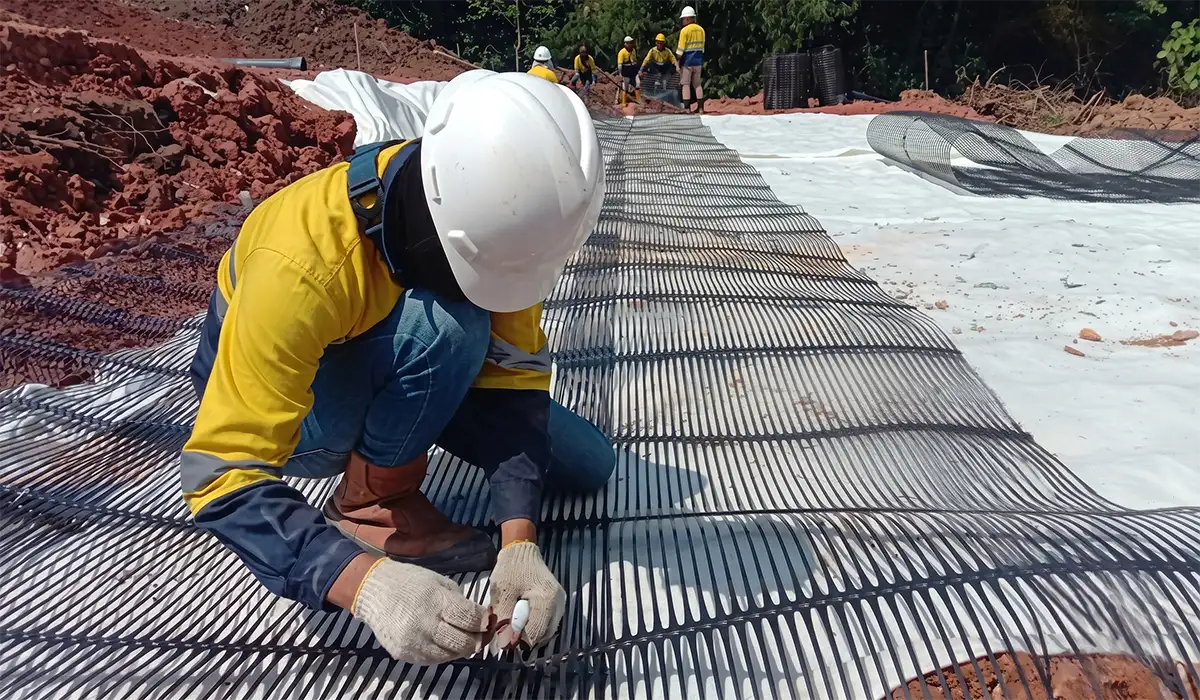
To overcome these technical problems, the engineering team decided to use a reinforced soil system. The materials chosen were Uniaxial Geogrid with a tensile strength of 150kN/m as the main reinforcement, combined with 250gsm Non Woven Geotextile for filtration and separation.
Here is a technical breakdown of how these two materials work like the bones and muscles of a retaining wall structure:
1. Maximum Reinforcement with 150kN/m Uniaxial Geogrid
Why Uniaxial Geogrid and not Biaxial? In a retaining wall, the dominant force is tension in one particular direction (perpendicular to the wall face). Uniaxial Geogrid is specifically designed with long ribs that have very high tensile strength along the roll (machine direction).
In this project, the 150kN/m Uniaxial Geogrid performs three crucial technical functions:
- Resisting Lateral Earth Pressure
The geogrid is installed in horizontal layers into the embankment. It provides the tensile strength that soil does not have. The geogrid “ties” the soil mass together and prevents a slip surface from forming, so the threat of a landslide can be eliminated. - Vertical Load Distribution
When vehicles or structures load the embankment, the geogrid spreads that vertical load evenly over a wider area below. The interlocking mechanism between the soil aggregate and the geogrid apertures creates a stiff platform that drastically reduces the risk of local settlement. - Increasing Subgrade Bearing Capacity
By transferring loads over a wider area, the stress on the subgrade becomes lower than its original bearing capacity, making the whole structure far more stable.
2. Protection and Drainage with 250gsm Non Woven Geotextile
The Geogrid cannot work at its best if the subgrade is left to mix with water and mud. This is where 250gsm Non Woven Geotextile plays a vital role:
- Separation Function
The geotextile is laid directly on the original subgrade before the new fill is placed. Made from needle-punched fibers, it acts as a separating blanket. It ensures that the quality, well-graded fill does not sink into and mix with the soft soil beneath, keeping the structural integrity of the embankment intact. - Drainage and Filtration Function
Dense embankment soil can trap water. Non-woven geotextile has excellent permeability. It can carry excess pore water in the soil to the drainage outlets, while holding back soil particles so they are not washed out by the flow (piping). Reducing pore water pressure is essential to prevent the soil from losing its shear strength.
Results and Performance
By combining 150kN/m Uniaxial Geogrid and 250gsm Non Woven Geotextile, this embankment project in South Sumatra achieved its target structural stability. The retaining wall system showed outstanding resistance to vertical loads and lateral thrust, with no signs of deformation or cracking on the wall face.
What’s more, using these geosynthetic materials significantly cut construction time compared with conventional methods, and reduced the logistics costs of hauling natural materials.
Conclusion
This South Sumatra project is clear proof that to overcome critical soil challenges, you do not always have to rely on massive concrete structures. The right combination of engineered materials, with Uniaxial Geogrid resisting forces and spreading loads, and Non Woven Geotextile acting as a protective separator, can create a retaining wall that is strong, efficient and economical.
Other Articles
Geogrid Drilling Pad on Soft Soil in Sumatra
Project Background & Challenges: The Nightmare of a Soft Subgrade This geogrid drilling pad project is located in the interior of Sumatra, an area known for high rainfall and dominated by muddy clay with very low bearing capacity. Initial geotechnical tests recorded a field California Bearing Ratio (CBR) of less than 3%. At the same […]

Biaxial Geogrid Access Road for Kalimantan Palm Oil
Background: Extreme Challenges on Kalimantan Soil If you have ever set foot in a palm oil plantation in West Kalimantan, you know the soil there is very challenging. The dominance of peat and soft clay puts the bearing capacity of the subgrade at rock bottom, often with a CBR (California Bearing Ratio) value below 3%, […]