


Geogrid Drilling Pad on Soft Soil in Sumatra
Project Background & Challenges: The Nightmare of a Soft Subgrade
This geogrid drilling pad project is located in the interior of Sumatra, an area known for high rainfall and dominated by muddy clay with very low bearing capacity. Initial geotechnical tests recorded a field California Bearing Ratio (CBR) of less than 3%.
At the same time, the drilling pad had to support nonstop heavy equipment traffic, from material haul trucks and cranes to the drilling rig itself, which exerts enormous static and dynamic pressure.
If the contractor had relied only on conventional methods such as placing massive amounts of crushed stone aggregate (gravel), several fatal risks would have been lurking:
- Punch-through Failure: The aggregate sinks into and mixes with the soft clay beneath it under the concentrated loads of heavy equipment.
- Differential Settlement: Uneven settlement that can tilt the drilling rig and endanger worker safety.
- Over-Budget: An aggregate layer more than 1 meter thick would be needed to reach the desired stability, which means material and logistics transport costs would balloon drastically.
You would surely agree that conventional methods are not a smart choice in extreme conditions like these.
Technical Solution: The Mechanics of a 30-30 Biaxial Geogrid Drilling Pad

To solve this problem, the engineering team decided to apply Biaxial Geogrid 30-30 as a reinforcement layer between the soft subgrade and the base course (stone aggregate layer).
Why the 30-30 type? The number is not just a code. It refers to the material’s Tensile Strength of 30 kN/m, in both the longitudinal direction (Machine Direction/MD) and the transverse direction (Cross Machine Direction/CMD). Because a drilling pad receives multi-directional loads spreading in all directions from the wheels or tracks of heavy equipment, the balanced strength of a biaxial material is absolutely necessary.
Here are the three main technical mechanisms by which Biaxial Geogrid 30-30 saved this project:
1. Lateral Confinement (Aggregate Interlock)
When heavy loads pass over, the aggregate underneath tends to be pushed sideways (lateral displacement), which forms deep wheel ruts (rutting). The apertures of Biaxial Geogrid are specifically designed to “lock” the aggregate particles. This mechanical interaction stops the aggregate from shifting sideways, creating a stiff, solid composite layer.
2. Tension Membrane Effect
When truck tires or rig loads press on the ground, the geogrid beneath deflects elastically and absorbs the tensile stress. The tensile strength of the geogrid polymer transfers vertical pressure from the load into horizontal tensile force in the material. Simply put, it acts like a stiff trampoline that stops the load from punching straight into the soft soil.
3. Stress Distribution (Snowshoe Effect)
Without geogrid, loads are distributed at a narrow angle, striking a small point on the subgrade with high pressure. With the interlock provided by Biaxial Geogrid 30-30, the load distribution angle widens. Loads of hundreds of tons are now spread over a much larger area of subgrade. It is like walking on deep snow: high heels will make you sink, but flat snowshoes will keep you on top.
Execution and Results in the Field

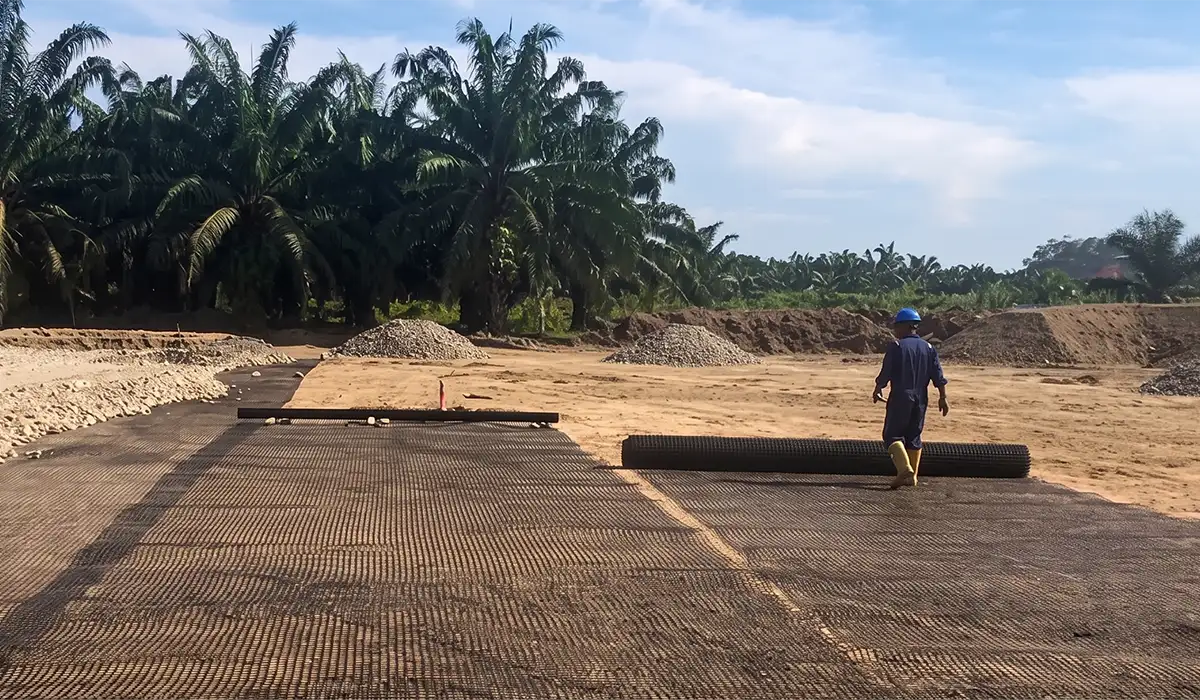
Installing Biaxial Geogrid at this Sumatra project site proved very practical. After minimal leveling of the subgrade, the geogrid rolls were laid with a standard overlap (about 30-50 cm between panels). The aggregate was then dumped and compacted on top of the geogrid.
The results were very satisfying and technically measurable:
- Reduced Material Thickness: The thickness of the aggregate layer (base course) was reduced by up to 40% compared with a conventional design without geosynthetics. This saved billions of rupiah in stone material purchases and logistics transport costs.
- Construction Speed: Drilling pad preparation was faster because far less fill material had to be moved.
- Full Stability: After operating for months under heavy rain and the operational loads of a giant drilling rig, field inspections showed zero signs of severe rutting or differential settlement. The drilling pad stayed level, stiff and safe.
Conclusion
Working with a low-CBR subgrade in tough terrain like Sumatra is always a challenge for engineers. However, this drilling pad case study proves that a modern geotechnical approach is not about adding more stone, but about making the material work smarter structurally.
Other Articles

Biaxial Geogrid Access Road for Kalimantan Palm Oil
Background: Extreme Challenges on Kalimantan Soil If you have ever set foot in a palm oil plantation in West Kalimantan, you know the soil there is very challenging. The dominance of peat and soft clay puts the bearing capacity of the subgrade at rock bottom, often with a CBR (California Bearing Ratio) value below 3%, […]
Geogrid Retaining Wall Project in South Sumatra
Project Background Infrastructure development in South Sumatra often has to deal with subgrade dominated by soft soil or swamp areas. On this embankment project, the contractor faced a tight deadline to build access and loading areas that required a high, solid retaining wall, and a geogrid retaining wall proved to be the answer. Conventional retaining […]