


Biaxial Geogrid Access Road for Kalimantan Palm Oil

Background: Extreme Challenges on Kalimantan Soil
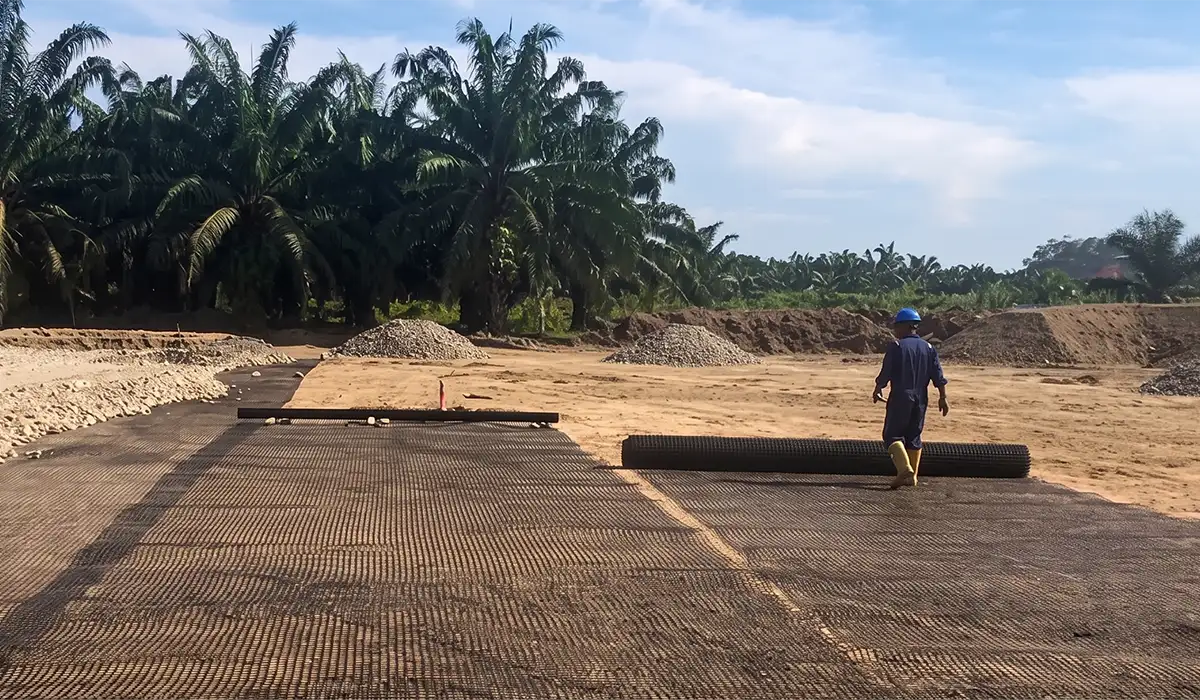
If you have ever set foot in a palm oil plantation in West Kalimantan, you know the soil there is very challenging. The dominance of peat and soft clay puts the bearing capacity of the subgrade at rock bottom, often with a CBR (California Bearing Ratio) value below 3%, which is why this project needed a biaxial geogrid access road.
Picture this: a fleet of trucks carrying dozens of tons of Fresh Fruit Bunches (FFB) has to cross this route every day. When the rainy season comes, water soaks into the subgrade and drastically reduces the soil’s strength. The result? The road turns into mud, truck wheels sink, and permanent deformation occurs, known in civil engineering as rutting.
Rutting is not just a cosmetic road problem. For plantation operations, a sunken road means a broken supply chain, soaring heavy equipment maintenance costs and wrecked time efficiency. Building an embankment on soft soil without the right reinforcement system is like dumping stone aggregate into a swamp: the fill will keep sinking and shifting laterally.
Technical Solution: Why PET 100-100 for a Biaxial Geogrid Access Road?
To overcome this structural deformation, conventional approaches such as continually increasing the thickness of the aggregate layer (base/subbase) are very inefficient and astronomically expensive. That is why using geosynthetics is an absolute must. In this project, the material of choice was PET Biaxial Geogrid 100-100.
You might ask, “Why PET (Polyester) and not ordinary PP (Polypropylene)? Isn’t a tensile strength of 100 kN/m very high?”
Technically, PET is crucial for embankment reinforcement applications. Polyester geogrid has an absolute advantage in creep resistance, which is far superior to that of Polypropylene. Because this access road carries the dead load of the embankment itself as well as the constant dynamic load of heavily loaded trucks, the reinforcement must not stretch over time. A tensile strength of 100 kN/m (kiloNewtons per meter) in both the longitudinal (Machine Direction) and transverse (Cross Direction) directions ensures this Geogrid can withstand extreme tensile stress from all directions without significant deformation.
How It Works

When PET Biaxial Geogrid 100-100 is laid on the soft subgrade before the aggregate is placed, three main geotechnical mechanisms come into play:
- Lateral Confinement & Interlocking
When granular aggregate is spread and compacted over the geogrid, the stone particles enter and lock into the geogrid apertures. This interlocking mechanism prevents the aggregate from moving or shifting sideways (laterally) when truck tires run over it. Without geogrid, axle loads push the aggregate outward, causing the road to sink. With geogrid, the aggregate layer becomes a single solid stiff platform. - Bearing Capacity Improvement
Geogrid changes the way loads are distributed to the subgrade. Imagine standing on a soft mattress in high heels versus on a snowboard. Geogrid works like the snowboard: it spreads axle loads that were concentrated at one point over a much wider area. This lower vertical pressure keeps the stress on the subgrade below its failure limit (yield capacity). - Tension Membrane Effect
If minor rutting begins, the geogrid stretches and deflects to follow the ground contour. This is where the 100 kN/m tensile strength of PET works at its best. The strain generates an upward force that counters and balances the vertical stress from the truck wheels, stopping the road from sinking any further.
Project Results and Impact
Applying PET Biaxial Geogrid 100-100 on this palm oil plantation access road in West Kalimantan delivered a measurable transformation:
- Significant Reduction in Deformation
Rutting depth was reduced by more than 70%. The road base stayed intact, with no material penetrating into the soft subgrade beneath. - Nonstop Operations (Zero Downtime)
FFB haulage stayed 100% operational even at the peak of the rainy season. Truck wheels have stable traction thanks to the rigidity of the aggregate layer locked into the geogrid. - Material & Financial Efficiency
Because bearing capacity increased dramatically, the design thickness of the stone aggregate layer could be reduced by 30-40%. This saved material and transport costs and shortened the overall project duration.
For engineers, contractors and plantation owners, this case study proves one thing: investing in well-targeted geosynthetic engineering is not just an upfront cost, but insurance for a long road service life and smooth business operations over the long term.
Other Articles
Geogrid Drilling Pad on Soft Soil in Sumatra
Project Background & Challenges: The Nightmare of a Soft Subgrade This geogrid drilling pad project is located in the interior of Sumatra, an area known for high rainfall and dominated by muddy clay with very low bearing capacity. Initial geotechnical tests recorded a field California Bearing Ratio (CBR) of less than 3%. At the same […]
Geogrid Retaining Wall Project in South Sumatra
Project Background Infrastructure development in South Sumatra often has to deal with subgrade dominated by soft soil or swamp areas. On this embankment project, the contractor faced a tight deadline to build access and loading areas that required a high, solid retaining wall, and a geogrid retaining wall proved to be the answer. Conventional retaining […]