


Geocell Residential Road Reinforcement in Surabaya
Background
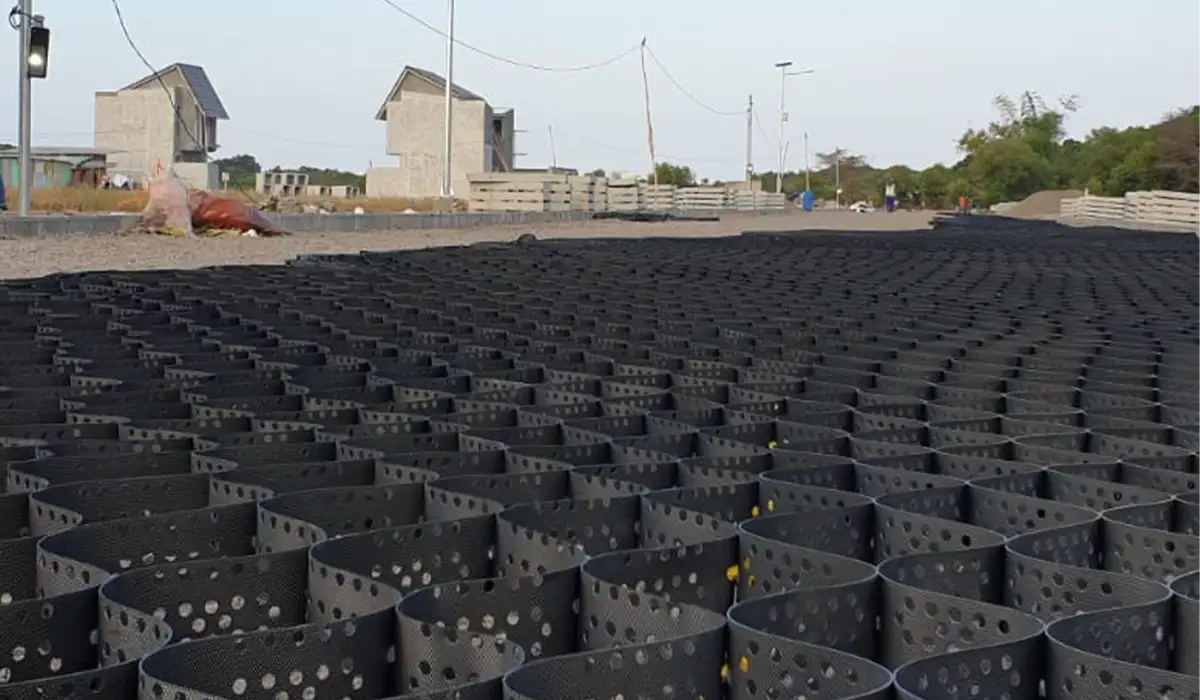
Surabaya is a city with a massive pace of residential development. However, a geographic challenge at some of its development sites is the less-than-ideal condition of the base soil (subgrade). In this housing project, the main access road had to carry varying loads, from residents’ private vehicles to trucks carrying heavy materials during construction of the next cluster phase. It became a textbook case for geocell residential road reinforcement.
The housing developer needed a reinforcement solution that was quick to apply and cost-efficient, yet technically able to guarantee a long road service life (pavement design life) without constant maintenance (patching).
Challenges on Site
The subgrade at the project site had a relatively low CBR (California Bearing Ratio) value. When this subgrade is directly covered with aggregate (crushed stone or sand-gravel) and asphalt, several technical problems immediately arise:
- Lateral Shear Force: When heavy vehicle wheels pass, the aggregate under the asphalt tends to be pushed sideways (spreading out) because nothing binds it.
- Risk of Settlement: Uneven compaction of the soil under traffic loads causes local subsidence.
- Wheel Ruts (Rutting): Repeated pressure on the same track creates long depressions or deep wheel marks.
If left unchecked, the asphalt on top loses its support (the base layer “runs away”), so the asphalt suffers fatigue cracking (alligator cracking) and eventually breaks apart.
Technical Solution: 7.5 cm Geocell

To meet these challenges, the team decided to apply Geocell with a 7.5 cm panel height.
Geocell is a geosynthetic material with a 3D beehive-like structure (honeycomb) made of High-Density Polyethylene (HDPE). When stretched out and filled with granular material (such as soil, sand or stone aggregate), geocell works on a brilliant soil mechanics principle: the Cellular Confinement System.
Instead of thickening the crushed stone layer at great cost, the 7.5 cm geocell panels are installed on the subgrade (usually over a Non-Woven Geotextile layer first as a separator), then filled with fill material and compacted.
How Does Geocell Residential Road Reinforcement Work?
Technically, the 7.5 cm geocell used on this Surabaya project targets three main mechanical reinforcement functions:
1. More Even Load Distribution (Mattress Effect)
When heavy vehicle tires pass, a very large vertical load presses on the road surface. On a road without geocell, this vertical load presses directly onto a single point of the subgrade. With geocell, however, the vertical pressure is converted into circumferential stress (hoop stress) in the HDPE cell walls. Because the cells are interconnected, the load is distributed laterally (sideways) over a much wider area. This is often called the Slab Effect or Mattress Effect. The result? The subgrade below receives only a fraction of the original load, so the road does not sink quickly.
2. Reducing Subsidence (Settlement) & Maintaining Elevation
The geocell walls hold the aggregate infill very firmly. Friction between the stone and the textured HDPE walls creates passive resistance. This means that when pressed from above, the stones inside the cells cannot “run away” or shift sideways. Because the aggregate particles are tightly locked (confined) in their cells, the density of the base layer is maintained. The road elevation becomes very stable and uniform, preventing differential settlement (uneven settlement).
3. Drastically Reducing Rutting (Wheel Ruts)
Rutting occurs when the material beneath the wheel path is pushed sideways and upward, forming a depression. Because the 7.5 cm geocell locks the material in through 360 degrees in each cell, shear movement (shear failure) of the base material is almost zero. No matter how heavy the vehicles passing repeatedly along the same track, they cannot create wheel ruts that damage the road profile. The asphalt or paving block layer on top also gets a rigid, concrete-like footing.
Final Results
Applying 7.5 cm geocell on this Surabaya housing access road delivered very significant results. In terms of construction operations, compaction of the base layer was much faster.
In terms of performance, after the road was opened to heavy vehicle traffic during the follow-on construction phase, no asphalt cracking, significant loss of elevation or wheel ruts (rutting) were found. The road remains solid and stable. The developer also saved on its long-term budget because road maintenance costs (maintenance cost) dropped drastically.
Most important for the developer? Road maintenance costs (grading, adding stone) fell sharply, delivering an outstanding Return on Investment (ROI) for the company’s infrastructure.
Other Articles
Geocell Landscape Slope Solution in Bali
Project Background & Challenges Bali has always been a centre of green architecture innovation. In this geocell landscape slope project, the contractor and architect worked on a 1,368 m² area designed as a green space. The main problem was the site contours and a structural design with fairly steep slopes, including the architectural roof. When […]

