


Geocell Slope Protection at BSD City

Background and On-Site Challenges
This geocell slope protection project addresses a common challenge in residential development: topography that requires cutting or filling soil and creates artificial slopes. At this BSD City project, a 2,000 m2 slope lies very close to road infrastructure and a residential area.
The main challenge was clear: Erosion caused by heavy rainfall and the risk of slope failure (landslides).
The exposed slope soil was highly vulnerable to rainwater runoff. Without reinforcement, shear stress from flowing water and gravity would carry away topsoil particles. Furthermore, without an effective load-retaining system, the soil could become saturated and eventually cause a landslide. Conventional concrete solutions such as a retaining wall (soil retaining wall) were considered too rigid, costly and detrimental to the aesthetics of a residential environment designed around a green living concept.
A geosynthetic engineering approach was therefore needed that would be both structurally robust and environmentally friendly.
Technical Solution: Geocell Slope Protection with 10cm Geocell and 200gsm Non-Woven Geotextile

To address these complex problems, the slope protection design uses two primary layers of defense: 200gsm Non-Woven Geotextile as the base layer and 10cm Geocell as the main soil-retaining structure. How do these two materials work together technically?
1. 200gsm Non-Woven Geotextile: Separation and Filtration Foundation
Before the Geocell is expanded, the slope surface is first covered with 200gsm Non-Woven Geotextile. This 200gsm material was selected for specific reasons.
This material is made from polypropylene (PP) fibers formed with precision to provide very high tensile strength. It serves two functions on this slope:
- Filtration & Drainage: Allows rainwater entering the soil to continue flowing through the geotextile pores without carrying fine soil particles with it (piping). This prevents hydrostatic pressure from building up inside the slope, a frequent primary cause of landslides.
- Separation: Separates the original slope soil from the infill material subsequently placed inside the Geocell, ensuring that the structural integrity is maintained.
2. 10cm Geocell: Cellular Confinement System
The Geocell with a depth (height) of 10cm is installed over the geotextile layer. Geocell is a three-dimensional panel with a honeycomb structure made from High-Density Polyethylene (HDPE). A depth of 10cm was selected because it was considered optimal for retaining topsoil at the slope angle found in this residential area.
When the Geocell cells are expanded and filled with soil, the material creates a confinement system. Soil that could previously move easily becomes locked within the polymer cell walls. This mechanism dramatically increases the soil’s shear strength and prevents lateral movement.
Performance and Long-Term Results
The installation of 10cm Geocell and 200gsm Non-Woven Geotextile across this 2,000 m2 area at BSD City successfully delivered two vital functions:
- Load Distribution That Ensures Slope Stability The three-dimensional Geocell structure distributes loads evenly over a wider area. Pressure from rainfall or static loads above the slope is no longer concentrated at a single weak point. The cell walls convert vertical pressure into hoop stress, making the slope highly stable, rigid and resistant to landslides even under consecutive heavy rainfall.
- Supporting Vegetation Growth as Natural Protection One of Geocell’s main advantages over concrete reinforcement is its ability to support a green environment. After the Geocell cells were filled with fertile soil (topsoil), grass seed was planted directly on the slope surface.
The Geocell walls protect the grass seed from being washed away by rain during the initial growth period. Over time, the grass roots grow through the soil layer, interlocking within and across the Geocell cells until they eventually integrate with the Non-Woven Geotextile below. The result is a continuous, natural and sustainable slope protection system in which plant roots and geosynthetic structures work together as one solid unit.
Conclusion
This slope stabilization project at BSD City proves that modern geotechnical engineering does not always have to impair the landscape with massive concrete structures. Across an area of 2,000 m2, the combination of 10cm Geocell and 200gsm Non-Woven Geotextile successfully provided a mechanically robust slope protection solution that prevents landslides while remaining environmentally friendly by supporting lush vegetation growth.
If you are managing a residential development, road infrastructure or landscaping project that requires soil stabilization, the quality of the geosynthetic materials is critical. Always use proven products to ensure the long-term safety of your structure.
Other Articles
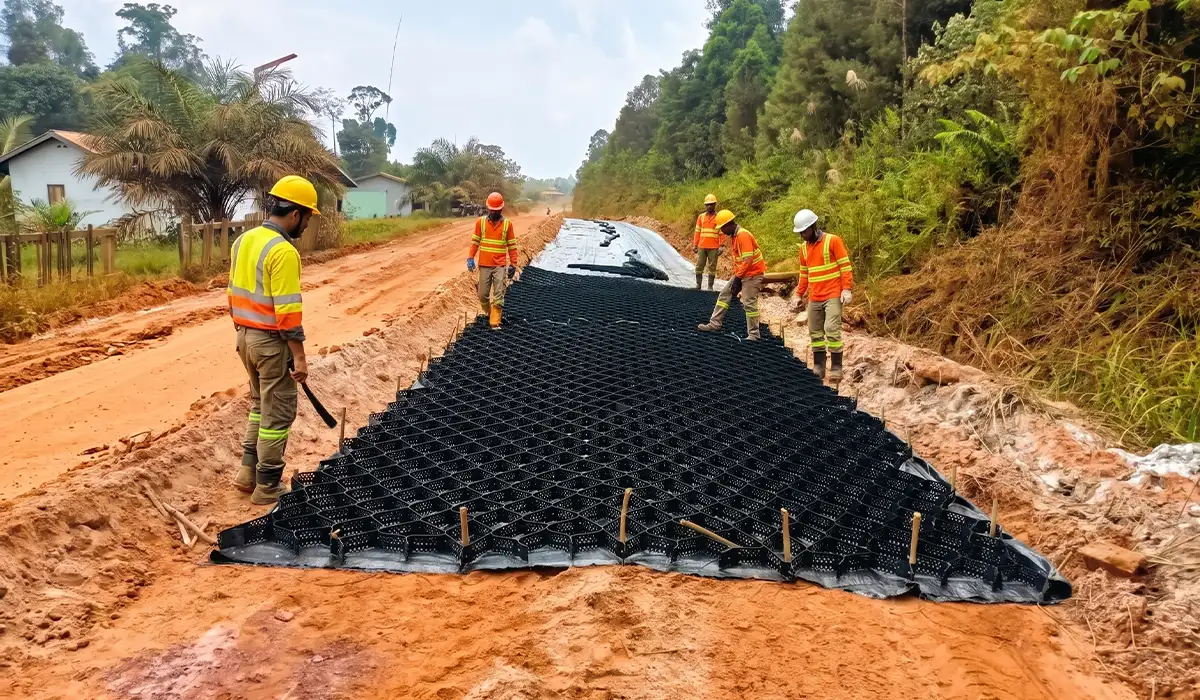

Palm Oil Plantation Road Pavement with Geocell: Case Study
Background: Tackling Kalimantan’s Soil Challenges West Kalimantan is known for challenging subgrade conditions. In many plantation areas the soil tends to be soft, has a low CBR (California Bearing Ratio) value, and is highly sensitive to changes in moisture content, which makes a geocell palm oil plantation road an attractive solution. Before this project, the […]

Geocell Road Construction Project in Surabaya
Geocell road construction project / Geocell project / road construction / geocell installation / geocell laying Geocell application: Road Construction Location: SurabayaMaterial: Project description: