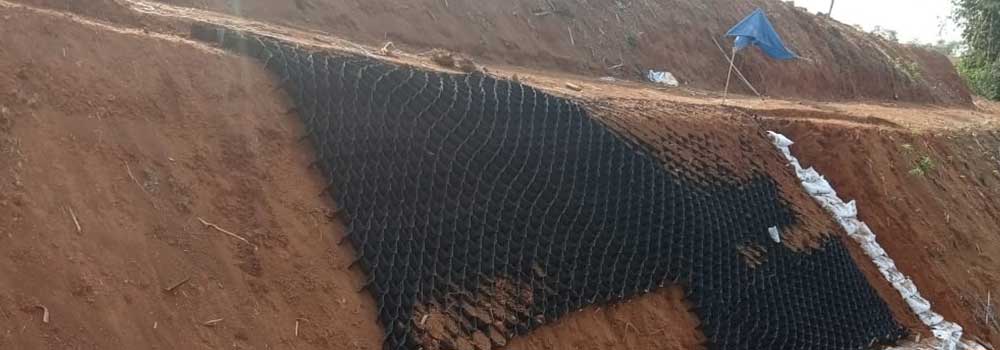
Geocell Slope Protection in Sentul

Background: The Threat of Sloping Land on a University Campus
The Sentul area is known for its hilly topography and relatively high rainfall. When an educational institution decides to build or expand a university campus here, the biggest geotechnical challenge that immediately emerges is slope stability, and with it the need for reliable geocell slope protection.
Steep slopes on a university campus are not just an aesthetic issue; they are purely a matter of structural safety. Sentul’s heavy rainfall constantly pounds the upper soil layer (topsoil), triggering massive water infiltration. If you work in construction, you know that water is soil’s main “enemy”. Water increases the driving stress (shear stress) while reducing the soil’s shear strength. Left unprotected, soil movement and even large-scale landslides are only a matter of time.
The challenge: how do we protect this sloping land structurally so that the surrounding university facilities are safe, while preserving the green space that defines the campus landscape?
Technical Challenge: Why Conventional Methods Are Not Enough
In the traditional approach, concrete or masonry retaining walls (retaining wall) are often the “shortcut”. However, for a university campus that prioritizes water infiltration and ecological aesthetics, concreting the entire slope is not a wise solution.
Concrete has a fatal weakness on large slopes: it holds water back. Without a flawless drainage system (weep holes), hydrostatic pressure from rainwater trapped behind the concrete wall builds up and can cause the wall to fail. Concrete also kills the local ecosystem by preventing natural vegetation from growing. This is where modern geosynthetic technology becomes crucial.
Engineering Solution: A Cellular Confinement System with 10cm Geocell
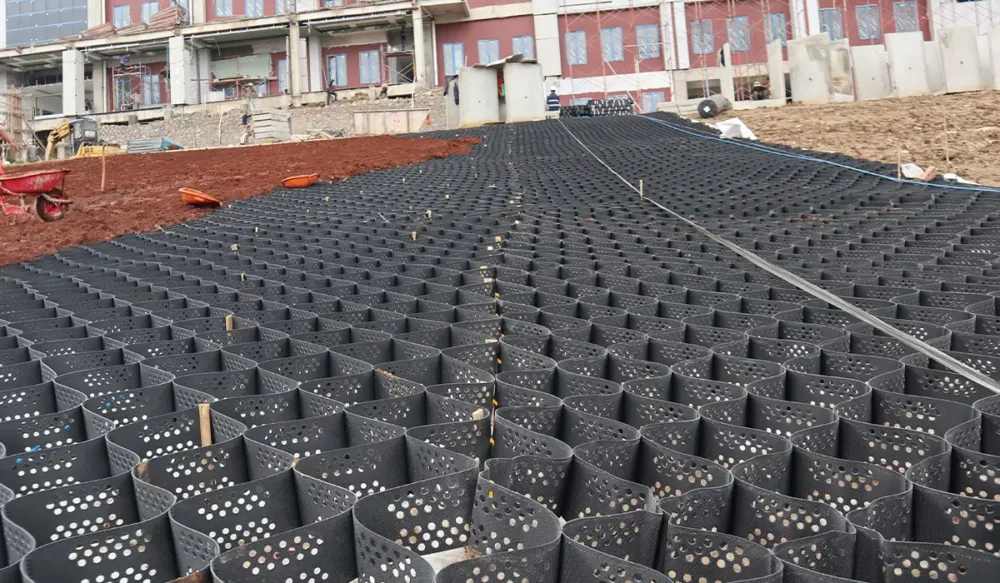
To meet this challenge, the project team decided to use Geocell 10cm as the backbone of the slope protection system.
Geocell is a three-dimensional, cell-based soil containment system (cellular confinement system) made from high-strength polymer (usually High-Density Polyethylene or HDPE). When expanded, Geocell forms a structure resembling a beehive (honeycomb). The 10cm cell depth on this Sentul project was precisely calculated to hold a layer of topsoil thick enough for vegetation roots, while limiting lateral soil movement at that specific slope angle.
1. Superior Load Distribution Mechanism
Technically, how can 10cm polymer panels prevent landslides? The secret lies in the mechanism of lateral confinement.
When the Geocell cells are filled with soil, the cell walls provide tensile resistance (tensile strength) that restrains the soil particles from every side. The system effectively creates a stiff “mat” on the slope surface. When static or dynamic loads act on the slope (from rainwater or gravity), they no longer stress a single weak point but are distributed evenly across the entire Geocell matrix.
The Geocell walls convert vertical loads into circumferential stress (hoop stress). This dramatically increases the load-carrying capacity (bearing capacity) of the underlying soil and stops soil particles from sliding downslope under gravity. The result? The slope becomes highly stable and is locked firmly in place.
2. Supporting Vegetation Growth for Long-Term Ecological Protection
The second vital function of the 10cm Geocell on this project is its role as an ecological anchor. You might ask, why not just leave the soil bare? Soil exposed directly to the weather is easily eroded by raindrop impact (splash erosion).
Geocell panels are designed with perforated walls (small holes). These perforations serve two purposes:
- Natural Drainage: They allow lateral water movement within the soil, preventing the hydrostatic pressure build-up that often destroys concrete walls.
- Cross-Cell Root Network: They allow plant roots to grow through from cell to cell.
After the Geocell was installed and filled with topsoil, the surface was planted with grass or ground-cover vegetation (for example by hydroseeding). As the roots flourish, they interlock with the Geocell’s 3D structure. This root matrix works like natural “reinforcing steel” in the soil.
Conclusion: Geocell Slope Protection with Optimal Results
The synergy between the structural engineering of 10cm Geocell and the biological mechanism of plant roots provides double protection. In the short term, Geocell distributes loads and stabilizes the slope from the first day of installation. In the long term, once vegetation is established, the system becomes a strong green shield that blends perfectly with the natural environment of the Sentul campus and is 100% resistant to erosion from extreme rainfall.
This is clear proof that geosynthetic technology offers a far more efficient, environmentally friendly and technically robust solution than conventional methods.
Other Articles

Geocell Slope Erosion Control in Batam
Project Background & Challenges Batam is an area of rapid infrastructure development, but it often faces the challenge of undulating topography. On this geocell slope erosion control project, a 4,000 m2 slope had been left exposed after earthworks. The main problem was the high potential for surface erosion. When it rained, surface runoff quickly scoured […]

Geocell Channel Protection at Jakarta International Stadium
Project Background: Why Is Channel Protection So Important? As a stadium located in North Jakarta, an area close to the coast with fluctuating rainfall, JIS needs a very robust drainage and surface water channel system, which is why geocell channel protection was chosen. Water flowing at high volume and velocity carries destructive kinetic energy. Without […]