


Geocell Channel Protection at Jakarta International Stadium

Project Background: Why Is Channel Protection So Important?
As a stadium located in North Jakarta, an area close to the coast with fluctuating rainfall, JIS needs a very robust drainage and surface water channel system, which is why geocell channel protection was chosen. Water flowing at high volume and velocity carries destructive kinetic energy.
Without adequate protection, the soil around the channels erodes easily. This not only risks damaging the landscape around the stadium but can also threaten the stability of nearby structures due to channel slope failure. Geotechnical engineering was therefore needed that was not only structurally strong but also efficient and environmentally friendly.
Site Challenges: Fighting Scour and Water Velocity
With a channel area of 4,100 m2, the technical challenges facing the engineering team on site were serious. The main issues to solve included:
- High potential for soil erosion and scouring on the channel bed and sides due to stormwater discharge.
- Risk of minor slips on channel slopes with certain gradients.
- The need to reduce surface runoff velocity so that water does not damage the channel profile.
- Difficulty keeping infill materials (such as soil, gravel or concrete) in place under strong flows.
Technical Solution: Combining 10cm Geocell and 200gsm Non-Woven Geotextile
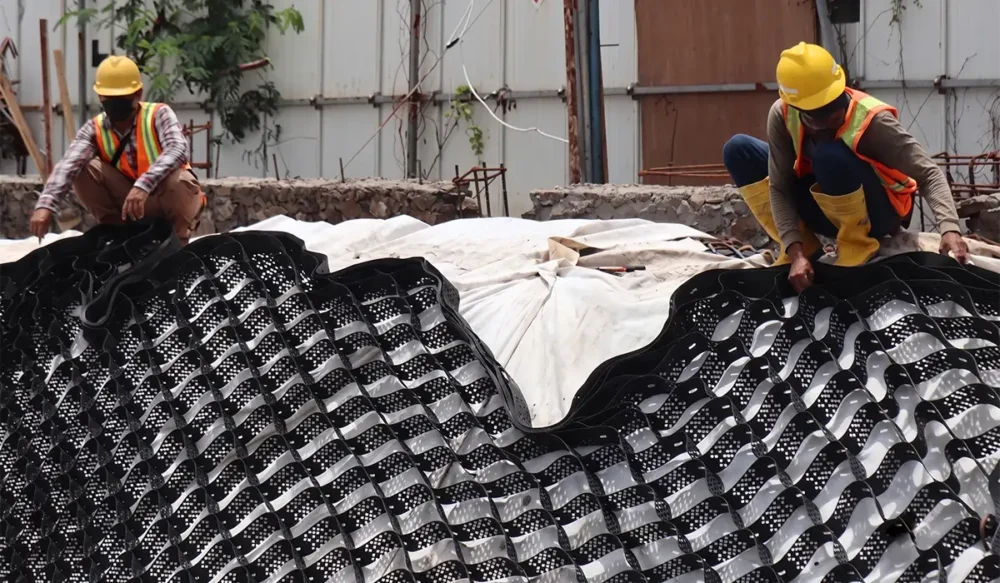
To meet these hydraulic challenges, the protection system chosen combined two advanced geosynthetic materials: 10cm high Geocell over an underlayer of 200gsm Non-Woven Geotextile.
How do these two materials work together like a suit of armour?
- Bottom Layer (Filtration & Separation)
200gsm Non-Woven Geotextile Before the geocell was installed, the channel slopes and bed were first lined with 200gsm non-woven geotextile. In geotechnical terms, this material acts as a hydraulic filter and separator. The geotextile lets groundwater drain out (preventing hydrostatic pressure) while retaining soil particles so they are not washed away (piping effect). This layer is crucial for preventing erosion beneath the protective structure. - Top Layer (Confinement & Protection)
10cm Geocell On top of the geotextile, geocell with a 10cm panel height was laid out and stretched into a honeycomb structure. This 3D structure was then filled with aggregate, soil or concrete. Geocell works on the principle of cellular confinement. The cell walls lock the infill laterally, so it does not move even under the shear stress of fast-flowing water.
How It Works & Results on Site
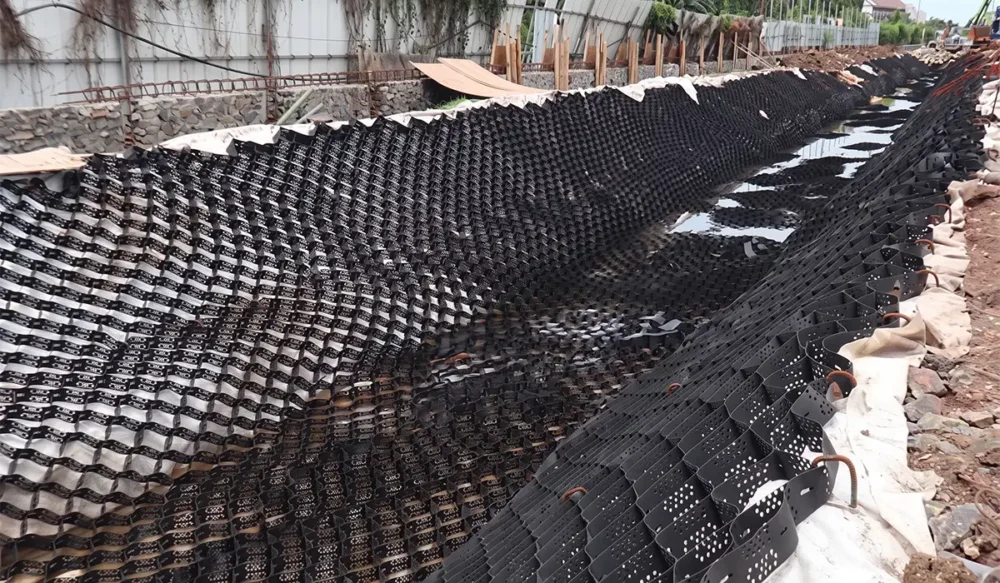
The geocell and geotextile system applied over 4,100 m2 at JIS delivered outstanding mechanical results. Here are the technical functions and performance achieved:
- Reduced Water Energy & Velocity
The cellular surface created by geocell provides a certain roughness. This effectively reduces flow energy and lowers surface runoff velocity, drastically minimising the destructive force of the water. - Scouring Prevention
With infill tightly locked inside the 10cm geocell cells, the system successfully reduces erosion of the channel bed and sides and fully prevents scouring. The infill is held in place. - Cross-Section & Slope Stability
The protection system significantly increases the strength of the protective layer as a whole. As a result, the team was able to keep the channel cross-section stable and improve channel slope stability, which automatically reduces the risk of minor slips on the slopes that are vulnerable. - Comprehensive Control
Overall, the system works perfectly to control erosion caused by water flow and reduce the potential for soil loss in the long term, keeping JIS infrastructure safe from hydrological threats.
Conclusion
The channel protection project at Jakarta International Stadium proves that water management on modern mega-infrastructure requires a precise geotechnical approach. The combination of 10cm geocell and 200gsm non-woven geotextile over 4,100 m2 proved to be a highly effective, efficient and durable engineering solution against the erosive force of water.
Other Articles

Geocell Slope Protection Project in Bogor
Geocell Project / Geocell Slope Protection / Access Road / Slope Reinforcement Location: Jasinga, Bogor Materials: Project description:

Geocell Industrial Road for Heavy Loads in Batang
Project Challenges The industrial estate in Batang is growing rapidly, and this geocell industrial road project shows a typical problem there: infrastructure is often built on less than ideal subgrade conditions. If crushed stone aggregate (base course) is spread directly over soft subgrade, several serious problems emerge over time: The aggregate mixes with mud […]

Geocell Hauling Road on Soft Soil in East Kalimantan
Project Background and Challenges A hauling road has one main enemy: concentrated vertical stress, which is exactly what a geocell hauling road is built to handle. When heavy truck wheels pass over a conventional road surface, the stone aggregate risks being pushed sideways (lateral displacement). On this East Kalimantan project, the contractor faced several critical […]