


HDPE Geomembrane Pond Liner for a Farm Reservoir in Bogor

Background: Percolation and Unpredictable Weather
Bogor is known as the City of Rain. However, weather anomalies and climate shifts mean rainfall can no longer always be predicted. For farmers, going without water for just a few weeks can lead to total crop failure (puso).
To deal with this, farmers need an embung (a small retention reservoir) to store rainwater or surface runoff. The biggest technical challenge lies in the local geotechnical conditions. Soil in the Bogor area often has fairly high permeability. If the reservoir is just an ordinary excavation without a liner ( unlined pond ), the water quickly percolates down into the ground. This high seepage rate prevents the reservoir from working as a long-term water retention facility.
To cut seepage to almost zero ( impermeable ), a synthetic liner is required. For this 700m2 project, we recommended and installed a geomembrane pond liner of High-Density Polyethylene (HDPE) Geomembrane with a thickness of 0.75mm.
Why HDPE, and Why a 0.75mm Geomembrane Pond Liner?
- High
Impermeability At the molecular level, the crystalline structure of high-density polyethylene (HDPE) provides outstanding resistance to liquid infiltration. HDPE geomembrane has a very low hydraulic permeability ( hydraulic conductivity ), so it effectively prevents the water in the reservoir from seeping into the underlying soil ( subgrade ). - Resistance to Environmental Exposure (UV & Chemicals)
The HDPE geomembrane we use is not pure polyethylene; it is formulated with added Carbon Black (about 2-3%), antioxidants and a UV stabilizer. This formulation makes the material resistant to direct ultraviolet radiation from the sun (since the reservoir is open) and prevents material degradation ( photo-oxidation ). - 0.75mm Thickness: Balancing Flexibility and Strength
For farm reservoirs with moderate depth and hydrostatic pressure, a thickness of 0.75mm is the sweet spot from an engineering standpoint. The material is thick enough to resist tearing ( puncture resistance ) from small stones in the subgrade, yet flexible enough to follow the designed contours of the reservoir slopes.
Execution Details and Installation Process
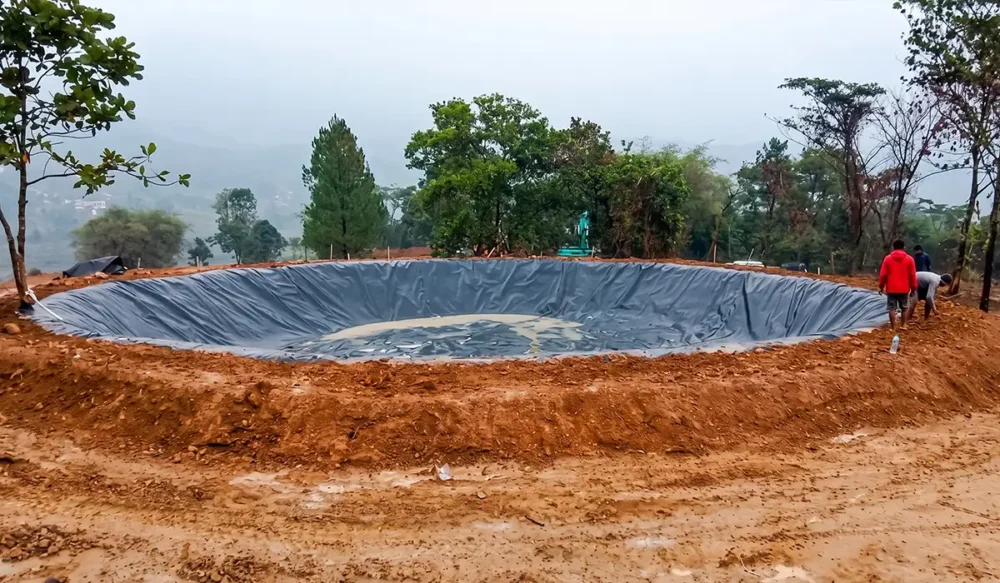
A waterproof liner cannot be installed carelessly. The process involves a series of technical procedures to make sure there is not even the smallest leak:
- Preparing the Subgrade (Base Soil)
Before the geomembrane was deployed, the 700m2 excavation was compacted and cleared of sharp objects such as pointed gravel or tree roots that could cause point load stress on the membrane. - Digging the Anchor Trench
An anchor trench was dug around the rim of the reservoir. The edges of the geomembrane sheets were placed in this trench and backfilled with soil. Mechanically, this locks the liner in position so it does not slide down under the pulling load of a full reservoir. - Thermal Welding
Because factory-made geomembrane rolls have a limited width, the sheets must be joined on site. We used a Hot Wedge Welder with a double-track system. This machine melts the surfaces of the two overlapping sheets ( overlap ) and presses them together at the same time. - Quality Testing (Quality Control)
The air channel formed between the two weld tracks (double-track) was tested with an air pressure test. If the air pressure stays stable and does not drop over a set period, the welded seam is proven 100% watertight.
Results and Long-Term Impact
Using 0.75mm HDPE Geomembrane on this 700m2 farm reservoir project in Bogor delivered clearly measurable results:
- Seepage Successfully Prevented
The reservoir’s water volume now decreases only through natural evaporation, not through percolation into the soil. - Critical Water Reserves Secured
The reservoir now works at full capacity as a backup irrigation system, ready to supply water for the crops when rainfall drops sharply. - Better Water Quality
Because it is isolated from the subgrade, the reservoir water does not mix with mud sediment. The water stays clear, sedimentation is minimized and pH changes caused by reactions with soil minerals are prevented, making it ideal for plant growth.
With a well-targeted geosynthetic engineering approach, agricultural infrastructure can operate far more efficiently. If you are planning a reservoir, wastewater pond or other water storage project that needs a long-term waterproof guarantee, make sure you use geomembrane with standardized specifications and installation.
Other Articles

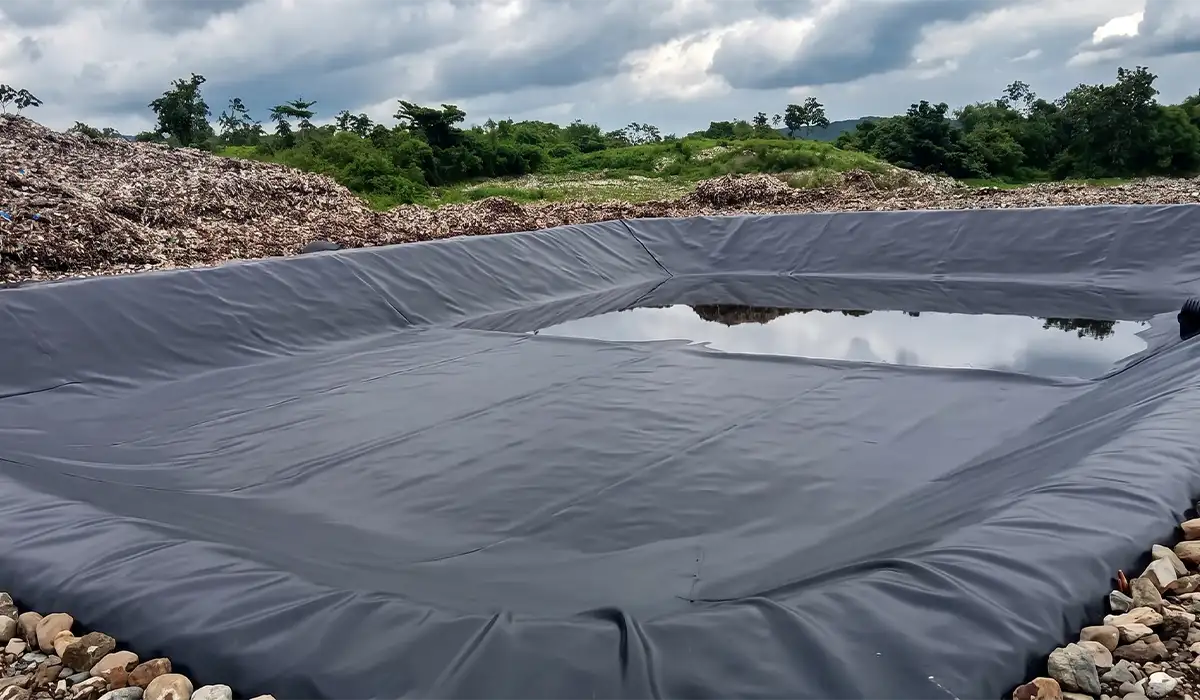

Shrimp Farm Success with 0.3mm Viroline Geomembrane
Project Background and Challenges The Tegal coast has outstanding potential for shrimp farming. However, this 14,000 m² shrimp farm project, which ended up using 0.3mm geomembrane, initially faced the classic problems of conventional earthen ponds. Traditional ponds that rely only on clay have unpredictable porosity. The main challenges facing the farm owner were: Seepage and […]