


Shrimp Pond Geomembrane Lining in Ujung Kulon

Background
This shrimp pond geomembrane project is located on the coast of Ujung Kulon, Banten, an area that is geographically ideal for aquaculture thanks to its ample seawater supply. Our client manages a vannamei shrimp farm, and the total area worked on reached approximately 3,920 m2.
The owner wanted to upgrade from traditional earthen ponds to an intensive system. To reach optimal harvest targets and a high shrimp Survival Rate (SR), the pond infrastructure had to be rebuilt to meet modern biosecurity standards.
Challenge: Contamination & Leakage Risks
Before a lining system is used, earthen ponds have several technical problems that seriously hamper operational efficiency. If you work in pond construction, you will be very familiar with these challenges:
- Leakage (Seepage):
The soil around the site is porous enough for pond water to seep out. This makes the water volume unstable and drives up pumping costs. - Cross-Contamination:
Without a barrier, pond water risks contamination by toxic minerals in the soil (such as pyrite) that can drastically lower the water pH. Conversely, pond wastewater can also seep in and pollute the surrounding groundwater. - Harmful Sludge Build-Up:
In ordinary earthen ponds, leftover feed and shrimp waste mix with the pond bottom soil to form black sludge. This sludge produces ammonia and hydrogen sulfide gas, which are highly toxic to vannamei shrimp.
Technical Solution: 0.75 mm HDPE Geomembrane
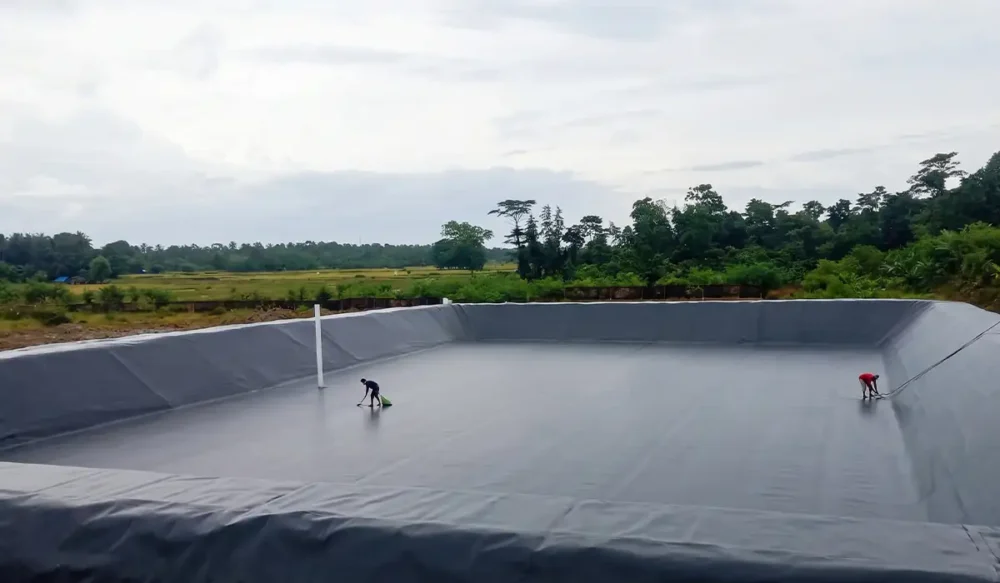
To address these challenges, the material used in this project was 0.75 mm thick HDPE Geomembrane. Why this material?
High-Density Polyethylene (HDPE) has outstanding impermeability, so leakage problems can be solved 100%. A thickness of 0.75 mm is the sweet spot for shrimp ponds. It is thick enough to resist punctures from blunt objects or shrimp claws, yet flexible enough to follow the contours of the pond during installation.
HDPE Geomembrane also contains a UV Stabilizer, so it will not easily become brittle or crack even after years of exposure to the intense coastal sun of Banten.
Execution Details & Installation Method
Installing the lining over 3,920 m2 requires technical precision. These were the execution steps on site:
- Subgrade Preparation:
Before the geomembrane was deployed, the pond subgrade was compacted and cleared of sharp gravel, tree roots and shells that could perforate the material (puncture effect). - Material Deployment:
The geomembrane rolls were carefully laid over the entire pond bottom and slopes (dikes). Along the top edge of the dike, an anchor trench about 50 cm wide and deep was dug to lock the geomembrane edges so they do not slide down when the pond is filled. - Welding Method:
The geomembrane sheets were joined using automatic Hot Wedge Welder machines, which produce a double track seam. For complex areas such as pond corners or drain pipe penetrations, the technicians used an Extrusion Welder. - Quality Control (Leak Testing):
After welding, every seam was tested using the Air Pressure Test method (injecting pressurized air between the two weld tracks) to make sure there were no leaking pores at all.
Effective Sludge Prevention
One of the main advantages of HDPE Geomembrane is its very smooth surface. In vannamei pond operations, you will often use paddle wheel aerators, which create a circular current inside the pond.
Because the pond bottom is lined with a smooth geomembrane, dirt, leftover feed and shrimp waste do not stick to the bottom. The current sweeps all this solid waste to the center of the pond (central drain), where it can be siphoned out very easily. As a result, toxic sludge no longer settles on the pond bottom.
Project Results & Conclusion
Installing 0.75 mm HDPE Geomembrane at this Ujung Kulon farm turned a conventional pond into an intensive aquaculture facility with high biosecurity. Water leakage was reduced to zero, water quality and pH became much more stable because there is no contact with the native soil, and post-harvest pond cleaning is now faster and more efficient.
Other Articles

HDPE Geomembrane Reservoir Pond for Palm Oil in Paser
Background Paser has rather unusual soil characteristics. In some spots, the soil has high permeability (the ability to absorb water). In other words, if you simply dig a hole and turn it into a pond without a protective liner, the water you worked so hard to collect from rainfall or river flow will seep into […]

Fire Hydrant Tank Geomembrane in Tangerang
Problem Background: An Invisible Threat to the Water Tank This project is located in a strategic area of Tangerang that needed a large-capacity water reservoir dedicated to its hydrant system. Building an open or semi-open water storage tank in direct contact with the soil carries a high risk, because soil has a certain permeability (ability […]