


Heap Leach Pad: The Key to Mining Efficiency

Petra Friends, have you ever wondered how the modern mining industry can extract gold, copper, or silver from low-grade ore and still make a profit? The answer is not always digging a giant, deep pit but using a smart method called a Heap Leach Pad.
In civil engineering and mining, this term may already be familiar. However, understanding the technical details, especially the crucial role of geosynthetic materials, is essential if you work in this industry.
In this article, the Petra Nusa Elshada team will thoroughly explain what a Heap Leach Pad is, how it works, and why this system is a favorite for reducing mining operating costs. Read through to the end!
What Is a Heap Leach Pad?
Simply put, a Heap Leach Pad (heap leaching facility) is a specially engineered area with an impermeable layer (liner) on which mined ore is stacked and then irrigated with a chemical solvent solution. Its purpose? To separate valuable metals from the ore rock.
Imagine a giant coffee filter. You place coffee grounds (ore) on filter paper (a geosynthetic liner), then pour hot water (the chemical solvent). The water dripping below (leachate/pregnant solution) carries the coffee essence (valuable metal) ready for further processing.
This method is highly popular in Indonesia, especially for gold and copper mines, because its operating costs are much lower than those of other conventional processing methods.
How It Works: From Heap to Profit

The process inside a Heap Leach Pad combines simple chemistry with complex civil engineering. Here are the stages you should know:
- Site & Liner Preparation:
The ground is leveled and compacted. Then, a lining system (liner system) is installed. This is the most critical part. If the liner leaks, the company not only loses mining output but also damages the environment. - Stacking (Stacking):
Crushed ore (crushed ore) is stacked on the pad. Heap height can vary from several meters to tens of meters. - Irrigation (Leaching):
A solvent solution, usually cyanide for gold or sulfuric acid for copper, is applied through a drip-irrigation system (drip irrigation) over the ore heap. - Percolation:
The solution seeps down through the heap, dissolving the target metal. - Collection (Collection):
The solution, now rich in metal (called a Pregnant Leach Solution or PLS), is retained by the base liner, then flows to a collection pond (pond) through drainage pipes for processing and refining.
The Vital Role of Geosynthetics in a Heap Leach Pad
This is where Petra Nusa Elshada’s role as a geosynthetics specialist becomes highly relevant. A Heap Leach Pad will not function, and may even become a disaster, without the right geosynthetic materials.
Why? Because the main challenge of this method is Leakage. The solvents used are very harsh and hazardous to soil and groundwater.
The following primary geosynthetic components are mandatory in Heap Leach Pad construction:
1. Geomembrane (Primary Barrier)
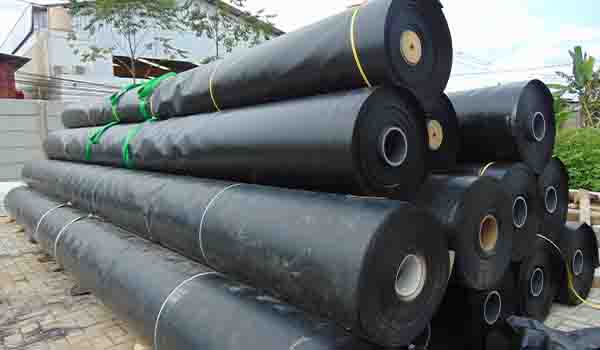
This is the most important part of the system. HDPE (High Density Polyethylene) Geomembrane is usually the standard choice. You need a material with exceptionally high chemical resistance (chemical resistance) because it will be continuously exposed to acid or cyanide.
Besides chemical resistance, HDPE Geomembrane also withstands UV exposure. At Petra Nusa Elshada, we always recommend geomembrane with a thickness that meets technical specifications, usually 1.5mm to 2.0mm, to ensure zero leakage.
2. Geotextile (Protective Layer)

Below or above the geomembrane, we often install Non-Woven Geotextile. It serves as a cushion . Imagine sharp ore rocks pressing directly against geomembrane; tearing would certainly be a risk. Geotextile protects the geomembrane from punctures by coarse material (protection function) while also assisting filtration.
3. Geonet or Geocomposite (Flow Path)

For the solution to flow smoothly to the collection pond, you need an effective drainage system at the base of the heap. Geonet or Geocomposite is often used to replace or supplement gravel or sand drainage layers. This material ensures liquid does not pond within the heap, which could cause slope instability and landslides.
Design & Safety: Avoid Missteps
Building a Heap Leach Pad is not simply laying a plastic carpet and stacking rocks. There are engineering aspects that you must consider seriously.
Slope Stability (Slope Stability):
One of a mining engineer’s nightmares is a heap leach slope failure. This can occur if the heap becomes oversaturated or if friction between geosynthetic layers (interface shear strength) is too low. Therefore, selecting the geomembrane texture is very important. Often, Textured Geomembrane (with a rough surface) is used on slopes to increase friction so soil or ore does not slide downward.
Stormwater Management:
Indonesia has high rainfall. Pad design must account for rainwater entering the system. If the collection pond overflows, environmental contamination can occur. Geosynthetic drainage systems help convey this excess water quickly to a safe location.
Advantages of the Heap Leaching Method
Why do many mining companies switch to, or continue using, this method?
- Low Capital Cost (Low CAPEX): There is no need to build a complex, expensive processing plant.
- Low Operating Cost (Low OPEX): The process does not require large amounts of electricity for very fine ore grinding.
- Efficient for Low Grade Ore: This method enables companies to mine low-grade ore previously considered waste (waste) and turn it into something economically valuable.
- Flexibility: The pad can be expanded as new ore reserves are discovered.
Challenges and Maintenance
Of course, no system is perfect. You must be prepared for several challenges, such as longer extraction times than plant-based methods. Gold may take months to dissolve fully.
In addition, maintaining exposed liner surfaces is very important. Sharp objects, uncontrolled heavy-equipment traffic, or wild animals can damage liner integrity. Routine inspection is the key.
Need a Consultation for Your Requirements?
A Heap Leach Pad demonstrates engineering ingenuity in maximizing natural resources. Behind a seemingly passive rock heap is a complex system working 24 hours a day to produce valuable commodities. At the base of it all, geosynthetic materials work behind the scenes to carry loads and prevent contamination.
Do you need HDPE Geomembrane, Geotextile, or Geocomposite solutions for your Heap Leach Pad project?
Feel free to consult us about your geosynthetic-material requirements. We supply a wide range of high-quality geosynthetics ready for delivery throughout Indonesia. Let us discuss your project needs today!
View Our Catalog: Click here
Chat on WhatsApp Now: Click here
Remember Geosynthetics, Remember Petra!
Other Articles


Geosynthetic Clay Liner (GCL): Definition and Functions
Geosynthetic Clay Liner, better known as GCL, separates soil layers from water and also forms a waterproof layer. Among the key geosynthetic clay liner functions, it combines sodium bentonite with non-woven geotextile and woven geotextile layers, usually reinforced by needle punching. GCL generally works like geomembrane, but it can be a far more reliable and […]

Blue Pond Liner: Geomembrane Color Benefits
What Is a Blue Pond Liner or Blue Waterproof Liner? A Blue Pond Liner is a type of geomembrane specially manufactured in blue. This geomembrane functions like a standard geomembrane, but can enhance the aesthetic value of infrastructure compared with a standard geomembrane. Blue is chosen to improve visual appeal when the geomembrane is under […]