


What Is HDPE Geomembrane? Types and Applications
What Is HDPE Geomembrane?
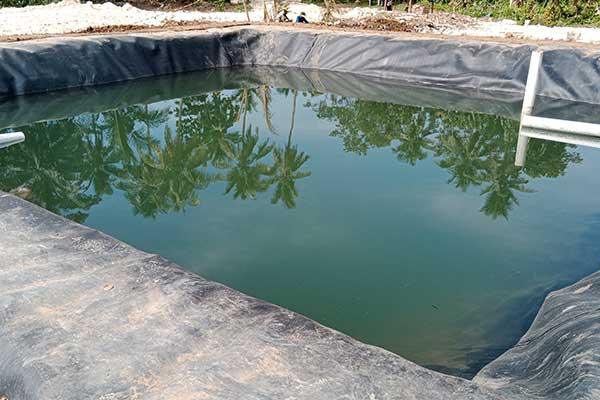
HDPE geomembrane is a geosynthetic product made from polyethylene polymer resin. The polyethylene used is high-density, with a density of around 0.94 g /cm3. Geomembrane, also known as HDPE tarpaulin, is impermeable to water and gas. This impermeability is widely used by construction professionals to contain wastewater or raw water as an alternative to concrete structures.

Virgin HDPE resin
HDPE geomembrane is generally manufactured from HDPE (High Density Polyethylene) resin with small amounts of antioxidant additives and carbon black. It is this choice of resin and additives that gives geomembrane its excellent environmental resistance.
Compared with ordinary tarpaulin, geomembrane is far superior in durability. Good resistance to sunlight, good temperature resistance ( ± 60 oC), corrosion resistance and a longer service life make geomembrane the preferred choice of construction professionals in Indonesia.

HDPE geomembrane

HDPE geomembrane

HDPE geomembrane packing
Types of Geomembrane
Geomembrane can generally be divided into two types: smooth geomembrane and textured geomembrane. The difference can be seen on the surface. Smooth geomembrane has a smooth, slippery surface, while textured geomembrane has a rougher surface.

HDPE geomembrane
Read Also
https://petrane.co.id/blog/jenis-geomembrane-dan-perbedaannya
Smooth Geomembrane
Smooth geomembrane can be recognized by its smooth, slippery surface on both sides. Because smooth geomembrane is relatively cheaper than textured geomembrane, it is the type most often found in construction projects.

HDPE geomembrane
Textured Geomembrane
Textured geomembrane has a rough, textured surface on one side (single side textured) or on both sides (double side textured). Textured geomembrane is used specifically on projects with steep slopes that need extra friction (anti-slip) between the geomembrane and the soil so that the geomembrane stays in place.

Textured Geomembrane
Functions of Geomembrane
The main function of geomembrane is to act as a waterproof layer, because geomembrane is impermeable to both gases and liquids.
For example, in raw water storage projects, geomembrane is used to line retention ponds / rainwater reservoirs so that the water does not easily seep into the ground and can be used for irrigation, especially in the dry season.
Another example is landfills and mining tailings ponds, where geomembrane is used to prevent hazardous waste from seeping into the environment.
Besides liquids, geomembrane can also be used to contain methane gas in biogas applications. This greatly helps reduce air pollution and makes use of renewable energy.

HDPE geomembrane

HDPE geomembrane

HDPE geomembrane
Finally, geomembrane is not limited to containment ponds; it can also be used within soil, especially expansive soft soil. It prevents expansive soil from swelling and shrinking, which could damage road structures.

Road Construction Project with Geomembrane
Differences Between HDPE, LLDPE and PVC Geomembrane
1. High Density Polyethylene (HDPE) geomembrane has the best chemical and UV resistance compared with LLDPE and PVC. HDPE geomembrane is installed by thermal welding to join the sheets. However, HDPE geomembrane has some drawbacks: lower flexibility (it is stiff), heavy weight and a fairly high price.
2. Linear Low Density Polyethylene (LLDPE) geomembrane stands out for its flexibility. Because it is flexible, LLDPE geomembrane easily adapts to surface conditions on site.
This material is ideal for applications where the geomembrane is designed to deform under continuous movement above it without damaging the LLDPE. HDPE, being relatively stiffer, would be damaged more easily in such applications.
3. Polyvinyl Chloride (PVC) geomembrane is very flexible and can easily be bent without damaging the material. It can be joined with glue or by thermal welding. PVC geomembrane is relatively cheaper than other materials. However, its UV resistance is not as good as that of HDPE and LLDPE.
For convenience, we have attached a geomembrane comparison table

Geomembrane comparison table
Geomembrane Thickness Options
On the Indonesian market, HDPE geomembrane is available in several thicknesses, including 300 micron, 500 micron, 750 micron, 1000 micron, 1500 micron, 2000 micron and 3000 micron.
In general, 300 micron and 500 micron HDPE geomembrane is often used for salt pond and fish pond projects.
HDPE geomembrane from 750 micron to 3000 micron is intended for geotechnical projects that require specifications meeting international standards.
These standards are set by the Geosynthetics Research Institute (GRI), specifically in GRI GM 13.

Geosynthetics Research Institute (GRI)
Characteristics of HDPE Geomembrane
In general, HDPE geomembrane has the following characteristics that affect its use in geotechnical design:
1. HDPE geomembrane is a waterproof layer that prevents seepage and leaks.
2. HDPE geomembrane can withstand high temperatures (60oC) and low temperatures (-60oC).
3. HDPE geomembrane has good chemical resistance against corrosion by hydrocarbons, alkalis and strong acids.
4. HDPE geomembrane is resistant to weathering and has a long lifetime
5. HDPE geomembrane has high tensile strength and elongation, making it suitable for areas with complex geology and fairly extreme weather.
How Durable Is HDPE Geomembrane?
Geomembrane made from HDPE (High Density Polyethylene) is far more durable than other polymers. Here are the advantages of using HDPE polymer:
1. Excellent chemical resistance (it can safely contain hydrocarbons, chlorine and alkalis).
Below is a reference for the chemical resistance of HDPE material
2. Good oxidation resistance.
3. Good resistance to biological conditions.
4. Good ultraviolet (UV) resistance. The carbon black added to the geomembrane gives it excellent UV resistance.
5. It can withstand both high and low temperatures.
The service life of HDPE geomembrane is a frequent question from professionals before they use it. The answer is not simple, because it depends on the application.
The service life of geomembrane is affected by the intensity of UV exposure, oxidation, ozone, chemicals, biological agents, temperature and other environmental factors. In geomembrane test documents, for covered (unexposed) applications such as landfills, geomembrane can last 69 years at a temperature of 40 oC.
So what is the service life of exposed HDPE geomembrane? GRI documents explain that laboratory tests predict a service life of more than 36 years for exposed HDPE geomembrane.
HDPE Geomembrane Applications
HDPE geomembrane applications generally rely on its waterproofing ability and chemical resistance. Here are its applications:
1. HDPE geomembrane is used to protect the environment from pollution. Examples: landfills, wastewater ponds, treatment ponds
2. HDPE geomembrane is used for raw water conservation ponds. Examples: embung (small retention reservoirs), reservoirs, dams.
3. HDPE geomembrane is used in agriculture. Examples: irrigation canals, reserve ponds, reservoirs
4. HDPE geomembrane is used in aquaculture. Examples: fish ponds, shrimp ponds, salt ponds.
5. HDPE geomembrane is used in landscaping and gardens. Examples: artificial ponds, streams, golf course ponds, rooftops
6. HDPE geomembrane is used in mining. Examples: heap leach pads, storage yards, tailings ponds
How to Install Geomembrane
In short, HDPE geomembrane installation consists of 3 stages: site preparation, deployment and geomembrane seaming
Stage 1: Site Preparation
Transportation, loading, unloading and storage on site must be handled with care. Proper handling is needed to prevent damage to the geomembrane.

HDPE geomembrane
Geomembrane must be stored on level ground. Sharp objects or anything else that could damage the geomembrane must be removed.

HDPE geomembrane
The work area must be properly prepared before geomembrane installation. The soil must be compacted according to the project specifications, and soft or compressible (loose) areas must be compacted.

Geomembrane installation
The membrane trench must be excavated to the width and depth specified in the project design and drawings before installation. During excavation, the excavation procedure must be planned to prevent the membrane trench from collapsing

Geomembrane installation

Geomembrane anchor
Stage 2: Deploying the HDPE Geomembrane
All equipment used to deploy the geomembrane must be checked to prevent the geomembrane from being pulled and torn

Geomembrane tools
The geomembrane is rolled out and cut into panels to suit each area of the site. Use sandbags to prevent the geomembrane panels from being lifted by the wind.
Smoking is not allowed in the geomembrane deployment area. Minimize walking on the geomembrane in shoes to prevent possible damage.

Geomembrane
Stage 3: Seaming & Testing the HDPE Geomembrane
HDPE geomembrane sheets can be joined using a geomembrane welder and welding rod. There are two kinds of geomembrane welding tools: fusion welding and extrusion welding.
Fusion welding is the welder generally used for straight seams between geomembrane sheets.

Geomembrane seaming
Extrusion welding is the geomembrane welder used for repairs and for joints around pipes.

Geomembrane extrusion seaming
The finished seams are then tested with a Vacuum Test and an Air Pressure Test.

Geomembrane leak test
Geomembrane Project References – Petra Nusa Elshada
Here are references of geomembrane use by PT. Petra Nusa Elshada:
1. Project: Biogas; Thickness: 1.5 mm geomembrane (1500 micron)

Geomembrane project
2. Project: Raw Water Pond; Thickness: 1 mm geomembrane (1000 micron)

Geomembrane project
3. Project: Embung (retention reservoir); Thickness: 0.75 mm geomembrane (750 micron)

HDPE geomembrane
4. Project: Shrimp Pond; Thickness: 0.5 mm geomembrane (500 micron)

HDPE geomembrane shrimp pond
5. Project: Wastewater Pond; Thickness: 1.5 mm geomembrane (1500 micron)

HDPE geomembrane water pond
6. Project: Rooftop Lining; Thickness: 0.75 mm geomembrane (750 micron)

HDPE geomembrane rooftop
7. Project: Landfill; Thickness: 1.5 mm geomembrane (1500 micron)

HDPE geomembrane
Note: The project photos shown are only a small selection of our clients’ projects that required geomembrane. PT. Petra Nusa Elshada has carried out these projects since 2015, so the quality of the geomembrane we supply is well maintained and reliable.
Other Articles

Road Construction with Geotube
Engineers already know geotubes for many construction needs, including geotube road construction. Access roads are increasingly important as development grows. Road construction is generally straightforward when the foundation soil and surroundings are suitable. Roads are difficult to build when the area is flooded with water. This is common when access roads must be built in […]

