


Drainage Planning Guide: Flood-Free and Durable
Have you ever seen a newly paved road develop potholes within only a few months, Petra Friends? Or a property yard that becomes muddy every time it rains? Often, the main problem is not the asphalt or soil quality but one frequently overlooked factor: a poor drainage system.
If you are designing a residential development, commercial area, or even road-infrastructure project, drainage planning is the “heart” that determines your project’s service life. Without planned waterways, an investment worth billions of rupiah can literally be washed away.
This article thoroughly explains how to plan effective, modern, and certainly efficient drainage for the long term. Let us take a look!
Why Is Drainage Planning So Important?
Simply put, drainage is the art of controlling water. Its purpose is not only to remove water as quickly as possible but to manage it so it does not damage surrounding structures.
If you neglect this stage, the risks are serious:
- Structural Damage: Water seeping into foundations or the underlying soil layer (subgrade) can weaken the soil’s bearing capacity.
- Flooding & Ponding: These are the main enemies of road-user comfort and safety.
- Soaring Maintenance Costs: Repairing water damage is far more expensive than building proper drainage from the start.
Two Types of Drainage Systems You Need to Know
Before discussing technical planning, you must first understand that drainage is not limited to concrete roadside ditches.
1. Surface Drainage

This is the type you see most often. It captures rainwater falling on surfaces such as roads, roofs, and parking areas, then conveys it to a receiving water body. Examples include ditches (ditch), gutters, and channels.
2. Subsurface Drainage

This type often escapes attention but is crucial for modern projects. The system lowers the groundwater table or removes water that seeps into the ground, keeping the subgrade dry and stable.
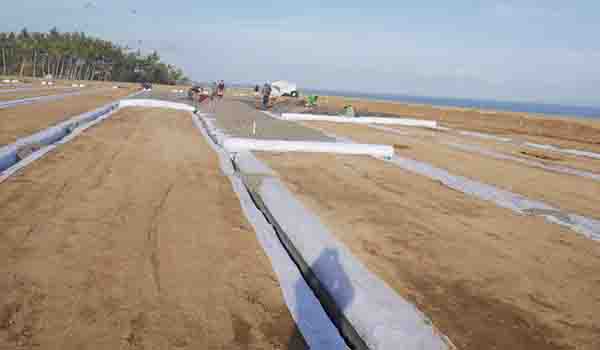
Today, conventional materials such as river stone are beginning to be replaced or combined with Geosynthetics. Why? Because they are faster to install and highly efficient.
Vital Stages in Drainage Planning

Drainage design requires proper engineering; you cannot simply dig a trench. Here are the systematic stages you need to follow:
- Topographic and Site Survey
The first step is understanding the site. You need ground-contour data to identify the natural direction of water flow, from high ground to low ground. Do not design a channel that “fights” gravity because doing so requires costly pumps. - Hydrological Analysis (Rainfall)
How heavy is the rainfall at your project location? Annual rainfall data is essential for calculating the “Design Discharge.” You can use the Rational Method to estimate how much rainwater will enter your channel.
- Basic Formula: Q = 0.278 x C x I x A
- (Where Q is discharge, C is the runoff coefficient, I is rainfall intensity, and A is the area).
- Route Selection (Layout)
Once you know the water volume, determine the channel route. The best route is the shortest possible path to the outlet, such as a river or retention pond, with few bends to minimize erosion of the channel walls. - Channel-Dimension Design
Do you need a 30 cm-diameter pipe or a 1-meter-wide channel? These dimensions are determined by the discharge calculation. Make sure the channel is large enough to accommodate maximum rainfall, usually based on a 5- or 10-year return period, without overflowing. - Material Selection: Concrete vs Geosynthetics?
This is where you can improve efficiency.
- Concrete: Strong but heavy and slow to install.
- Geosynthetics: For subsurface drainage, you can use Geopipe , a perforated or corrugated pipe, wrapped in Non-Woven Geotextile. The geotextile filters soil so it does not clog the pipe, while the geopipe conveys water quickly. This combination is highly popular in sports-field, toll-road, and retaining wallprojects.
- Channel Gradient (Slope)
Water needs a gradient to flow. The standard minimum gradient is usually around 0.5% to 2%, depending on the channel type. If it is too flat, water will pond and become a mosquito breeding ground. If it is too steep, water will erode the channel bottom.
Common Mistakes
- Miscalculating the Runoff Coefficient: Forgetting that paved areas, such as parking lots, produce far more water runoff than grassy areas.
- Ignoring Sedimentation: Failing to install a control basin (catch basin) to trap sediment, causing the channel to become shallow quickly.
- Not Using a Filter: In subsurface drainage, installing pipes without a geotextile wrap often causes them to become clogged with soil in a short time.
A Modern Solution: Why Switch to Geosynthetics?
At Petra Nusa Elshada, we see a shift toward more sustainablesolutions. Using Geotextile as a drainage filter and Geopipe as a water conduit offers advantages that conventional methods struggle to match:
- Fast Installation: Lightweight and easy to cut.
- Economical: Reduces excavation volume and stone-aggregate requirements.
- Durable: Resistant to chemicals in the soil and to corrosion.
This system is highly suitable for drainage behind retaining walls, golf-course and football-field drainage, and soft-soil stabilization.
Maintenance Tips for Durable Drainage
We often think the job is finished once drainage construction is complete. In fact, the greatest enemy of a drainage system is not a rainstorm but lack of maintenance. Even an advanced drainage system will fail without routine maintenance management.
- Sedimentation Control
This is a classic problem. Rainwater carries soil particles, sand, and dust that gradually settle at the bottom of a channel. If left in place, this sediment drastically reduces the channel’s capacity.
- Action: Dredge sediment (dredging) at least once a year, especially before the rainy season.
- Advantage of Modern Systems: If you use a subsurface drainage system with Non-Woven Geotextile, the risk of sediment entering the pipes or aggregate layer is greatly reduced because the geotextile filter retains soil while allowing water to flow freely.
- Removing Waste and Weeds
Plastic waste and wild plants are the main causes of blockages at inlets and outlets. Wild plants growing on earthen channel walls can also obstruct water flow by increasing the wall-roughness coefficient.
- Action: Clean thetrash rackweekly. Also make sure no illegal structures or piles of construction materials obstruct the waterway.
- Routine Inspection of Control Chambers (Manholes/Catch Basins)
A control chamber allows debris to settle before water enters the main pipe. This area is often overlooked because it is covered.
- Action: Open and inspect control chambers regularly. If sediment has reached half the chamber depth, clean it immediately. Do not wait until it overflows!
- Repairing Physical Structural Damage
Fast-flowing water has erosive power. In concrete or masonry channels, check for cracks or scouring along the bottom.
- Action: Patch small cracks immediately before water seeps through and damages the subgrade beneath the channel. Neglected minor damage can cause the channel wall tocollapse.
- Evaluating Performance During Heavy Rain
The best time to assess your drainage quality is during heavy rain.
- Action: Check whether water ponds in areas that should remain dry. Does water overflow from the channel? If so, there may be an unseen blockage, or the channel dimensions may need anupgrade through a capacity reassessment.
Conclusion
Drainage planning is a long-term investment. With accurate hydrological analysis, intelligent routing, and modern materials such as geosynthetic products, you can create a flood-free, safe, and valuable development.
Remember, water is an ally when managed well but can become an enemy when left uncontrolled. Make sure your drainage system is ready for the coming rainy season!
Need a Consultation for Your Requirements?
Still unsure which drainage design is most efficient for your project? Or are you looking for quality geosynthetic materials such as Geotextile and Geopipe?
Feel free to consult us about your geosynthetic-material requirements. We supply a wide range of high-quality geosynthetics ready for delivery throughout Indonesia. Let us discuss your project needs today!
View Our Catalog: Click here
Chat on WhatsApp Now: Click here
Remember Geosynthetics, Remember Petra!
Other Articles

Geotube Dewatering: Advantages and Process Steps
Construction projects and waste management often call for a special method known as geotube dewatering. This process effectively helps dry out sludge or sludge overflow coming from wastewater treatment plants. A geotube is a technology used to prevent severe coastal erosion. Put simply, a geotube is a fabric tube made of woven or non-woven geotextile. […]


What Is a Geotube? Definition, Functions and Advantages
Efforts to tackle and prevent abrasion and erosion are important because they minimize the damage caused. Besides the geobag method, geotube technology can also be used. So what is a geotube, and how does it differ from a geobag? Much like a geobag, this method uses geotextile material, but shaped like a large tube. The […]