


Coal Yard Geomembrane: Applications and Benefits

Hi, Petra friends! If you work in the mining industry, the terms coal yard and coal stockpile are surely part of your everyday vocabulary. This area is the heart of mining logistics, where thousands to millions of tons of coal are collected before being distributed to end-users or power plants.
But have you ever realized how large the environmental risks and operational challenges in this area are? Managing open-air coal stockpiles is not easy, especially in Indonesia, which has very high rainfall. Coal constantly exposed to rain and heat can trigger serious problems, from a drop in calorific value to environmental pollution caused by acid mine drainage.
To overcome these problems, the modern mining industry relies heavily on geosynthetic technology. One of the most crucial and irreplaceable solutions is the coal yard geomembrane.
Why is this material so important? How does it protect the environment while securing your company’s assets? Let’s examine everything in this article!
What Exactly Is a Geomembrane?
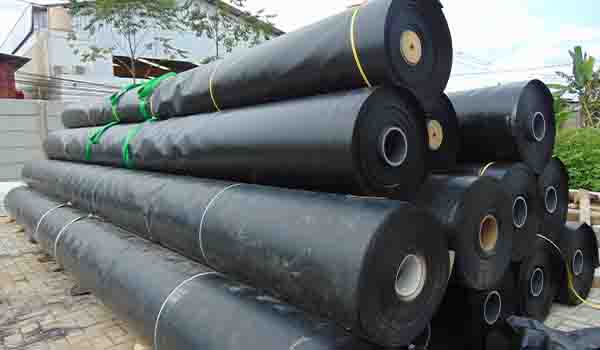
Before going further, let’s establish a common understanding. A geomembrane is a synthetic waterproof liner (impermeable layer) specially designed to keep liquids, gases and chemicals from seeping into the ground.
Visually, this material often looks like a giant jet-black plastic sheet. But don’t be mistaken. This is no ordinary plastic. Geomembranes are made from high-grade polymers; the most commonly used in heavy industry are High-Density Polyethylene (HDPE) and Low-Density Polyethylene (LDPE).
The material is deliberately produced with special additives such as carbon black, antioxidants and UV stabilizers. These give the geomembrane outstanding resistance to direct sunlight, extreme temperature changes and harsh chemical reactions often found in mining areas.
Environmental Threats at the Stockpile
To understand why we need this waterproof liner, you first need to know what happens when coal stockpiles are left in direct contact with natural ground without protection.
Coal naturally contains the mineral pyrite (iron sulfide). When rain falls on a coal stockpile, the rainwater reacts with the pyrite and oxygen in the air. This natural chemical reaction produces liquid sulfuric acid. This phenomenon is widely known as acid mine drainage (Acid Mine Drainage / AMD).
Acid mine drainage has a very low pH and is highly corrosive. Worse still, its acidity can dissolve toxic heavy metals in coal, such as lead, mercury and arsenic.
If the coal yard does not have a good liner system, this leachate (toxic liquid) will seep straight into the ground (seepage). The consequences are severe:
- Groundwater Pollution:
Wells and water sources used by communities around the mine can become contaminated with heavy metals and unfit for consumption. - Ecosystem Damage:
If leachate flows into a nearby river, the freshwater ecosystem will be destroyed and river life killed. - Strict Government Sanctions:
Companies proven to have polluted the environment can face fines of billions of rupiah, a downgrade in their PROPER (Corporate Environmental Performance Rating Program) rating and even revocation of their mining business permit (IUP).
This is the main reason why geomembrane applications in coal yards are no longer just an option, but an absolute requirement for modern mining operations.
Main Functions of a Coal Yard Geomembrane

So where exactly is geomembrane installed in a coal handling area? In general, there are three main applications of this material at a stockpile:
1. Stockpile Base Protection
The most vital function of geomembrane is as the base liner of the stockpile itself. Before coal is piled up, the compacted ground surface is lined with geomembrane.
This layer acts as an impenetrable shield, ensuring that every drop of rainwater that wets the coal (and becomes acid mine drainage) does not seep into the ground. The contaminated water is retained on top of the geomembrane and channeled through a dedicated drainage system to treatment ponds.
Besides preventing pollution, a solid base also prevents coal losses from sinking into or mixing with the muddy subgrade. This clearly improves efficiency when heavy equipment reclaims the coal for distribution.
2. Mine Wastewater Pond Liner
Rainwater mixed with coal dust and sulfuric acid from the stockpile area must be treated before being discharged into public waters. This treatment takes place in a Settling Pond or mine wastewater pond.
These settling and neutralization ponds must be lined with geomembrane. The native soil of an excavated pond cannot fully contain acidic water. Geomembrane ensures hazardous chemical liquids stay inside the pond during the settling of Total Suspended Solids (TSS) and pH neutralization using coagulants and flocculants.
3. Coal Stockpile Cover
At some mining operations with strict Quality Control, geomembrane is also used as a cover system. Covering coal stockpiles from heavy rainfall helps maintain the coal’s calorific value (GCV) so it does not drop because of high moisture content. Covering also prevents coal dust from being blown by the wind, which can harm the respiratory health of workers and nearby residents.
Why Choose HDPE Geomembrane?
Of the various types of geomembrane on the market, HDPE Geomembrane is the most widely used material for coal yard applications. There are several technical reasons to choose this material:
- High Chemical Resistance:
HDPE has a very dense molecular structure. This makes it immune to corrosion from the concentrated sulfuric acid in acid mine drainage and resistant to many other reactive chemicals. - Strong Tensile Strength:
A stockpile is a busy area used by heavy equipment such as excavators, loaders and dump trucks. Although geomembrane must not be driven on directly, the static load from coal piled more than ten meters high requires a base material that does not stretch or tear easily. - Durable in Extreme Weather:
Thanks to its carbon black content, HDPE geomembrane can withstand the tropical sun for many years, even decades, without structural cracking (environmental stress cracking).
It is important to note that geomembrane does not work alone. To prevent the sheet from being punctured by sharp coal lumps or gravel from the subgrade, it is usually sandwiched between layers of Non-Woven Geotextile. This geotextile acts as a protective cushioning layer that absorbs puncture energy, keeping the waterproof layer intact.
Proper Installation Stages

Buying expensive material is pointless if it is installed carelessly. Installing geomembrane at a stockpile requires precision and very strict Quality Control (QC) procedures. Briefly, these are the stages:
- Subgrade Preparation (Subgrade):
The ground must be leveled, compacted and cleared of sharp stones, tree roots and other hard materials that could tear the geomembrane from below. - Material Deployment (Deployment):
Geomembrane sheets are laid out to follow the site contour, with an overlap of about 10-15 cm between sheets in preparation for seaming. - Welding Process (Welding):
This is the most crucial stage. Sheets are not joined with glue, but melted together using special welding machines. For long straight runs, Hot Wedge Welding is used, producing a double track weld. For corners, pipes or patches, Extrusion Welding is used. - Integrity Testing (Testing):
After welding, the seams must be tested. On double-track welds, pressurized air is pumped into the channel between the two welds (Air Pressure Test) to make sure there are no leaks at all.
Regulatory Compliance
In Indonesia, the government, through the Ministry of Environment and Forestry (KLHK), has very rigid standards for managing mining waste. Every mining company is required to prepare a comprehensive Environmental Impact Assessment (AMDAL).
Building proper wastewater treatment facilities, including using geomembrane for coal run-off containment, is an absolute requirement for a company to operate legally. Ignoring this not only leads to administrative sanctions, but also destroys the company’s reputation among global investors, who now care deeply about Environmental, Social, and Governance (ESG) issues.
Conclusion and the Best Solution
Investing in environmental protection infrastructure is not a cost burden, but a strategy to secure the future sustainability of a mining business. Coal yard geomembrane applications have been proven scientifically and in practice to prevent acid mine drainage pollution, maintain product quality and keep company operations compliant with government regulations.
Need a Consultation for Your Project?
If you are planning coal yard management or building a safe, leak-proof and efficient wastewater pond, we are ready to be your trusted partner.
Feel free to consult us about your geosynthetic material needs. We supply a wide range of high-quality geosynthetics ready to ship throughout Indonesia. Let’s discuss your project needs now!
Check our catalog: Click here
Chat on WhatsApp Now: Click here
Remember Geosynthetics, Remember Petra!
Other Articles


How to Use an HDPE Welding Rod
Welding rod, also called HDPE welding wire, is commonly used in mining and civil engineering projects, and it is one of the most frequently used materials. Even so, many new field workers on civil engineering or mining projects are still unfamiliar with it, so here is how to use welding rod. Extrusion The extrusion method […]

Coastal Erosion: Dangers and How to Prevent It
Hello, Petra friends! Have you ever noticed the shoreline in your area retreating day by day? Or perhaps you have seen seaside buildings that used to be far from the water’s edge now being eaten away by waves? This phenomenon is not just an ordinary sight, but a real sign of coastal erosion. For those […]