


Geotextile: Definition, Types, Functions and Installation

What Is Geotextile?
Geotextile is a porous material made from synthetics such as polyester or polypropylene and used in construction and civil engineering projects. Its main functions are reinforcing soil, preventing erosion and improving the durability of structures.
This material belongs to the geosynthetics category, meaning man-made materials specifically designed to interact with soil and water. Geotextile is widely used in highway, bridge, reservoir and dam projects, as well as environmental conservation.
Types of Geotextile
In general, geotextile is divided into two main types:
- Woven Geotextile
- Made through a weaving process that produces high tensile strength.
- Suitable for soil reinforcement applications in highways, railways and building foundations.
- Advantages: resistant to mechanical stress, with more even load distribution.
- Non-Woven Geotextile
- Made by arranging fibers randomly using mechanical, chemical or thermal processes.
- More flexible, softer and effective for filtration and drainage.
- Suitable for reservoirs, dams, waterways and conservation projects.
Geotextile Installation Methods
For geotextile to deliver optimal benefits, it must be installed correctly. Here are the general steps:
- Site preparation Clear the area of stones, plant roots and other materials that could damage the geotextile.
- Cutting to size Match the sheets to the project design and make sure the overlap between sheets is at least 30–50 cm.
- Overlapped installation Avoid gaps to prevent soil movement.
- Additional securing Use anchors or soil backfill to keep the geotextile in position.
- Final inspection Make sure there are no folds or wrinkles that could reduce effectiveness.
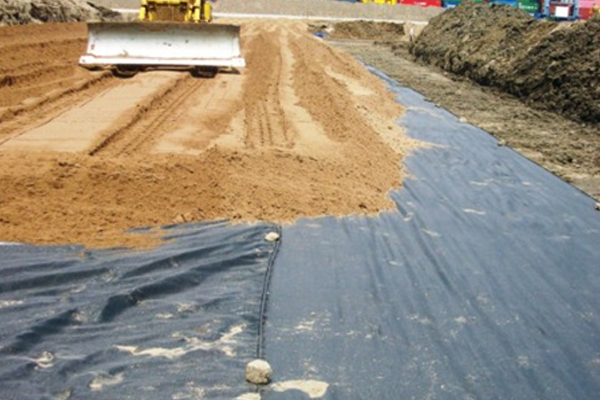
Main Functions of Geotextile in Construction
Geotextile has several main functions:
- Soil reinforcement Increases soil bearing capacity for roads, bridges and foundations.
- Erosion protection Protects slopes from landslides caused by rainwater or river flow.
- Filtration Filters fine soil particles so they are not carried away by water.
- Drainage Improves water flow and reduces hydrostatic pressure.
- Separation Separates soil layers from construction materials so they do not mix.
Advantages and Drawbacks of Geotextile
Advantages:
- Significantly increases soil bearing capacity.
- Resistant to chemicals and extreme environmental conditions.
- Speeds up construction because installation is relatively easy.
- Reduces long-term maintenance costs.
Drawbacks:
- Effectiveness depends heavily on proper installation.
- Susceptible to damage under excessive stress.
- The initial price is relatively higher than conventional methods.
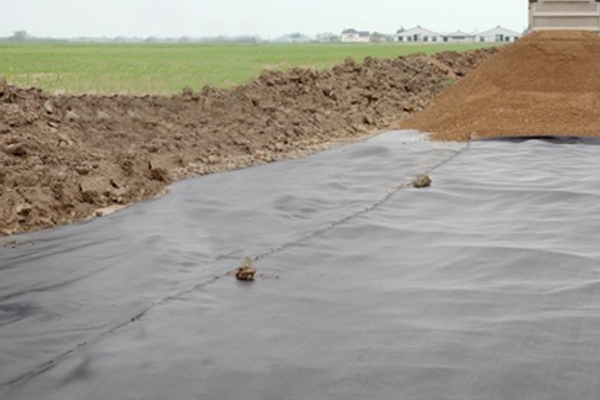
Geotextile Applications in the Field
Geotextile has a very wide range of uses, including:
- Highways & railways → reinforce the base layer so it does not deteriorate quickly.
- Dams & reservoirs → prevent erosion and maintain structural stability.
- Drainage channels → filter soil particles so water continues to flow smoothly.
- Coastal reclamation projects → protect the shoreline from abrasion.
- Landfills → serve as a separation layer and geomembrane protection.
Get Geotextile and other geosynthetic materials now, only at Petra Nusa Elshada. For more information, please click here!
Other Articles

HDPE Pipe: Advantages, Types and Prices
HDPE pipe is a type of pipe recognisable by its black colour with blue stripes. With that appearance, you can be sure the pipe is HDPE, and it is widely used for water distribution. This article explains the HDPE pipe advantages, types and prices. When choosing a pipe for clean water at high pressure, this […]

Building a Geomembrane Biofloc Pond with HDPE
Biofloc is a farming technique for catfish, fish, shrimp and other farmers that uses probiotic bacteria to process the organic waste produced from digestion and leftover feed. A geomembrane biofloc pond helps make this technique very effective at increasing productivity and maintaining water conditions. Biofloc ponds usually use a circular steel frame lined with tarpaulin. […]

Visual Soil CBR Identification in the Field
Soil CBR identification. To determine the CBR of a soil precisely, tests must be carried out in accordance with SNI 1738:2011 using a field CBR apparatus or a DCP (Dynamic Cone Penetrometer). This requires certified specialists to perform the CBR test, interpret and process the data, and make recommendations based on the results. For […]