


Geotube for Coastal Protection and Abrasion Control
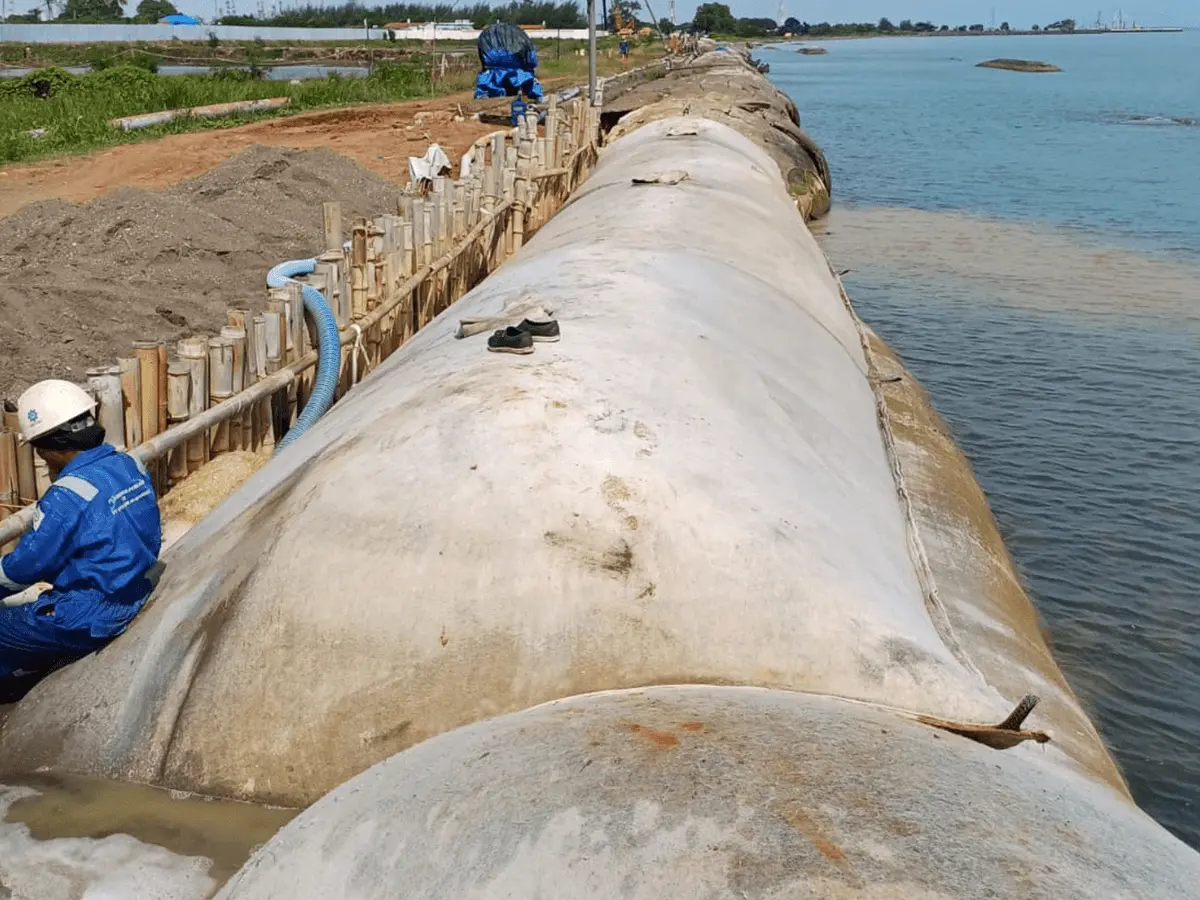
The threat of coastal abrasion and riverbank erosion is becoming an increasingly serious ecological and infrastructure challenge in many regions of Indonesia. The combination of rising sea levels, climate change and increasingly severe ocean waves has the potential to damage residential areas, tourist destinations and vital infrastructure in coastal regions.
To address this problem, conventional methods such as building river-stone embankments or rigid concrete retaining walls (retaining wall) often require very high investment costs and lengthy construction while having an ecological impact that is less friendly to the surrounding ecosystem.
As a solution, geosynthetic material technology offers an innovation known as Geotube (or geotextile tube). This article comprehensively discusses what geotube is, how it works, its field applications and technical advantages, and how it compares with conventional structures.
What Is Geotube?
Geotube is a giant cylindrical or tubular containment structure made of high-strength synthetic geotextile fabric (high-strength woven geotextile). Its casing generally uses polymer fibers such as polypropylene (PP) or polyester (PET), designed for long-term resistance to ultraviolet (UV) exposure, chemicals in seawater and mechanical abrasion from water currents.
This tubular structure is produced in various sizes, ranging from 1.5 meters to more than 5 meters in diameter, with lengths reaching tens of meters according to technical requirements in the field.
Principles and Operation of the Geotube Dewatering System
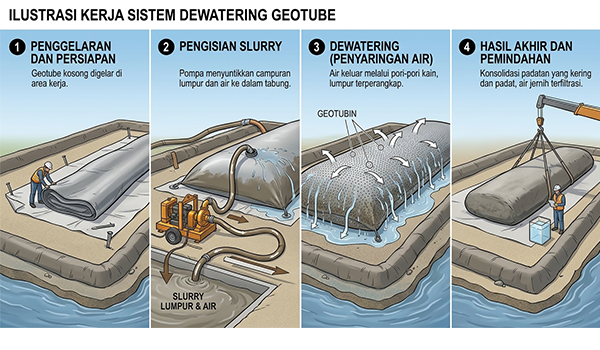
One of the main distinguishing features of geotube technology is its filling and filtration system, known as the dewatering process. The following are the stages of geotube operation in the field:
-
Positioning and Deployment: The empty geotube is deployed at the designated location, such as along a shoreline or riverbank.
-
Slurry/Sand Filling (Pumping): A mixture of water and local material—such as beach sand, river mud or soil sediment—is pumped into the geotube through an inlet (inlet/filling port) using a dredging machine or hydraulic pump.
-
Water Filtration (Dewatering): The micropores in this specialized geotextile fabric are designed to let water flow smoothly through the fabric while completely trapping solid sand or mud particles inside the tube.
-
Consolidation and Hardening: Over time, all water drains out and the solid material inside undergoes natural consolidation. The final result is an extremely dense, sturdy and stable synthetic rock barrier.
Geotube Applications in Abrasion Control and Construction
Geotube is highly versatile and can be applied to various civil engineering, environmental and coastal management projects. Some of its main applications include:
1. Offshore Breakwaters (Offshore Breakwater)
Densely filled geotubes can be arranged offshore to dissipate wave energy before it reaches land. This effectively reduces the force of ocean currents so abrasion along the shoreline can be prevented.
2. Abrasion-Control Embankments and Reclamation
In coastal areas experiencing severe erosion, geotubes are installed parallel to the shoreline to restrain soil movement and serve as the boundary of a new land reclamation area.
3. River Normalization and Bank Protection
Strong river currents at bends often erode banks and cause landslides. Geotubes can be placed along riverbanks to reinforce the soil structure and prevent erosion.
4. Integration with Mangrove Ecosystem Restoration
Geotubes often serve as an initial protective barrier for newly planted mangrove seedlings. With geotube protection, the seedlings will not be swept away by strong waves, allowing the natural coastal ecosystem to grow optimally.
Comparison Table: Geotube vs Conventional Concrete Walls
To understand why geotube is increasingly favored in modern coastal infrastructure projects, the following table provides a technical comparison between geotube and conventional concrete structures:
| Parameter | Geotube (Geosynthetic) | Concrete / River-Stone Wall |
| Structural Properties | Flexible & conforms to ground contours | Rigid and prone to cracking if the ground shifts |
| Fill Material | Local material (local sand/mud) | Cement, crushed stone, special sand, reinforcing bar |
| Construction Cost | More economical (reduces logistics costs) | More expensive due to materials & transportation |
| Installation Time | Very fast and practical | Takes a long time (curing process) |
| Environmental Impact | Low carbon footprint, can blend with vegetation | Leaves cement waste & alters the landscape |
| Weather Resistance | Resistant to UV rays and saltwater corrosion | Can last a long time, but is prone to cracking |
Main Advantages of Geotube Technology
Besides cost efficiency and ease of construction, geotube technology offers several strategic advantages:
-
Highly Environmentally Friendly: It releases no toxins or chemical waste into surrounding waters. Its locally sourced fill material makes geotube an ideal choice for ecological conservation projects.
-
Effective Solution for Remote Areas: Transporting concrete or river stone to outlying islands or isolated coastal areas incurs extremely high logistics costs. With geotube, contractors only need to bring rolls of geotextile fabric and can use sand or mud available at the project site.
-
Highly Adaptable: Its flexibility means geotube does not easily break or collapse when the underlying ground shifts (ground settlement) or during minor earthquakes.
Other Articles


What Is Geogrid? How It Works and Its Uses
The construction industry uses many technologies and materials to increase the strength, stability and durability of structures. One popular innovation is geogrid. This article explains what geogrid is, how it works, its applications in construction and the benefits it offers. What Is Geogrid? Geogrid is a material made from polymer or metal in the form […]

Embankment Reinforcement with Woven Geotextile
Woven Geotextile can serve as reinforcement, a separator or drainage, and woven geotextile reinforcement is key for embankments. If an embankment sits on soft soil, excessive deformation causes it to bend downward. This deformation damages the structure above it. Basically, an embankment behaves like a loaded beam: if it bends too sharply, cracks form at […]