


Woven and Non-Woven Geotextile for Geotube Fabrication
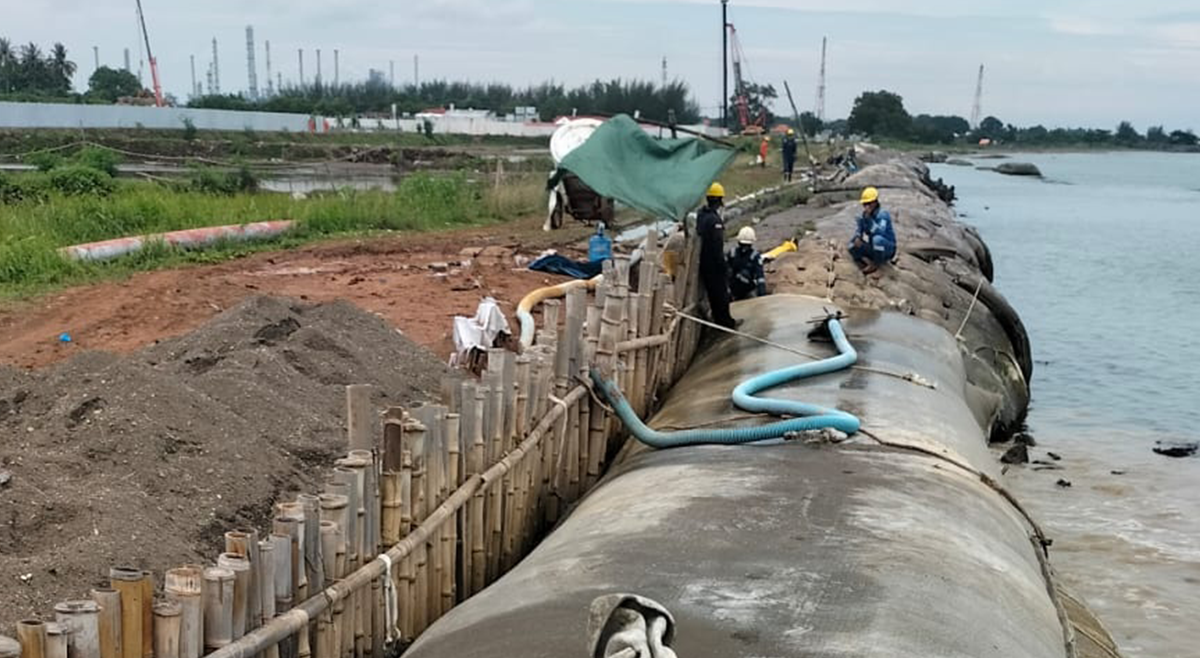
In civil engineering, geotechnics, and environmental management, the use of geosynthetics has changed the way we address soil stability, coastal erosion, and waste treatment problems. One of the most effective and fastest-growing geosynthetic applications is Geotube (geotextile tube) technology.
A geotube is a giant tube- or bag-shaped structure made of a flexible polymer-based material, filled with slurry (mud, sand, or liquid sediment) through hydraulic pumping. The success of a geotube application depends heavily on the choice of its construction material, namely woven geotextile and non-woven geotextile.
Complete Guide to Woven and Non-Woven Geotextile for Geotubes
In civil engineering, geotechnics, and environmental management, the use of geosynthetics has changed the way we address soil stability, coastal erosion, and waste treatment problems. One of the most effective and fastest-growing geosynthetic applications is Geotube (geotextile tube) technology.
A geotube is a giant tube- or bag-shaped structure made of a flexible polymer-based material, filled with slurry (mud, sand, or liquid sediment) through hydraulic pumping. The success of a geotube application depends heavily on the choice of its construction material, namely woven geotextile and non-woven geotextile.
This article provides a thorough, in-depth look at the characteristics, technical differences, working mechanisms, and economic and environmental aspects of these two types of geotextile in geotube fabrication.
What Are Woven and Non-Woven Geotextiles?
Before discussing their application in geotubes, it is essential to understand the fabrication basics and physico-chemical characteristics of these two types of geotextile.
1. Woven Geotextile
Woven geotextile is produced by weaving synthetic yarns on large-scale industrial looms. The yarns are generally slit-film (flat tape) or multifilament made from Polypropylene (PP) or Polyester (PET) polymer.
-
Fabrication Method: The yarns are interlaced at right angles between the weft yarns (weft) and warp yarns (warp), forming a regular grid pattern.
-
Physical Characteristics: The fabric sheet tends to be thin but very stiff, with an extremely dense structure.
-
Main Mechanical Properties: It has very high tensile strength with low elongation under load.
2. Non-Woven Geotextile
Unlike the woven type, non-woven geotextile does not go through a yarn-weaving process. It is formed from polymer continuous filament or short fibers (staple fiber) spread randomly on a conveyor belt.
-
Fabrication Method: The random fibers are then bonded mechanically by needle punching (needle-punched) or thermally by heating (heat-bonded).
-
Physical Characteristics: It resembles a thick-textured carpet fabric: flexible, soft and full of random pores.
-
Main Mechanical Properties: It has high puncture resistance and water flow capacity (permeability), but relatively lower tensile strength than woven.
Technical Parameter Comparison: Woven vs Non-Woven
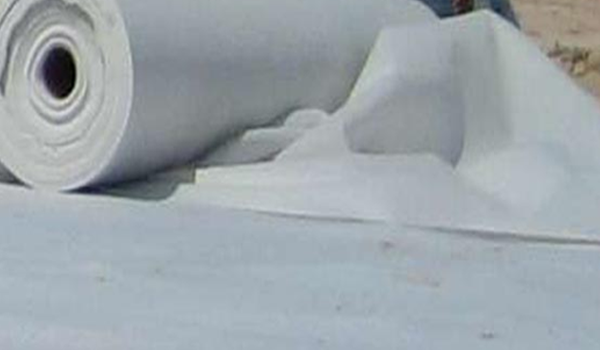
In the technical design of a geotube, geotechnical engineers review various laboratory test parameters based on ASTM (American Society for Testing and Materials) or ISO standards. Here is a comparison of the main technical parameters of the two materials:
| Technical Parameter | Test Standard | Woven Geotextile | Non-Woven Geotextile |
| Main Raw Material | – | Polypropylene (PP) / Polyester (PET) | Polypropylene (PP) / Polyester (PET) |
| Tensile Strength (Tensile Strength) | ASTM D4595 | Very High ( to ) | Low – Medium ( to ) |
| Elongation (Elongation) | ASTM D4595 | Very Low () | Very High () |
| Puncture Resistance (CBR Puncture) | ASTM D6241 | High | Very High |
| Water Flow Rate (Water Flow Rate) | ASTM D4491 | Low – Medium () | Very High () |
| Apparent Opening Size (AOS / ) | ASTM D4751 | Regularly structured () | Random & Flexible () |
| Main Structural Function | – | Reinforcement & Containment | Filtration, Drainage, & Protection |
The Specific Role of Geotextile in a Geotube System
A geotube works on the principle of solids retention (containment) and liquid release (dewatering). When a mixture of mud and water is pumped into the geotube under hydraulic pressure, the textile must withstand the internal expansion pressure while letting clear water seep out.
This is where the specific roles of each type of geotextile complement each other:
1. Woven Geotextile as the Main Wall Structure (Shell Material)
Because a geotube is pumped to a certain height and holds thousands of tons of material inside, the internal pressure on the geotube wall becomes very high.
-
Withstanding Pumping Pressure: Woven geotextile serves as the main load-bearing frame (load-bearing structure). Without the high tensile strength of woven material, the geotube would burst (rupture) during pumping.
-
Maintaining Shape (Dimensional Stability): Because woven material has low elongation, the geotube will not bulge excessively, which could compromise the structure’s appearance and geometric stability.
-
Coastal Abrasion Resistance: In coastal embankment structures, the woven layer is highly resistant to sand abrasion and wave impact.
2. Non-Woven Geotextile as Filter and Protection (Liner & Protection)
Although woven fabric can withstand mechanical loads, its pore size is often too large to retain fine mud particles (clay/silt). If only woven fabric is used, fine mud will escape with the water and the solids process will fail.
-
High Dewatering and Filtration Function: Non-woven geotextile is installed as an inner layer (inner liner) or combined as a composite. The random pores of non-woven fabric act as a micro-filter that retains solid particles down to micron size, while water continues to flow out freely and efficiently.
-
Protective Function (Bantam/Cushion Layer): When a geotube is placed on rough ground containing sharp rocks or debris, a non-woven geotextile layer is installed beneath the geotube (underlayment) to absorb impact and prevent tearing from punctures (puncture).
Analysis of the Geotube Dewatering Mechanism
The dewatering process using geotubes is one of the most environmentally friendly and energy-efficient innovations in waste management and dredging (dredging). The mechanism takes place in three main stages:
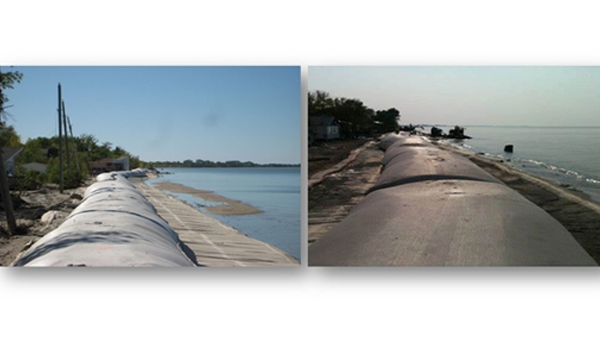
Stage 1: Pumping and Flocculant Addition (Filling)
Liquid sludge or river/sea dredging material is mixed with a special polymer (flocculant). This polymer binds fine particles in the sludge into large clumps (flocs). The mixture is then pumped through an injection port into a geotube made from a combination of woven and non-woven geotextile.
Stage 2: Dewatering (Filtration and Decantation)
As the pumping pipe fills the geotube, the water in the slurry begins to separate from the solid clumps. Water passes through the pores of the non-woven/woven geotextile, which acts as a semi-permeable filter medium. Soil particles or solid waste are 100% trapped inside the tube, while clear water exits through the fabric pores to the surrounding environment.
Stage 3: Consolidation (Consolidation)
After pumping stops, drying continues naturally through evaporation and gravity. The volume of solids inside the geotube will shrink by more than 60% – 80%, leaving dry, stable solid material. The consolidated geotube can then be permanently covered with soil as an embankment or opened so the solids can be disposed of.
Real-World Geotube Projects Across Sectors
The combination of woven and non-woven materials in geotubes has been widely applied in Indonesia and internationally. Here are the main sectors where it is used:
1. Coastal Reclamation and Shoreline Protection
-
Breakwaters (Breakwater): Large-diameter geotubes are filled with local sea sand and submerged offshore to dissipate wave energy before it reaches land.
-
Abrasion Protection & Coastal Embankments: Installed parallel to the shoreline to resist erosion caused by tides and tidal flooding.
2. Port, River and Lake Dredging (Dredging)
Dredging sediment from river mouths or port shipping channels often faces a shortage of land for drying sludge. With geotubes, dredged sludge is pumped directly into a compact dewatering area without the need for a giant settling basin (settling pond).
3. Industrial and Mining Waste Treatment (Tailings Dewatering)
The mining industry, palm oil mills (POME), textile factories and municipal waste treatment use geotubes to dewater sludge containing hazardous chemicals. The non-woven fabric ensures solid contaminants are safely isolated inside the tube.
4. Disaster Mitigation and Emergency Embankment Construction
When a river embankment leaks or tidal flooding threatens, geotubes can be installed and filled quickly using emergency water pumps to form temporary or permanent flood defenses.
Economic and Environmental Feasibility Analysis
Geotube technology based on woven and non-woven materials offers significant competitive advantages over conventional construction methods such as concrete retaining walls (gabion/sheet pile) or the settling pond method.
1. Cost Efficiency (Cost Efficiency)
-
Less Material Transport: Geotube filling uses local material available on site (such as sand or dredged sludge), cutting the cost of transporting armor stone or concrete from outside the project site.
-
Installation Speed: Geotube installation is much faster than casting reinforced concrete, directly lowering labor and heavy equipment rental costs.
-
Small Land Footprint: Geotube dewatering requires a much smaller operational area than conventional sludge-drying methods.
2. Environmental Sustainability (Environmental Sustainability)
-
Low Carbon Footprint (Low Carbon Footprint): Because it does not use much cement, river stone or steel, the carbon emissions from manufacturing and transport are much lower.
-
Supporting the Circular Economy: The high-quality PP and PET polymers used in geotextile can be recycled at the end of their service life.
-
Natural Infill and Ecosystem Integration: Over time, geotube structures in coastal areas can become covered by mangrove vegetation or coral reefs, blending naturally with the surrounding ecosystem without damaging marine habitats.
How to Choose the Right Geotextile Specifications for Geotubes
To ensure a project succeeds and avoids structural failure, here are some practical guidelines for engineers and developers when determining material specifications:
-
Perform a Soil Particle Size Analysis (Particle Size Distribution): Test samples of the mud/sand to be pumped in. If the fine mud content (silt/clay) is $>30\%$, include a non-woven geotextile layer or use a woven composite with high filter efficiency.
-
Calculate Pumping Pressure and Tube Height: The higher the target geotube height ($>2\text{ meter}$), the higher the woven geotextile tensile strength required (at least $100 \times 100 \text{ kN/m}$).
-
Evaluate Environmental Corrosiveness: For saltwater (coastal) locations or acidic/alkaline industrial waste, choose material based on pure Polypropylene (PP) with high UV Stabilizer additives so it resists degradation from sunlight and chemicals.
-
Run a Small-Scale Trial (GDT / Hanging Bag Test): Before ordering material at scale, perform a Geotextile Dewatering Test (GDT) in the laboratory to determine the right flocculant polymer dosage and test the filtration rate of the geotextile fabric.
Other Articles


POME Dewatering Geotube for Palm Oil Waste
POME Dewatering Geotube as an Effective Palm Oil Mill Effluent Treatment Method What Is a Geotube? Geotube is an advanced technological innovation in geosynthetics. It is made from geotextile with high tensile strength and high permeability for various construction applications. A Geotube structure must be designed with sufficient strength to withstand pumping pressure and provide […]

HDPE Geomembrane: Specifications and Advantages
The term HDPE plastic may be more familiar to the general public than HDPE geomembrane. In general, geomembrane is a civil engineering construction material closely associated with water containment. This article looks at HDPE geomembrane specifications, functions and advantages. To learn more about geomembrane in general and HDPE in particular, the following article covers its […]