Prefabricated Vertical Drain (PVD) for Soil Stability
In construction, especially on projects involving soft soil, speed and efficiency are key to successful execution. One innovation that has become increasingly common in recent years is the prefabricated vertical drain (PVD). This technology accelerates soil consolidation and significantly improves structural stability. This article takes an in-depth look at prefabricated vertical drains, including their function, benefits and applications in construction projects.
The prefabricated vertical drain is an innovative solution that has proven able to overcome many challenges in soft soil conditions. It is widely used in geotechnical and earthwork methods, saving time while improving the quality of the finished project. Let us explore this technology in more depth through several important aspects.
Origins and Development of the Prefabricated Vertical Drain

Every innovation has a historical background and a development process behind it. Understanding the origins of the prefabricated vertical drain helps us appreciate how important this innovation is in soil construction. PVD emerged as an answer to the difficulty of accelerating the consolidation of soft soil, which usually takes a very long time with conventional methods.
Initially, conventional methods for accelerating soil consolidation, such as vertical wick drains or traditional vertical drains, had a number of limitations. Installation was manual, took a long time and was often inefficient over large areas. As technology advanced, the concept of prefabrication emerged, allowing these drains to be mass-produced in factories and then installed more quickly on site.
The prefabricated vertical drain is made from high-quality materials that withstand both the installation process and the surrounding environment. The innovation is also supported by more modern and efficient materials and installation techniques, helping to speed up major construction projects such as highways, bridges, and industrial and commercial areas. In general, the development of this technology combines advanced materials and innovative design to tackle soft soil effectively.
Prefabricated vertical drain technology has undergone continuous development that keeps improving its strength, durability and ease of field application. Its use is spreading in many countries, including Indonesia, which has many construction projects in areas with soft soil and clay.
Components and Working Mechanism of the Prefabricated Vertical Drain

Every technology has main components that determine its function and effectiveness. For the prefabricated vertical drain, understanding its main parts and the mechanism behind them is essential for optimal field application. The technology consists of several components that work together to accelerate soil consolidation efficiently and effectively.
One of the main components of a PVD is the drain core, made from polypropylene or other synthetic materials. The core acts as the main channel that carries water from the soil to the surface during consolidation. Around the core is a geotextile filter that prevents soil particles from entering, keeping the channel clean and working at full capacity.
The working mechanism of the prefabricated vertical drain is based on draining water out of the soft soil layer through this drain core. When the drain is installed vertically in the ground, soil pressure pushes the water up to the surface through it. As a result, the surrounding soil consolidates faster than with conventional techniques, as water pressure gradually dissipates. Soil that was initially loose and unstable becomes denser and more stable.
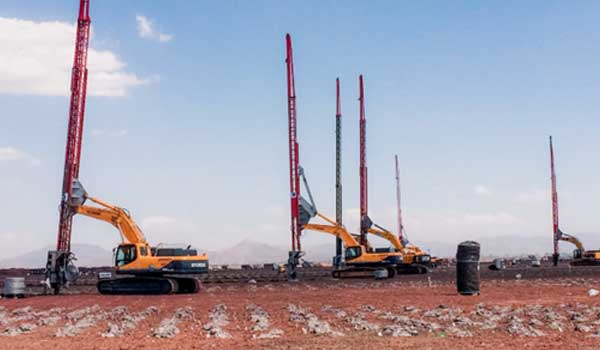
The drains are usually installed with heavy equipment that keeps them vertical and neatly positioned in the ground. Once installed, consolidation takes place around the drains, typically with the vertical wick method that uses gravity and the soil’s own pressure. PVD greatly accelerates soil consolidation, allowing subsequent construction to proceed faster and more safely.
Overall, these components and mechanisms help create more stable ground that is ready to carry the loads of buildings or other infrastructure. The prefabricated nature of the drains allows project owners to save time and money while improving the quality of the final result.
Applications of the Prefabricated Vertical Drain in Construction Projects
The prefabricated vertical drain has wide and varied applications in modern construction. Whether on large-scale infrastructure projects or high-rise buildings, stable and permanent ground is crucial. This technology can overcome the soft soil challenges that have long been a major obstacle in construction.
Prefabricated vertical drains are typically used in projects such as toll roads, skyscrapers, port wharves and other water infrastructure. In each of these projects, speed and soil stability are key factors for successful execution. With PVD, construction time can be shortened significantly, so projects finish on schedule and within budget.
This technology can also substantially improve soil quality. Soil that was initially soft and unable to carry loads becomes denser and more stable through PVD-assisted consolidation. This in turn reduces the risk of landslides, collapse and structural damage in the future. Because the process is so effective, using prefabricated vertical drains also reduces the need for other building materials and lowers environmental impact.
In the context of sustainable development, PVD can also be integrated with other methods such as reinforced soil and soil stabilization technology. On site, skilled workers and suitable heavy equipment are needed to ensure the drains are installed smoothly and effectively. The prefabricated vertical drain is therefore one of the best solutions for fast, safe and sustainable infrastructure development.
Applications of prefabricated vertical drains across projects:

- Road and bridge infrastructure
- High-rise buildings and housing
- Improving the stability of coastlines and port moorings
- Treating clay and soft soil in general
- Industrial areas and shopping centers
FAQs about the Prefabricated Vertical Drain
What are the main benefits of using a prefabricated vertical drain?
The main benefits of PVD are faster soil consolidation, improved stability of soft soil, significantly shorter construction time and lower overall project costs. The technology also reduces the risk of future structural damage thanks to denser, more stable ground.
How is a prefabricated vertical drain installed?
The drains are installed vertically using heavy equipment that keeps them perfectly upright. After installation, the soil consolidates naturally through a process accelerated by the drains, so the ground becomes stable in a shorter time than with conventional methods.
Is the prefabricated vertical drain suitable for all soil types?
PVD is best suited to soft soil and clay that require fast, effective consolidation. For hard or gravelly soil, other methods may be more suitable. A geotechnical study should be carried out first to confirm that the technology is appropriate.
How long does prefabricated vertical drain installation take?
Installation time depends on the size of the area and the depth of soil to be consolidated. In general, installing one meter of drain can be completed within a few hours. After installation, soil consolidation can take several weeks depending on soil conditions and the method used.
Is the prefabricated vertical drain environmentally friendly?
Yes. Because installation is fast and uses few chemicals or other additives, the technology is considered environmentally friendly. Reduced use of other building materials and shorter construction time also lower the overall environmental impact.
Conclusion
Prefabricated vertical drain technology is an innovation that breaks through the limits of soft soil construction. Through advanced components and an efficient working mechanism, PVD accelerates soil consolidation, improves stability and reduces the risk of future structural damage. Its wide use in modern infrastructure projects proves that it is an effective solution with significant benefits in time, cost and quality.
By understanding and applying the prefabricated vertical drain correctly, contractors and property developers can ensure their projects run smoothly, safely and sustainably. The technology not only simplifies construction, but also supports Indonesia’s increasingly advanced and globally competitive infrastructure development.
Other Articles

Geonet as a Drainage Liner
Every construction project needs a drainage system that can carry away liquids that would otherwise cause unexpected problems. Geonet drainage is one of the most effective solutions to the conditions commonly found in geotechnical construction, such as saturated soil, waterlogged ground, a bulging waterproof liner, seepage and leaks. To deal with and prevent these unexpected […]