With its high rainfall and distinctive hilly terrain, Bogor is an ideal location for developing ecotourism areas. Our client initiated the construction of an environmentally friendly tourism destination with a strong emphasis on preserving its natural surroundings.One masterpiece designed for this area was a network of interconnected artificial lakes and rivers. Its main purpose was not only to beautify the landscape and provide photo spots for visitors, but also to serve an ecological role as a rainwater retention area and artificial habitat supporting local biodiversity. PETRA's team was entrusted with lining the lake and river beds.
On-Site Challenges
Building an artificial lake in a largely natural area presents distinct challenges. Soil in Bogor generally has fairly high porosity, meaning it readily absorbs water. If these excavated artificial lakes and rivers were left without a dedicated waterproof liner, the water would quickly infiltrate the ground below. As a result, the lake could shrink drastically or even dry out during the dry season.A second challenge was the subgrade (subgrade), which was rocky, uneven, and filled with remaining tree roots. Laying waterproof lining directly over this rocky surface would create a high risk of tears or leaks caused by sharp objects. The client also set strict conditions: the solution had to be environmentally friendly and durable, without extensive conventional concrete that could diminish the site's natural character.
Our Smart Solution
To address these demanding challenges, PETRA's engineering team designed a dual-layer system combining modern geosynthetic materials that outperform concrete. These materials are far more flexible, can be installed rapidly, and have a lower carbon footprint.Our chosen solution combined HDPE Geomembrane as the primary water barrier with protective PET Non-Woven Geotextile underneath. Combining these two robust materials is an international technical standard for modern artificial lake and pond projects.
Design and Material Selection
The following core material specifications were selected by PETRA's team to ensure the project ran smoothly:250 gsm PET Non-Woven Geotextile
Before laying the geomembrane, we installed a protective cushion of Non-Woven Geotextile made from Polyester (PET), weighing 250 gsm, directly over the subgrade. This layer serves a crucial protection and separation (separator) function. The PET material protects the geomembrane sheet above it against possible punctures (puncture) from sharp stones or roots remaining in the subgrade.21 mm HDPE GeomembraneThis material provides the primary waterproof liner (impermeable layer). We selected a 1 mm High-Density Polyethylene (HDPE) geomembrane. Why exactly 1 mm? This thickness offers an ideal balance of flexibility to follow the artificial river's curves and exceptional durability under the pressure of the lake's water volume. HDPE is also known for its extreme resistance to direct sunlight and UV exposure, preventing cracks and ensuring that water cannot leak into the ground.
On-Site Installation Process
For those interested in the on-site process, experienced PETRA technicians performed the installation directly. First, we ensured that the excavated lake area was compacted and cleared of protruding sharp debris. Once the surface was ready, rolls of PET non-woven geotextile were laid over the entire floor and up the excavated slopes.The 1 mm HDPE geomembrane sheets were then carefully laid over the geotextile. Joining the individual sheets was a critical step. We used a specialized geosynthetic welding machine (hot wedge welder) with a double track welding method. This double-weld method allowed our team to pressure-test the air channel between the seams, confirming that the material was fully joined without even a hairline gap. After passing the leak test, the material edges were secured firmly in an anchor trench around the lake perimeter to keep the liner stable and prevent slippage.
A Satisfying Final Result
The artificial lake and river in this Bogor ecotourism area now function perfectly. Water levels remain stable throughout the seasons without seepage into the ground. Visually, the geomembrane edges were neatly concealed with natural river stones and waterside plants, creating an appearance that blends completely with nature.Beyond technical performance, this project also prioritizes aesthetics. A river that functions not only as a waterway but also as a landscape feature requires a neat, natural finish integrated with its surroundings. The geomembrane installation therefore focused not only on impermeability but also on visually concealing the material or combining it with cover elements such as soil, stone, or vegetation to create a more natural appearance.Overall, this project shows that applying geosynthetics to water features such as lakes and rivers is not limited to technical considerations; site conditions, geometric challenges, and aesthetic requirements must also be addressed. The combination of HDPE geomembrane and PET non-woven geotextile provides an effective system for optimal watertight lining.


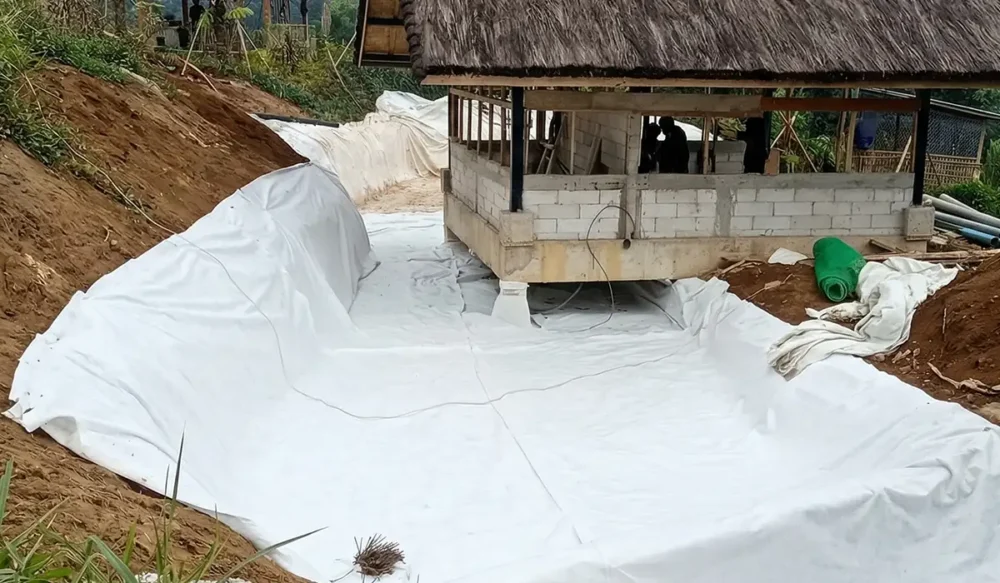 Before laying the geomembrane, we installed a protective cushion of Non-Woven Geotextile made from Polyester (PET), weighing 250 gsm, directly over the subgrade. This layer serves a crucial protection and separation (separator) function. The PET material protects the geomembrane sheet above it against possible punctures (puncture) from sharp stones or roots remaining in the subgrade.2
1 mm HDPE Geomembrane
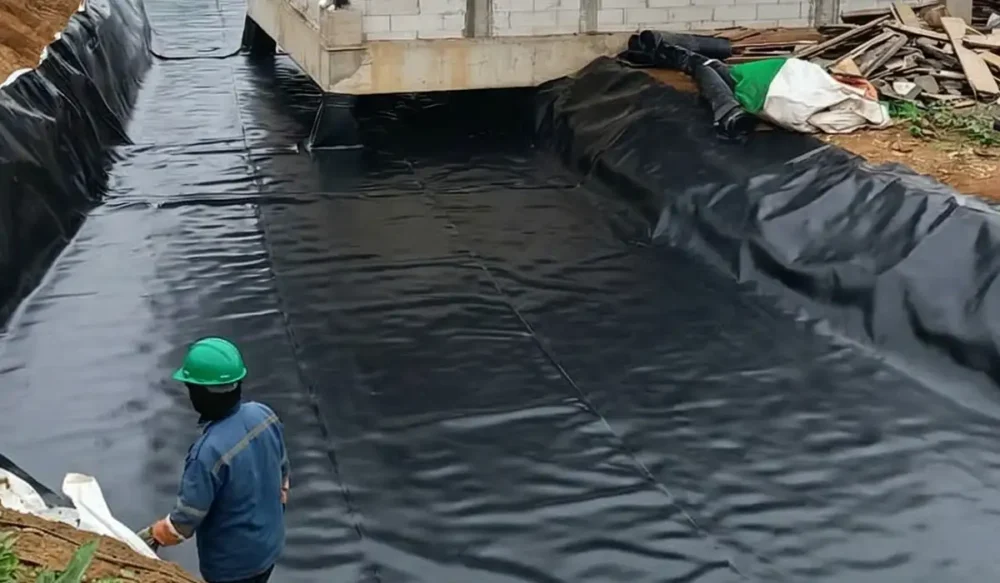 This material provides the primary waterproof liner (impermeable layer). We selected a 1 mm High-Density Polyethylene (HDPE) geomembrane. Why exactly 1 mm? This thickness offers an ideal balance of flexibility to follow the artificial river's curves and exceptional durability under the pressure of the lake's water volume. HDPE is also known for its extreme resistance to direct sunlight and UV exposure, preventing cracks and ensuring that water cannot leak into the ground.