Building a Modern Fish Pond with HDPE Geomembrane

Background: Why Switch from Earthen and Concrete Ponds?
Inland fish farming today demands high efficiency. In densely planned areas like BSD City, land must be used to the fullest. The project owner realized early on that a conventional earthen pond carries high risks. Soil permeability (its ability to let water through) varies. If the soil is porous, water keeps seeping away and is lost (seepage), which means water pumping costs soar. A geomembrane fish pond solves this problem.
On the other hand, a concrete pond is not ideal either. Besides very high construction costs and long build times, concrete is prone to micro-cracks caused by ground movement or temperature changes, which eventually lead to invisible leaks.
Technical Challenges on Site
The main challenge of this project was not simply digging a hole and filling it with water. The team had to meet several technical parameters:
- Stable Water Quality: Fish are very sensitive to pH changes. If the water is in direct contact with the subgrade, soil acidity can spoil the pond water quality.
- Waste Management (Ammonia): Leftover feed and fish waste accumulate on the pond floor. In an earthen pond, this waste soaks into the mud and produces toxic ammonia gas that can cause mass fish deaths.
- Material Durability: The liner must withstand intense UV exposure and extreme temperature fluctuations without degrading or becoming brittle.
Technical Solution: 0.75mm HDPE Geomembrane for the Fish Pond
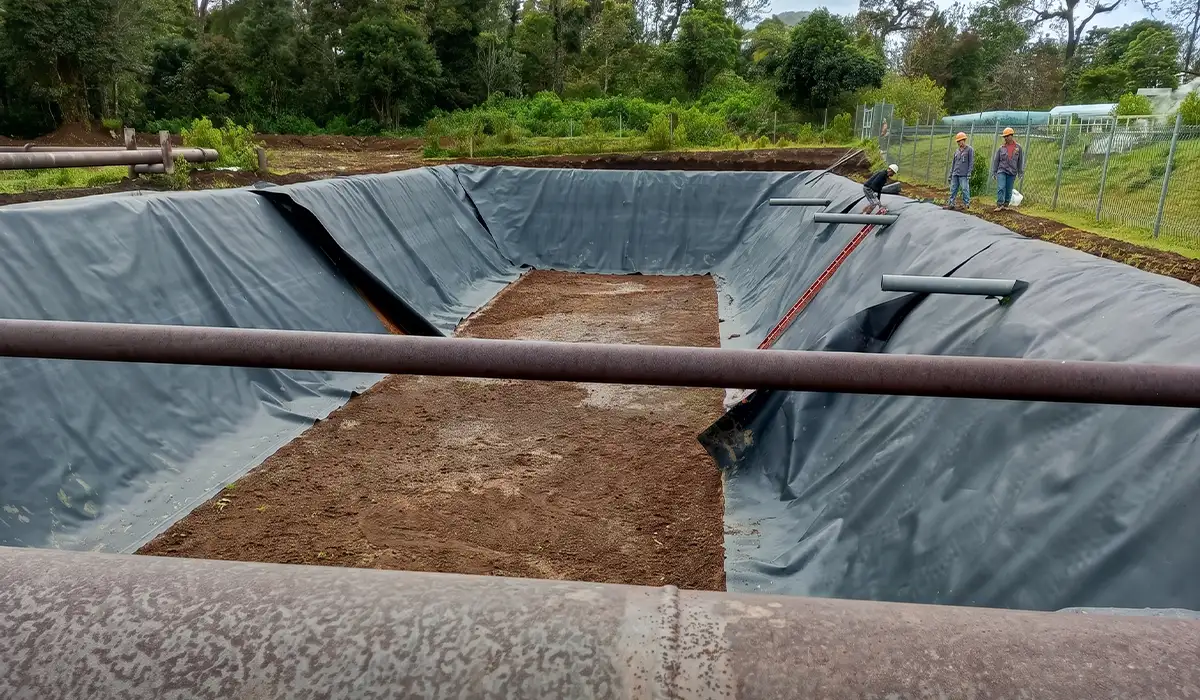
To meet these challenges, the project team in BSD City chose 0.75mm thick HDPE Geomembrane. Why 0.75mm?
A thickness of 0.75mm is the sweet spot for medium to large fish ponds. Technically, the material is thick enough to resist puncture from small stones in the subgrade, yet still very flexible for bending and following the pond’s corner contours.
The HDPE (High-Density Polyethylene) material from Petra Nusa Elshada contains UV protection (Carbon Black), so even after years in the sun its polymer structure will not crack easily. In addition, HDPE is food-grade and inert (it does not react with chemicals), making it 100% safe for the living ecosystem inside the pond.
Technical Installation Process
Installation requires specialist skills. After the soil was excavated and compacted (prepared so it was free of sharp stones), the geomembrane sheets were deployed. To join the sheets, the technicians did not use glue but Hot Wedge Welding (double-track heat welding).
The welding machine melts the edges of the geomembrane and fuses them permanently. This method produces a double seam that is even stronger than the parent material. Around the outlet pipe (Central Drain), Extrusion Welding was used to create a perfect watertight seal around the rigid material. At the pond rim, the geomembrane was locked in an anchor trench so that it would not shift when the pond was filled with thousands of liters of water.
Project Results and Evaluation
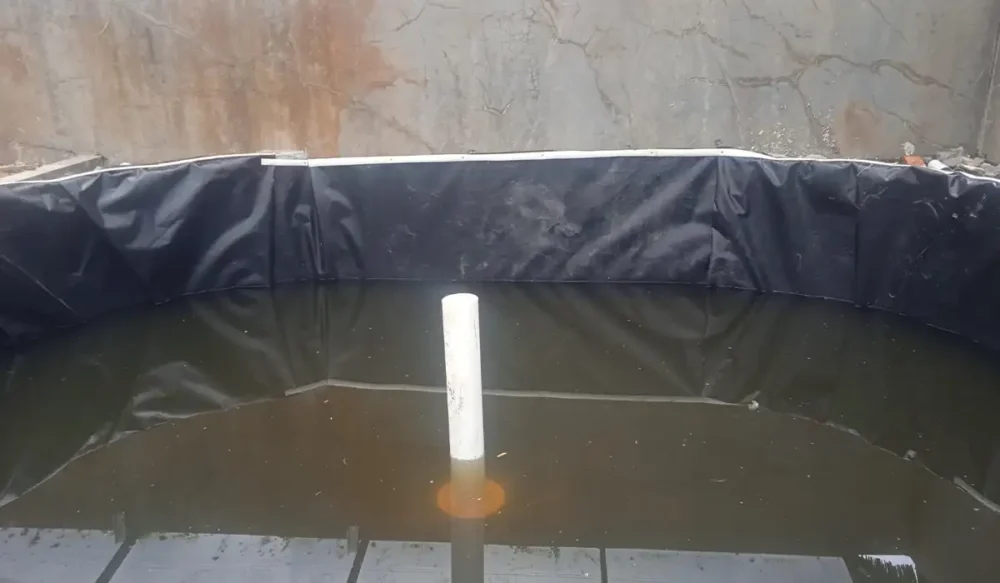
After the pond was installed and began operating, the 0.75mm HDPE Geomembrane delivered very significant results, including:
- Leaks and Water Loss Completely Prevented
HDPE permeability is close to zero. The problem of seepage, or water soaking into the ground, disappeared entirely. The water volume stays stable, and the project owner can cut the electricity costs of water pumping drastically. - Water Quality Kept Under Control
Because there is a separating layer between the water and the soil, the water pH is much more stable. The water is not contaminated by minerals or acidic substances from the subgrade, which keeps the pond ecosystem very healthy for fish growth. - Higher Farming Efficiency (Better FCR)
The water in geomembrane-lined ponds tends to be warmer and more stable, which stimulates the fish’s appetite. As a result, the Feed Conversion Ratio (FCR) improves, and feed is converted more efficiently into fish weight. - Easier Cleaning and Harvesting
The smooth, even surface of HDPE Geomembrane prevents fish waste and leftover feed from sticking. Waste is automatically swept to the lowest point of the pond toward the central drain. At harvest time, the process is very fast. No more fish hiding or getting stuck in thick mud. The fish come out clean, without a strong earthy smell.
Conclusion
This BSD City project proves that investing in the right material at the start of construction saves operating costs (OPEX) in the future. Using 0.75mm HDPE Geomembrane is not just an anti-leak liner, but an engineered system designed to maximize fish farming productivity.
Other Articles

1.5mm Agricultural Pond Geomembrane in Tangerang
Background & Challenges This agricultural project in Tangerang needed a massive raw water storage pond to serve the irrigation system of a plantation covering more than ten hectares. Initially, the most conventional option was to dig an ordinary earth pond, before an agricultural pond geomembrane was chosen instead. But let’s look at it from a […]

0.75mm Geomembrane for a Reservoir Project in Cianjur
Project Background: The Classic Challenge of an Embung (Small Retention Reservoir) This project is located in Cianjur, West Java, an area that relies heavily on water availability for agriculture and plantations. The main need was to build an embung, or retention pond, that could hold as much rainwater and surface runoff as possible, making a […]