


Visual Soil CBR Identification in the Field

Soil CBR identification. To determine the CBR of a soil precisely, tests must be carried out in accordance with SNI 1738:2011 using a field CBR apparatus or a DCP (Dynamic Cone Penetrometer).


This requires certified specialists to perform the CBR test, interpret and process the data, and make recommendations based on the results. For non-specialists, however, CBR can also be identified visually.
Read also
Dealing with expansive soil
- Very soft soil (CBR < 0.4%) can be identified by several visual parameters
- The soil squeezes out between your fingers when squeezed
- A person standing on this soil sinks > 7.5 cm
- Soft soil (CBR 0.4%- 0.8%) can be identified by several visual parameters
- The soil deforms under light finger pressure
- A person standing on this soil sinks 5.0- 7.5 cm
- Medium soil (CBR 0.8% – 1.6%) can be identified by several visual parameters
- The soil deforms under strong finger pressure
- A person standing on this soil sinks 2.5 cm
- Stiff soil (CBR 1.6% – 3.2%) can be identified by several visual parameters
- The soil indents deeply when pressed with a thumb
- A passing pickup truck leaves ruts of 13-25 mm
- Very stiff soil (CBR 3.2% – 6.4%) can be identified by several visual parameters
- The soil starts to indent when pressed with a thumb
- A loaded dump truck leaves ruts of 25-75 mm
- Hard soil (CBR > 6.4%) can be identified by several visual parameters
- The soil is hard to indent with a thumb
- A loaded dump truck leaves no ruts

Other Articles

What Is Multifilament Woven Geotextile?
Woven Geotextile Multifilament Yarn / Woven Polyester, or multifilament geotextile, is a woven geotextile with a uniaxial or biaxial pattern, used specifically for extra reinforcement, especially where the material must have high tenacity and adequate water absorption. The benefits of this material include very high strength of up to 200 kN/m, corrosion resistance, water permeability, […]
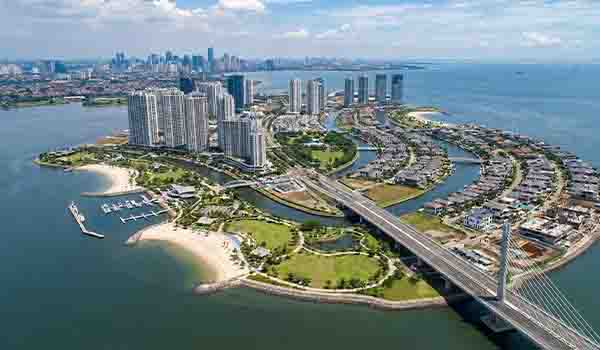
Island Reclamation Projects: Process and Materials
Have you ever heard the term reclamation while reading news about urban planning or large-scale infrastructure projects? Simply put, this topic is often associated with creating new land over the sea or open waters. With populations soaring and available land shrinking day by day, island reclamation has become one of the key civil engineering solutions […]

The Environmental Impact of Geosynthetics
What Are Geosynthetics? Geosynthetics are products made from various polymers, such as Polyethylene (PE), Polypropylene (PP), Polyester (PET), Polystyrene (PS) and others. To understand the environmental impact of geosynthetics, it helps to know that these polymers also vary in their physical parameters and processing methods. For example: Polyethylene is divided into several types based on […]