


Island Reclamation Projects: Process and Materials
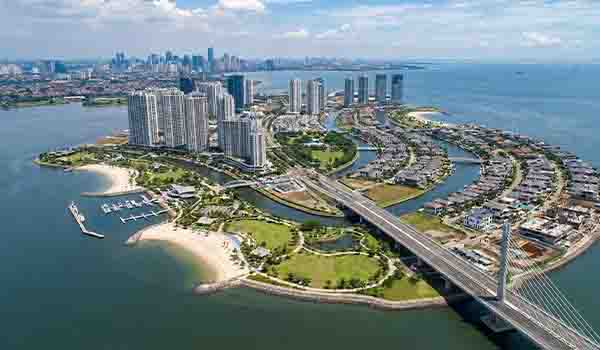
Have you ever heard the term reclamation while reading news about urban planning or large-scale infrastructure projects? Simply put, this topic is often associated with creating new land over the sea or open waters. With populations soaring and available land shrinking day by day, island reclamation has become one of the key civil engineering solutions of the modern era.
But did you know that the process behind island reclamation is not as simple as dumping soil or sand into the open sea? There is a very long planning process, advanced technology and special reclamation materials that support the new land so it is stable, safe to live on or usable as a center of industrial activity. From dredging the seabed to applying the essential functions of geosynthetics, everything must be calculated precisely.
In this article, we will cover everything about this type of engineering: its definition, why these projects matter for urban planning, the technical construction stages, the geotechnical materials used, and an objective look at the impacts of reclamation. Read the full explanation below!
What Exactly Is Island Reclamation?
Literally, island reclamation, or the formation of new land, is an engineering process to create stable land from an area previously covered by water, whether sea, lake, swamp or shoreline. According to the Indonesian Ministry of Public Works and Housing (PUPR), coastal reclamation is an activity in coastal areas carried out to increase the benefits and value of land resources for environmental and socio-economic purposes through filling, land drainage or artificial drainage systems.
This civil engineering process essentially “takes” or “converts” water areas into solid land so it can be used for various essential human needs. Interestingly, this practice is not a new invention of this century. Countries like the Netherlands have practiced polder reclamation for hundreds of years to create farmland and protect their mainland, which lies below sea level. However, thanks to rapid developments in heavy equipment and soil mechanics, reclamation today can be carried out on an extraordinarily massive scale to build exclusive self-contained cities, port infrastructure and even international airports.
Why Do We Need Reclamation?
You might wonder: with the earth being so vast, why do people still go to great expense to create new land on the sea? Naturally, there are several urgent and strategic reasons that drive many countries and metropolitan cities to undertake these mega-projects:
- Limited Urban Land:
In coastal metropolitan cities that are centers of national activity, urbanization is unstoppable. Extreme population density sends land prices soaring, and available vacant land is close to zero. Reclamation becomes a logical, strategic option for opening up new land for vertical and horizontal housing without forcibly evicting dense settlements on the original mainland. - A Catalyst for Economic Growth:
Man-made land directly bordering the open sea is ideal for conversion into a deep seaport, industrial complexes and special economic zones. This new geographic position speeds up logistics and export-import flows, ultimately boosting foreign exchange earnings and the national economy significantly. - Coastal Protection System:
In many scenarios, land development along the shoreline is also designed as a natural barrier against sea waves and a shield that dampens wave energy to prevent coastal erosion. With an accurate water management masterplan, the newly created land can minimize the threat of tidal flooding. - Large-Scale Infrastructure Development:
Many world-renowned international airports are built on reclaimed sea fill. Kansai International Airport in Osaka, Japan, and the expansion of Changi Airport in Singapore are real proof. Building over the sea is chosen because it minimizes noise pollution for residential areas and provides airspace free of skyscraper obstructions.
The Long Stages of the Reclamation Process

Engineering safe and strong land over water is certainly not a job that can be finished in months. The land reclamation process demands specialist geotechnical expertise, years of construction and extremely strict technical supervision. Here are the standard stages contractors must go through:
- Thorough Survey and Planning
The first and most essential step is a comprehensive project feasibility study. Civil engineers and marine experts must analyze a range of data, from seabed topography and the hydrodynamic strength of currents to wind profiles and local marine ecology surveys (such as coral reefs and seagrass). In addition, underwater mechanical testing or a soil test is mandatory to ensure the subgrade can carry thousands of tons of fill material. At this point, the legal Environmental Impact Assessment (AMDAL) document is also finalized and must receive government approval. - Building Retaining Embankments
Before millions of cubic meters of sand are sprayed in, the project boundary must first be enclosed by a retaining embankment, better known as a seawall. This massive structure has two vital functions: first, as a mechanical barrier so the fill sand inside doesn’t leak out or get carried away by currents. Second, it later acts as a protective belt for the artificial island against the force of the waves once the project is completed. Its main materials are usually giant boulder rock, precast concrete walls or innovative geotube systems. - Filling and Backfilling
Once the protective embankment is firmly in place, the next phase is transporting fill material to fill the enclosed sea basin. This operation generally uses advanced dredgers such as a Trailing Suction Hopper Dredger (TSHD). The vessel sucks clean sand from an offshore borrow area, then pumps it directly through high-pressure pipelines (the hydraulic filling method) into the new land enclosure. Filling continues non-stop until the ground level exceeds the highest tide elevation required by the design. - Consolidation and Stabilization
Freshly pumped sand or mud is very wet, highly porous and very prone to shifting. If a contractor rushed to build at this stage, the structure would certainly sink badly due to settlement. That is why compaction or consolidation is absolutely necessary. Water still trapped between the pores of the fill must be “squeezed” out. This is the stage where soil reinforcement technology shows its strength, cutting consolidation time that would ideally take decades down to just months.
Main Materials for Reclamation Projects
To create new land on this scale, you and your construction team need a large supply of reclamation materials. The main basic elements include:
- Dredged Sea Sand:
This is the favorite fill material because its physical and chemical properties make it relatively easy to pump long distances through pipes, it has good capillarity and permeability for compaction, and it is abundant in the sea. - Hard Rock (Boulders):
Placed specifically around the outer perimeter of the land as a sturdy structural protection layer (breakwater) that breaks the kinetic energy of the waves. - Clay / Top Soil:
Applied later as the uppermost layer of the fill so that green open spaces and trees can grow well across the island.
In fact, in the modern construction era, relying only on natural excavated material is very inefficient and high-risk. To lock in subgrade stability and speed up the project timeline, construction experts now rely heavily on one revolutionary geotechnical technology: synthetic polymer materials.
The Important Role of Geosynthetics in Island Reclamation
If you are active in civil engineering, marine construction or infrastructure, you surely know how much we rely on the functions of geosynthetics to solve consolidation problems on soft, waterlogged soil. Geosynthetics are a family of factory-made polymer materials designed specifically to engineer the geotechnical characteristics of soil. In island formation, their applications are very broad and irreplaceable:
Woven and Non-Woven Geotextile
Geotextile is usually spread widely over the seabed before sea sand is sprayed on top. The sheet acts as an essential separation layer, preventing clean sand from mixing with the soft mud on the seabed. More specifically, Non-Woven Geotextile is widely used on seawall faces thanks to its excellent filtration function: it stops sand grains from seeping out of the embankment while still letting seawater flow freely. Meanwhile, Woven Geotextile with high tensile strength is used for basal reinforcement to spread the tonnage of the fill above it evenly.
Prefabricated Vertical Drain (PVD)
This product is the most revolutionary innovation in consolidating ultra-soft clay. A PVD is a long geosynthetic drainage strip driven through the soil layers with a heavy equipment rig to depths of tens of meters. It works like a giant “drinking straw” that provides a fast vertical path for water trapped in the soil pores to escape to the surface when the area is loaded with a temporary surcharge. Without PVD, consolidation of seabed mud can drag on for decades.
Geobags and Geotubes
These two materials are often used as a complement to, or even a replacement for, boulder rock when building temporary embankments. Shaped like giant pillows or tubes made of strong geotextile fabric, these containers are filled with local sand. This method drastically cuts logistics costs compared with bringing in giant quarry stone from the mainland.
The construction schedule of modern reclamation projects depends heavily on how precisely these geosynthetic products are selected and specified in the field.
Positive and Negative Impacts of Reclamation

Like a coin with two opposite sides, these sea-filling mega-projects always spark lively discussion about the impacts of reclamation. As someone with technical understanding, you should view this issue in a balanced and objective way.
On the positive side, reclamation projects contribute massively. The creation of new commercial land stimulates hundreds of thousands of jobs, from construction to the commercialization of the city. This clean land allows urban planners to design far more ideal layouts, provide well-arranged green open spaces, raise the standard of local marine tourism and create a strong ripple effect on regional revenue (PAD) from the property sector.
On the other hand, the negative impacts of reclamation can turn into an ecological threat if it is managed without strictly following AMDAL recommendations. Mass dredging and the dumping of fill material will stir up and cloud the water quality in the work zone. If not contained, these suspended sediment particles can choke deep-sea coral growth and damage coastal ecosystems. Changes in the shape of the shoreline also risk bending natural current paths, which can cause erosion on other beaches. That is why environmentally friendly construction procedures today require the installation of a Silt Curtain (a sediment curtain made of non-woven geotextile) to contain the spread of mud while the project is active.
Examples of Successful Projects Around the World

To get a sense of how colossal the potential of this civil engineering is, let’s look at some pioneering sea reclamation projects around the world that have succeeded in layout and function:
- Palm Jumeirah, Dubai (United Arab Emirates):
This waterfront architectural masterpiece is perhaps the most famous man-made land of this century. Designed in the stunning shape of a majestic palm tree when seen from satellite imagery, this reclamation in the Persian Gulf has extended Dubai’s coastline many times over. More than just land, this giant project has become a global hub for elite property, filled with world-class ultra-luxury tourist resorts. - Tuas and Marina Bay Expansion, Singapore:
Born as an independent nation with critically limited natural land, Singapore relies absolutely on reclamation to survive. Since independence, geotechnical innovation has helped Singapore expand its total territory by more than 20%. And it doesn’t stop there: it is now completing Tuas Mega Port, whose entire facilities and infrastructure sit firmly on reclaimed land. - Pantai Indah Kapuk (PIK), Jakarta:
Nationally, the modern landscape of Pantai Indah Kapuk (especially PIK 2 and the island expansion around Jakarta Bay) has become the latest benchmark for integrated functional reclamation in Indonesia. What used to be coastal waters has transformed into an economic center, the capital’s most modern residential clusters and a well-planned seaside culinary destination.
Conclusion for Future Development
Building a structure on a foundation over open water is certainly not without sharp engineering and ecological challenges. In reality, however, amid today’s population boom, island reclamation is no longer seen merely as a show of aesthetic ambition, but as an essential and strategic way to save coastal cities from overcrowded urban space.
From the discussion above, you now surely have a clear picture that behind these grand seafront districts lie complex soil bearing capacity calculations, dozens of specialist dredgers coming and going and, most crucially, geotechnical innovations such as geosynthetic materials (Geotextile, PVD, Geotube/Geobag) working non-stop underground to keep the system stable without compromise.
One key to the sustainability of all this is maintaining a balance between the pressing need for urban economic development and the commitment to preserving marine ecology. If you are a decision-maker planning a coastal construction project, road infrastructure upgrade or soft soil development, the wise step you can always rely on is to make sure the project is supplied with the best-quality geotechnical structural materials with proven specifications!
Need a Consultation for Your Project?
Feel free to consult us about your geosynthetic material needs. We supply a wide range of high-quality geosynthetics ready to ship throughout Indonesia. Let’s discuss your project needs now!
Check our catalog: Click here
Chat on WhatsApp Now: Click here
Remember Geosynthetics, Remember Petra!
Other Articles


Geomembrane Design Part 1: How Gas Bubbles Form
Many geomembrane lining systems fail in wastewater treatment ponds and in ponds in the plantation and livestock sectors. Geomembrane gas bubbles that form beneath a lining system are usually caused by a chain of events: the lining system leaks, liquid collects under the geomembrane, methane gas forms, and the trapped gas gradually lifts the geomembrane. […]