


Shrimp Farm Success with 0.3mm Viroline Geomembrane

Project Background and Challenges
The Tegal coast has outstanding potential for shrimp farming. However, this 14,000 m² shrimp farm project, which ended up using 0.3mm geomembrane, initially faced the classic problems of conventional earthen ponds. Traditional ponds that rely only on clay have unpredictable porosity.
The main challenges facing the farm owner were:
- Seepage and Loss of Water Volume
The brackish water in the ponds kept dropping due to capillary seepage into the ground, driving up the operating cost of pumping water. - Cross-Contamination (Cross-Contamination)
Without an isolation layer, there was a high risk of groundwater carrying pathogens or heavy metals seeping into the shrimp ponds. - Sludge Accumulation
Leftover feed and shrimp waste mixing with the pond bottom soil creates anaerobic zones. This triggers spikes in toxic gases such as Ammonia (NH3) and Hydrogen Sulphide (H2S), which are deadly to shrimp.
You will surely agree that letting these problems happen in a 1.4-hectare pond is investment suicide. That is why a comprehensive technical intervention was needed.
The Material: Why 0.3mm Geomembrane for a Shrimp Farm?
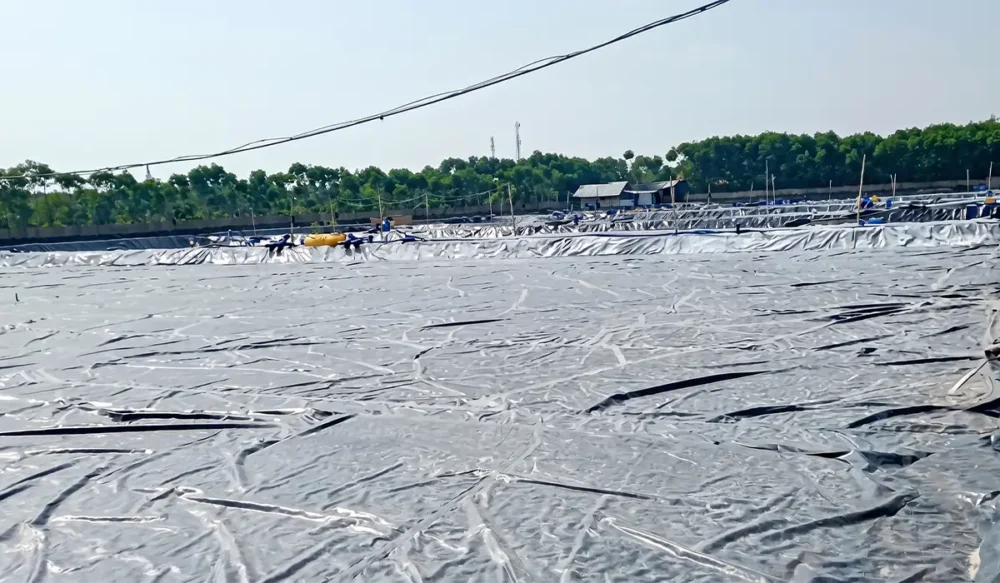
After an engineering assessment, it was decided that lining the pond bottom and walls with Geomembrane 0.3mm viroline was the optimal solution. But why 0.3mm, and why Viroline?
Technically, geomembrane is made from High-Density Polyethylene (HDPE) blended with carbon black, antioxidants and UV stabilisers. The 0.3mm (300 micron) thickness was chosen because it offers the perfect balance between tensile strength and material flexibility.
- If it is too thin (below 0.2mm), the material is prone to tearing when stepped on or under hydrostatic water pressure.
- If it is too thick (e.g. 0.75mm and above), installation around pond curves becomes too stiff and material costs go over-budget for a standard shrimp farm.
Viroline geomembrane is designed with near-total impermeability. It also withstands the intense UV exposure of the Tegal coast and resists the chemicals and probiotics often used during the farming cycle.
Technical Execution and Installation on Site
Turning 14,000 m² of land into bio-secure ponds is not as simple as rolling out a mat. The Petrane installation team had to apply strict technical standards. Here are the work phases:
1. Subgrade Preparation
Before the Viroline geomembrane is rolled out, the subgrade must be compacted and levelled. Never underestimate this stage! Sharp rocks, tree roots and snail shells must be removed completely. If even one sharp stone is left behind, tonnes of water pressure from above can puncture the geomembrane (puncture).
2. Deployment and Welding
The Viroline geomembrane sheets, delivered in large rolls, are deployed according to the panel layout designed by our engineers. To join the sheets, the team uses a Double Hot Wedge Welder. This machine heats both HDPE edges until they melt and presses them with high-pressure rollers, creating a double seam that is fused at the molecular level. For pond corners and the central drain pipe, Extrusion Welding is used so the seal is 100% tight.
3. Anchor Trench System
To stop the geomembrane from sliding towards the centre of the pond when filled with water or lifted by strong winds, the edges are locked in an anchor trench. A trench of about 50×50 cm is dug around the pond rim, the geomembrane edge is laid into it and backfilled with compacted soil. This provides excellent mechanical stability.
Final Results and System Performance
After the 14,000 m² project was tested (a leak test using an air pressure test on the double seam channels), the results were very satisfying.
The geomembrane worked effectively right away:
- Zero Leakage (Zero Leakage)
Pond water volume is now stable. Electricity costs for pumping fell sharply because water no longer seeps into the ground. - Perfectly Isolated Water Quality
The Viroline layer acts as a protective barrier. Acidic soil or contaminated groundwater can no longer disrupt water quality parameters (pH, salinity and Dissolved Oxygen stay stable). - Easier Waste Management
Because the pond bottom is lined with smooth plastic, there is no more soil mixing with waste to form black sludge. Shrimp waste and leftover feed are easily swept along by the paddle wheel current and collect neatly at the central drain for discharge. The ponds are very easy to clean at harvest time!
Conclusion
This 14,000 m² shrimp farm project in Tegal is real proof that investing in the right material brings major operational benefits. By using Geomembrane 0.3mm viroline, the risk of mass shrimp mortality caused by poor pond bottom quality can be kept to a minimum.
Other Articles


HDPE Geomembrane Pond Liner for a Farm Reservoir in Bogor
Background: Percolation and Unpredictable Weather Bogor is known as the City of Rain. However, weather anomalies and climate shifts mean rainfall can no longer always be predicted. For farmers, going without water for just a few weeks can lead to total crop failure (puso). To deal with this, farmers need an embung (a small retention […]