


Landfill Liner with HDPE Geomembrane in West Bandung

Background: The Serious Threat of Leachate at Landfills
This TPA (landfill) project in West Bandung was designed as a large-scale facility for daily waste volumes, and its landfill liner had one clear environmental task: how to contain millions of liters of highly corrosive leachate so it does not pollute the surrounding environment.
You need to understand that leachate contains a complex mix of heavy metals, ammonia and hazardous organic compounds. Without a solid barrier, the soil beneath the landfill would be directly exposed. That is why the engineers on this project needed a liner that is not only waterproof but also extremely resistant to aggressive chemical reactions, ultraviolet (UV) exposure and cracking under the weight of tons of waste.
Project Specifications & Material Choice
To meet these technical challenges, the liner selected was 1.5 mm Geoprotec HDPE Geomembrane, produced to resin quality standards equivalent to SOLMAX. Here is the project data:
- Project Location: West Bandung Regency, West Java.
- Material Used: 1.5 mm Geoprotec HDPE Geomembrane.
- Total Installed Area: 60,760 m².
- Main Function: A primary impermeable barrier to prevent leachate from leaking into the ground.
The 1.5 mm thickness was chosen specifically because it offers the right structural balance. On the one hand, the sheet is flexible enough to adapt to the contours of the landfill. On the other, it has very high tensile strength and puncture resistance. Its carbon black content also ensures the material will not become brittle even after years of direct sun exposure.
Subgrade Preparation Before Lining
Technically, before more than 6 hectares of material could be deployed, the subgrade had to be prepared very carefully. You cannot simply lay an HDPE liner on a poorly prepared surface.
The West Bandung landfill surface was first leveled and compacted with heavy equipment to the required mechanical density. The subgrade surface had to be completely free of sharp-edged rocks, coarse gravel, tree roots and metal debris. If any sharp objects were left behind, the risk of puncture under the weight of the waste would be very high. A level, stable subgrade is the key to a long-lasting lining system.
HDPE Geomembrane Installation and Welding
The most challenging part of this project was joining the panels, or welding. Given the 60,760 m² area, the geomembrane was delivered in stages as large rolls.
To join the edges of each main panel, the technicians used Hot Wedge Welding machines (heated double-track welding). Why this method? A hot wedge machine melts both geomembrane surfaces at the same time and presses them together, creating a double weld track enclosing an air channel in the middle.
For detailed, hard-to-reach areas such as around leachate pipes (pipe penetrations) or in the corners of the anchor trench, our technicians used Extrusion Welding. This machine extrudes molten HDPE over the overlapping panels to bond them absolutely.
Quality Control: Leak Tests & Tensile Tests
Quality is non-negotiable in environmental protection. After welding, the West Bandung landfill project team carried out very strict inspection and testing (Quality Assurance/Quality Control).
Non-destructive testing (Non-Destructive Test) was carried out using the Air Pressure Test on the double-track seams. High-pressure air is pumped into the channel between the weld tracks. If the pressure gauge shows no drop at all within the set time, the seam is declared 100% watertight with no micro gaps.
A Destructive Test was also carried out by cutting small weld samples and testing them on a Peel and Shear Test machine. The pass criterion is simple but strict: when pulled apart, it is the parent material that must tear (known as a Film Tear Bond), not the weld itself.
Result: Long-Term Environmental Protection
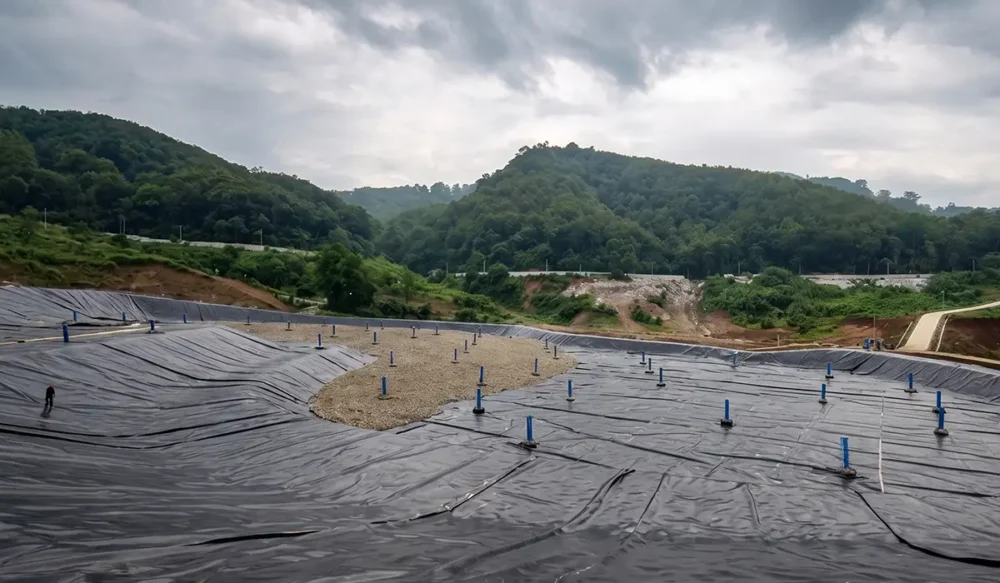
The installation of 60,760 m² of 1.5 mm Geoprotec HDPE geomembrane at the West Bandung landfill was completed on schedule. With this lining system in place, protection against environmental pollution is now established. The landfill is fully lined, so the soil and water sources beneath it are safe from toxic leachate infiltration.
Through careful material selection and precise technical execution, this project is an ideal example of how modern waste management infrastructure in Indonesia should be built.
Other Articles

Shrimp Farm Success with 0.3mm Viroline Geomembrane
Project Background and Challenges The Tegal coast has outstanding potential for shrimp farming. However, this 14,000 m² shrimp farm project, which ended up using 0.3mm geomembrane, initially faced the classic problems of conventional earthen ponds. Traditional ponds that rely only on clay have unpredictable porosity. The main challenges facing the farm owner were: Seepage and […]

0.75mm Geomembrane for a Reservoir Project in Cianjur
Project Background: The Classic Challenge of an Embung (Small Retention Reservoir) This project is located in Cianjur, West Java, an area that relies heavily on water availability for agriculture and plantations. The main need was to build an embung, or retention pond, that could hold as much rainwater and surface runoff as possible, making a […]