


Peat Soil Wastewater Pond: Geomembrane and Underdrain

Background: Aesthetics and Function
A palm oil mill in Siak, Riau, needed a new wastewater treatment (IPAL) pond with large capacity and long-term durability on peat soil. Its main goal was clear: ensuring smooth operations without the risk of waste leaks that could be disastrous for the surrounding ecosystem and breach environmental regulations. However, before the waterproof liner could be installed, the field team faced a natural obstacle that had to be solved first.
The Extra Challenge: Peat Soil & Organic Gas
If you have ever set foot in or worked on an infrastructure project in Riau, you will be very familiar with peat soil. The subgrade at this project site was dominated by peat, a material with unique characteristics that make building a wastewater pond bottom difficult.
Peat has a very high organic content. Over time, the organic material in the soil keeps decomposing and producing organic gas (such as methane). Peat also retains a lot of water, and its groundwater table rises easily.
Why is this dangerous? If a waterproof sheet is laid directly on top, gas and water from the ground become trapped. The pressure that builds up slowly pushes the liner upward, creating giant bubbles (often called the whaling effect or hippopotamus effect). These bubbles not only damage the pond structure and reduce its capacity but can also tear the liner because of the extreme stress.
The Combination: HDPE Geomembrane & Geotextile

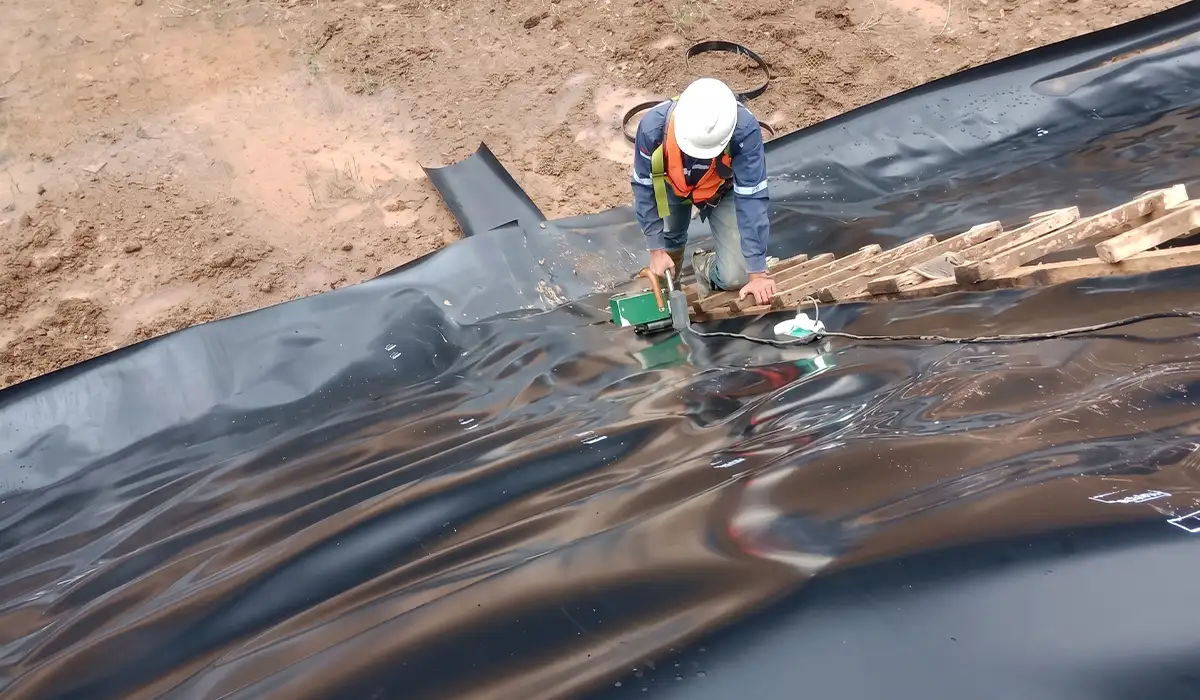
To meet this challenge, the material specifications were chosen with care. As the main line of defense, HDPE Geomembrane 1 mm thick was used. This High-Density Polyethylene material was chosen for its outstanding resistance to harsh chemicals (typical of POME, palm oil mill effluent), UV resistance and excellent tensile strength over decades of service.
However, HDPE Geomembrane cannot work alone on peat soil, which is full of sharp root and branch remnants. That is why Non-Woven Geotextile PET 300 gsm was installed as a cushion (protective layer) directly beneath the geomembrane.
The Polyester (PET) geotextile serves two purposes. First, it acts as a shield that prevents the geomembrane from being punctured by coarse material from the subgrade. Second, it is a separation layer that keeps the soft subgrade from mixing with the structural elements above, keeping the pond foundation stable.
Underdrain and Gas Release Innovation
Good materials alone are not enough without a smart installation method. To deal with the organic gas and groundwater threats described above, the team applied a special piping solution installed beneath the geotextile and geomembrane:
- Underdrain Piping System
A network of perforated pipes was installed strategically at the bottom of the pond. Its job is to capture rising or trapped groundwater and carry it quickly and efficiently to an external drain. This keeps the water table beneath the pond under control, so no hydrostatic pressure pushes the liner upward. - Gas Release System
Working alongside the underdrain, this system provides an escape route (ventilation) for the organic gas continuously produced by the peat. Instead of being trapped and forming giant bubbles, the gas is collected and directed to vent pipes at the edge of the pond, where it is safely released into the open air.
Final Result: A Durable Wastewater Pond for the Long Term
By combining the mechanical protection of Non-Woven Geotextile PET 300 gsm, the chemical resistance of 1 mm HDPE Geomembrane and a precisely designed underdrain and gas release system, the Siak project was completed successfully.
The wastewater pond now operates optimally without the slightest sign of bubbling. The palm oil mill can run its operations with peace of mind, knowing the surrounding environment is safe from liquid waste pollution.
Other Articles

Geomembrane Drilling Pond: 53,000 m2 HDPE Lining in Dieng
Background: Challenges at Dieng’s High Altitude The Dieng area has mountainous terrain with extreme temperatures and fairly high rainfall. During the drilling preparation phase (usually for geothermal exploitation), the contractor needs a very large water supply and a safe place to contain fluids or drilling mud, which is where a geomembrane drilling pond comes in. […]

1.5mm Agricultural Pond Geomembrane in Tangerang
Background & Challenges This agricultural project in Tangerang needed a massive raw water storage pond to serve the irrigation system of a plantation covering more than ten hectares. Initially, the most conventional option was to dig an ordinary earth pond, before an agricultural pond geomembrane was chosen instead. But let’s look at it from a […]