


Geocell vs Geogrid: Which Is Better for Roads?
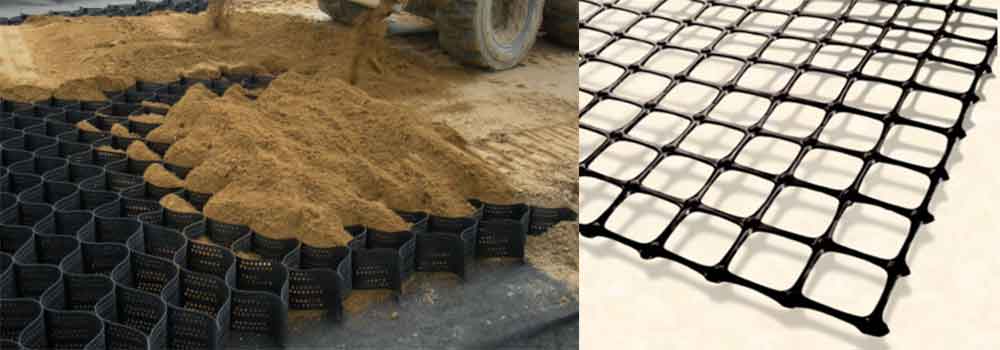
When designing a road, you may often be unsure which geosynthetic material is best for your project. For road reinforcement, the choice usually comes down to two materials: Geogrid and Geocell. Here is how geocell vs geogrid compare.

Both materials are reinforcements designed to be placed on top of the subgrade. Although either can be used, one will offer more benefits than the other.
This article gives a detailed comparison of Geocell and Geogrid that may help you choose which material suits you best.
- PHYSICAL FORM & SHAPE OF THE MATERIAL
- Geocell is a 3-dimensional, honeycomb-like material that can be folded and expanded. This shape has several benefits. First, the infill is locked inside the cells, so lateral movement of the material is prevented. Geocell also drains well: water flows through without carrying away the compacted infill.
- Geogrid has a 2-dimensional form. Geogrid is fairly flexible, but as support in a pavement it is not as good as geocell. For improving soil bearing capacity, geogrid is sometimes a less ideal alternative, because several layers of geogrid are needed. Even when more than 3 layers of geogrid are used, the bearing capacity problem may still not be solved. In addition, weather erosion and poor drainage remain issues to consider. For this reason, geogrid is usually used only as a separation layer.
- INFILL MATERIAL
- 2D and 3D structures have a very different impact on the type of infill material used. Geocell has the advantage of working with more types of material. In fact, geocell can use local material, even sand. So as long as granular material can be placed into the cells, it can be used as infill.
- Geogrid is more demanding: the infill must be well-graded, high-quality aggregate. Depending on the quarry location and the native soil, the cost of infill material can rise.
- PERFORMANCE ON SUBGRADE
- In some cases, you may have problems building a road on soft soil. Even with good subgrade preparation, the issue cannot be solved. Geocell is a far more economical option for allowing construction to continue. Because of the vertical support of each cell, geocell behaves like a semi-rigid slab. For roads, this saves you time and money.
- Geogrid does not perform well on soft soil. Especially for heavy-duty vehicles, 2 or 3 layers of geogrid need to be stacked on top of each other, which increases costs.
- COST
- Geocell outperforms geogrid in both the short and long term.
Although geocell may look less attractive in terms of initial cost, it reduces your maintenance costs. The savings in aggregate and maintenance with geocell pay back its initial cost.
Other Articles
Geosynthetics for Road Construction and Highway Engineering
In general, geosynthetics are man-made materials often used in construction projects such as subgrade reinforcement in road structures. In highway engineering, geosynthetics for road construction can act as a separation layer or as reinforcement to increase embankment stability. In this role, geosynthetics provide reinforcement through several mechanisms: lateral restraint, increasing the bearing capacity of the […]

HDPE Spiral Pipe: Advantages, Functions and Supply
HDPE Spiral Pipe HDPE spiral pipe (High Density Polyethylene) is a spiral-walled pipe specially designed for underground drainage systems, wastewater channels and large-scale piping networks. Made from high-quality HDPE, the pipe has excellent structural strength while remaining light and flexible, making it suitable for a wide range of soil conditions, including unstable ground, peat and […]
