


Geogrid Uses in Pavement Systems

Geogrid used in pavement systems can perform two functions: separation and reinforcement, and these define the main geogrid uses. Because of the large aperture size of most geogrid products, the ability of a geogrid to separate two materials depends on the material gradation and is generally outside the specifications of typical pavement materials.

However, geogrid can theoretically provide some degree of separation, albeit limited. For this reason, separation is a secondary function of geogrid used in pavements. The main function of geogrid in road pavements is reinforcement, where the geogrid mechanically improves the engineering properties of the pavement system.
Read Also
Geogrid
The three main uses of geogrid in pavement systems are (a) to serve as a construction aid over soft subgrade, (b) to improve or extend the projected service life of the pavement, and (c) to reduce the structural section for a given service life. Geogrid has been used successfully to provide construction platforms over soft subgrade.

Geogrid improves the ability to achieve compaction in the aggregate above it, while reducing the amount of material that has to be removed and replaced. Many research programs have also reported results documenting extended service life for pavement sections with geogrid compared with similar sections without geogrid. Finally, research has shown that the base layer thickness required for a given design can be reduced when geogrid is included in the design (same references). There is relative agreement that substantial benefits can be achieved by including geogrid in pavement systems.
Other Articles
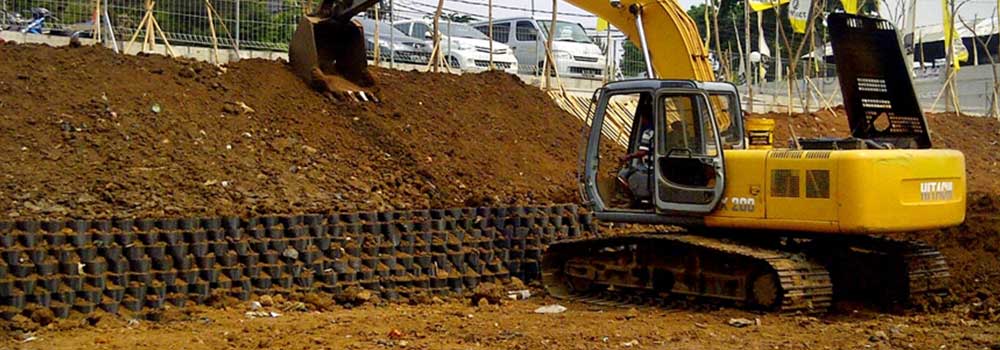
Comparing Geocell Infill Materials
When using geosynthetics, especially geocell, the main focus should be the infill material in each cell. The infill must be evenly distributed so that the results are effective and do not fluctuate. Besides even distribution, attention should also be paid to the types of geocell infill materials that can be used. Geocell infill can be […]

Geotextile Tube (Geotube) and Its Functions
A geotextile tube, or geotube, is made from non-woven or woven geotextile, in either polyester (PET) or polypropylene (PP), and shaped like a very large sack. To understand geotube functions, start with its size: geotextile tubes vary, reaching 15 to 30 metres as required, and can be filled with aggregate, sand or soil. Geotextile tubes […]