


Woven vs Non-Woven Geotextile: Key Differences
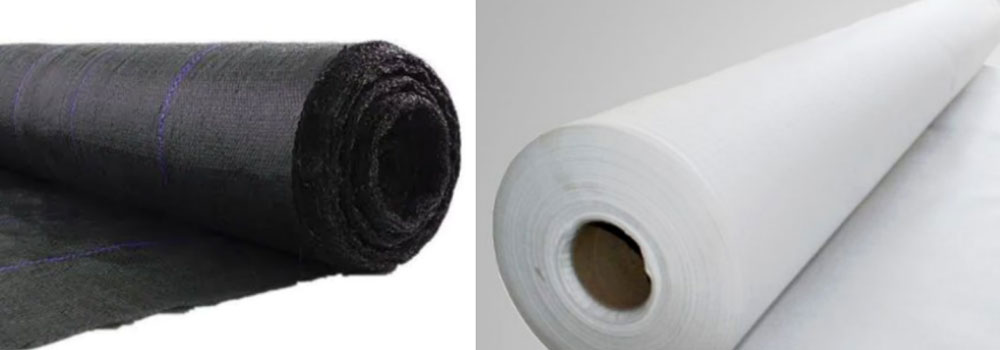
Question: What is the difference between woven and non-woven geotextile?
Answer:
The use of geotextiles has risen sharply over the last few decades. Geotextiles began with textiles already available on the market, such as carpets and upholstery fabrics. Seeing the opportunity, manufacturers started modifying these fabrics into geotextiles that could add value to road construction.
There are two types of geotextile, woven vs non-woven geotextile, yet many construction practitioners still struggle to identify geotextile products in the field. Misunderstandings about the functions of woven and non-woven geotextiles often make it hard for practitioners to choose the right one. This article gives detailed information on both geotextile products and their functions.

What Is Woven Geotextile?
Early generations of woven geotextile were made from slit tapes (ribbon-shaped). Their smooth surface gave these geotextiles low permittivity and a lower soil-fabric interaction value. This made this type of woven geotextile a poor choice for construction, especially in wet conditions.
Read Also: Woven geotextile for road construction reinforcement
Over time, woven geotextile has developed considerably with higher-performance materials. This development increased permittivity and improved the soil-fabric interaction coefficient. The material also offers very good filtration and drainage, making it well suited to separation, reinforcement and confinement.
What Is Non-Woven Geotextile?
Non-woven geotextile is made from synthetic textile produced with fibres that interlock with one another. Woven and non-woven geotextiles are used in similar applications, which makes them hard for practitioners to tell apart. The easiest way to distinguish non-woven from woven geotextile is by physical inspection. Non-woven geotextile feels like felt fabric, with a fine, fuzzy surface.
Non-woven geotextile is produced by needle punching. Needles in the machine bind a large number of fibres so that they lock together. In construction, non-woven geotextile is used for separation, combined with filtration and drainage.
The general difference between woven and non-woven geotextile is defined by the material specification. In general, woven has higher tensile strength, while non-woven has greater flow capacity and permittivity. The easiest way to tell them apart is the elongation parameter. Non-woven has higher elongation than woven. A non-woven geotextile has an elongation of more than 50%, while woven ranges only from 5% to 25%.
Read Also: Geosynthetics: geotextile, woven, non-woven, geogrid
Another frequent source of confusion between woven and non-woven geotextile is the material weight. For example, the weight of woven geotextile is rarely specified. The reason is that this geotextile is mostly used for separation and reinforcement, and its performance does not depend on its weight.
Non-woven geotextile, on the other hand, is often specified by weight. We often hear “I am looking for 150 gr, 200 gr, 500 gr non-woven geotextile, and so on”. A 500 gr non-woven geotextile means the product weighs 500 grams per 1 m2. Other specifications such as tensile strength, puncture strength and others depend heavily on the weight of the non-woven geotextile.
As technology advances, geotextile products have developed quickly. Today, non-woven can be produced at a lighter weight with the same strength, so costs can be reduced. Of course, the application must be considered, for example protection beneath a geomembrane. There, parameters such as puncture strength, weight and thickness are more important than tensile strength and permittivity.
Advantages of Woven vs Non-Woven Geotextile
The weaving process gives woven geotextile a very high load capacity, making it suitable for heavy-duty applications such as road works. However, the weave makes it less effective for drainage. Its low porosity also makes it quite suitable for slope erosion control projects, where water must pass through without carrying soil particles.
Non-woven geotextile, on the other hand, is ideal for separation and filtration. Unlike woven geotextile, non-woven is less suited to reinforcement and stabilisation, but it is an excellent choice for protecting a geomembrane against objects that could damage the geomembrane.
Non-woven geotextile has relatively lower strength than woven geotextile. However, for construction where ponding and water drainage are a problem, non-woven geotextile is an excellent solution. Non-woven geotextile offers very good durability and drainage, making it well suited to many construction applications.
Other Articles
HDPE Pipe: Leak-Proof Clean Water Pipe Solution
Have you ever been annoyed when the water bill at your home or project suddenly skyrocketed? After checking, the problem turns out to be a classic one: a pipe leaked or burst because it couldn’t withstand the water pressure. Piping problems are often taken lightly, yet their impact can be a real headache. If you […]

POME Dewatering Geotube for Palm Oil Waste
POME Dewatering Geotube as an Effective Palm Oil Mill Effluent Treatment Method What Is a Geotube? Geotube is an advanced technological innovation in geosynthetics. It is made from geotextile with high tensile strength and high permeability for various construction applications. A Geotube structure must be designed with sufficient strength to withstand pumping pressure and provide […]