


Geosynthetic Clay Liner (GCL): A Waterproof Lining Revolution
Hello, Petra friends! Have you ever been unsure how to handle a project requiring an extremely tight containment or water-retention system? It could be a landfill, a mine waste pond, or simply an attractive artificial lake in a residential development. The main challenge is always the same: “How can we stop this water or waste from leaking and contaminating the surrounding soil?”
In the past, the classic solution was a Compacted Clay Liner (CCL), meaning clay compacted as thickly as possible. Honestly, though, this method is complicated, requires a massive volume of soil, and its costcan escalate if your project is far from a source of quality clay.
In this article, Petra Nusa Elshada introduces a “remarkable” geosynthetic innovation called the Geosynthetic Clay Liner (GCL). This material is thin, yet its water-retention capacity is equivalent to clay one meter thick! Curious how it works? Read the full review below.
What Is a Geosynthetic Clay Liner (GCL)?
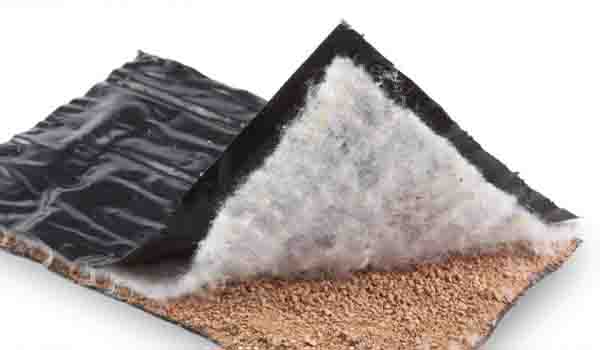
Let us start with the simplest definition. Imagine a sandwich biscuit. Instead of a filling between two biscuits, a GCL consists of two textile (geotextile) layers enclosing a core layer of Sodium Bentonite (bentonite clay).
Technically, GCL is a composite material manufactured hydraulically or by needle punching to lock bentonite powder in the middle.
Why bentonite? This natural volcanic mineral has a unique property. When exposed to water, bentonite swells to many times its original size. This swelling creates a very tight, waterproof seal so liquid cannot pass to the other side.
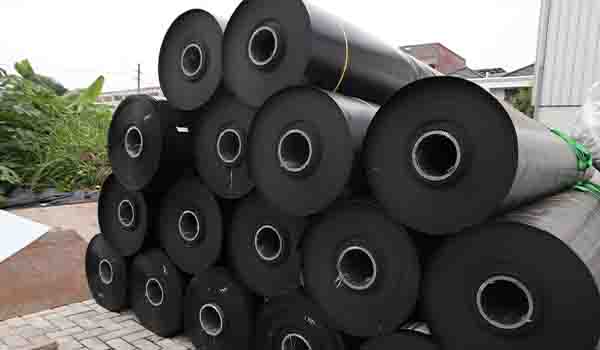
Physically, GCL looks like a thick, heavy carpet, but it contains advanced water-retention technology.
Component Breakdown: What Is Inside?
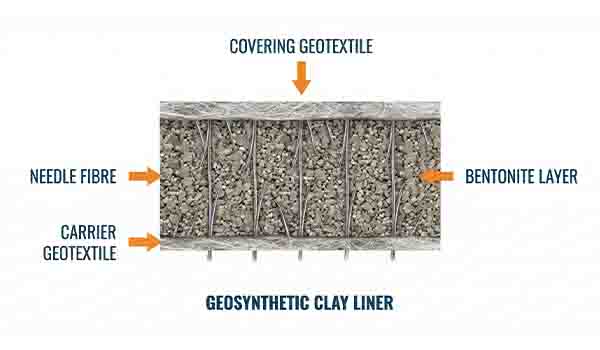
To understand why this material is so special, we need to examine its “internal anatomy.” GCL usually consists of three main components:
1. Carrier Geotextile:
Usually the bottom layer, which may be woven or non-woven. It functions as the base.
2. Bentonite Core:
This is the main part: granular Sodium Bentonite with high swelling capacity.
3. Cover Geotextile:
The top layer, usually non-woven so its fibers can be needle-punched through the bentonite into the bottom layer, locking the bentonite in place.
These three materials are joined by needle-punching or stitch bonding to ensure strong structural integrity, even when deployed on steep slopes.
How Does GCL Prevent Leaks?
You may ask, “It is just clay; how can it be that effective?”
The secret lies in the physicochemical reaction of Sodium Bentonite. When GCL is deployed and exposed to water (hydration), the clay particles absorb that water. Because the bentonite is confined between two geotextile layers and is usually covered by a load such as backfill or geomembrane, it cannot freely expand upward.
As a result, the bentonite becomes very dense inside this “enclosure.” This density creates what is known as very low hydraulic conductivity.
Simply put, water attempts to pass, but its path is blocked because bentonite particles fill all the voids.
Why Should You Switch to GCL?
If you are still deciding between GCL and conventional methods, consider the following benefits. These are not just theories; they have been proven in many major projects in Indonesia.
1. Volume and Space Efficiency
A single GCL layer approximately 10mm (1 cm) thick provides waterproofing equivalent to 1 meter of compacted clay liner (CCL). Imagine how much airspace you could save in a landfill project. With GCL, you can contain more waste because the liner is much thinner.
2. Fast and Easy Installation
Installing clay requires heavy equipment, complex compaction tests, and favorable weather; rain turns the soil to mud. By contrast, GCL arrives in rolls. You simply unroll it, level it, and ensure the overlapis correct. There is no need for water mixing or exhausting compaction work. The project is completed faster!
3. Resistance to Temperature Changes (Freeze-Thaw)
Ordinary clay can crack during extreme wet-dry or hot-cold cycles. GCL is more flexible and offers better resistance to freeze-thawcycles.
4. Cost-Effective
Although its price per square meter may seem higher than excavated soil, calculate the total cost: transporting clay in hundreds of trucks, compaction equipment, and labor time. GCL is often much cheaper in total project cost.
Where Can GCL Be Applied?
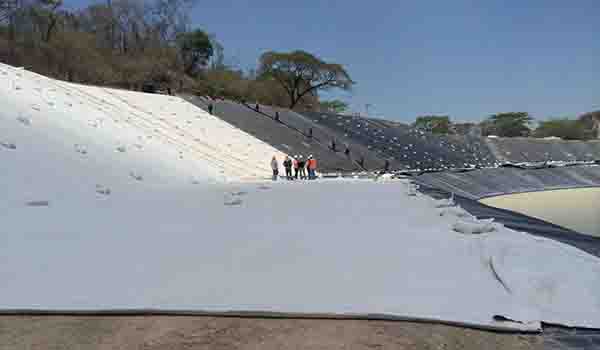
The flexibility of GCL makes it suitable for many civil and environmental engineering projects. Common applications include:
- Landfills: As a base liner or capping layer to prevent leachate from contaminating groundwater.
- Mining: Used in tailing ponds or heap leach pads to contain hazardous and toxic waste.
- Canals and Waterways: Prevents irrigation water from seeping into the ground, improving water-conveyance efficiency.
- Artificial Lakes & Golf Courses: Keeps water levels stable without frequent refilling.
- Secondary Containment: Lines embankments around oil or chemical storage tanks as a safeguard if the primary tank leaks.
- Basement Waterproofing: In high-rise construction, GCL is often used to protect underground concrete structures from groundwater seepage.
Brief GCL Installation Guide
Although it sounds easy—“just unroll it”—GCL installation still requires a proper SOP for optimal results. Here is a general overview:
1. Subgrade Preparation:
Make sure the base soil is level, compacted, and free of sharp stones or large gravel that could tear the GCL.
2. Deployment:
GCL is deployed using a spreader bar attached to an excavator or loader. Do not drag GCL across rough ground because this can damage the geotextile fibers.
3. Overlapping:
GCL is not heat-welded like geomembrane. Its seams use an overlap of approximately 15-30 cm.
4. Applying Bentonite Powder:
Spread additional bentonite powder or paste over the overlap area. This is the key! The powder ensures adjacent GCL sheets seal tightly when wet.
5. Covering:
Cover the GCL with backfill or geomembrane as soon as possible. Do not allow GCL to hydrate from rain before a load is placed on it, as this can cause premature swelling that reduces its effectiveness.
GCL vs Clay: Which Should You Choose?
You may often face a difficult choice. Here is a brief comparison to make it easier:
- Compacted Clay: Inexpensive when the source is nearby, but space-intensive, slow to install, and prone to cracking.
- GCL: Has self-healingcapability, installs quickly, and performs equivalently to thick clay.
Tip: High-risk modern projects, such as hazardous-waste landfills, often use a Composite Liner. This combines GCL underneath with HDPE Geomembrane on top. The combination provides exceptionally secure double protection!
Ready to Switch to a Geosynthetic Clay Liner (GCL)?
Using a Geosynthetic Clay Liner not only simplifies construction work but also reflects environmental responsibility. With superior impermeability, you help keep groundwater clean for future generations.
Technology continues to advance, and in construction, adopting geosynthetic materials such as GCL is an inevitable step toward modernization. You save time and cost while achieving more reliable results.
Need a Consultation or Geosynthetic Supply?
Still unsure how to calculate the GCL quantity for your project? Or need GCL technical specifications that meet standards?
Feel free to consult the Petra Nusa Elshadateam. We supply a wide range of high-quality geosynthetics ready for delivery throughout Indonesia. Let us discuss your project needs today!
View Our Catalog: Catalog
Chat on WhatsApp Now: WhatsApp
Remember Geosynthetics, Remember Petra!
Other Articles

Woven Geotextile: Definition and Functions
First, let’s look at the word geosynthetics, which combines two words: Geo (earth) and Synthetic (man-made). Geosynthetics are man-made materials widely used in construction. They come in several forms, one of which is geotextile. A geotextile is a thin, flexible, porous sheet, and geotextiles are divided into two types, woven geotextile & non-woven geotextile. In this article we explain […]
Geomembrane: Functions, Types & Applications in Indonesia
Have you ever seen a shrimp pond whose base is lined with a black material that looks like thick plastic, Petra friends? Or perhaps you have wondered how giant landfills manage to hold back leachate so it doesn’t pollute the surrounding groundwater? The answer lies in one remarkable material innovation: Geomembrane. In an era of […]