


Woven Geotextile Road Reinforcement Case Study

Background
Tanjung Batu, in East Kalimantan, is a strategic area undergoing rapid infrastructure and logistics growth. This woven geotextile road reinforcement case study starts there: as an economic artery, the area’s roads must operate 24/7 and withstand the continuous axle load of heavy vehicles.
However, like most of Kalimantan, Tanjung Batu has fairly challenging geology. The project area is dominated by subgrade with relatively low bearing capacity (a low CBR / California Bearing Ratio value) and high soil moisture. Such soft subgrade is a nightmare for highway engineers if it is not handled with the right reinforcement engineering.
Technical Challenges on Site
Without an adequate reinforcement system, building an aggregate foundation layer (base course) directly on the soft soil of Tanjung Batu would trigger a series of structural failures. The construction team had to solve several key technical challenges:
- Pumping Effect & Aggregate Intrusion
When heavy vehicle wheels pass, their dynamic pressure forces mud or fine soil particles from the subgrade up into the voids of the crushed stone (aggregate). Conversely, the expensive aggregate sinks into the soft soil. This causes the road foundation to lose its interlocking between stones and slowly break down. - Risk of Rutting (Wheel Ruts)
The combination of soft subgrade and repeated traffic loads causes plastic deformation. The road surface forms long depressions along truck wheel paths (rutting), which not only damages the asphalt/concrete above but also endangers road users. - Time and Cost Efficiency
Carrying out soil replacement (excavating the soft soil and replacing it with select fill) would be hugely expensive and take far too long. The project needed a fast yet high-performing method.
Solution: Woven Polypropylene Geotextile 250 gsm for Road Reinforcement
To meet these technical challenges, the team chose Woven Polypropylene Geotextile weighing 250 grams per square metre (gsm) as a separation and reinforcement layer. The product was supplied and laid directly on the levelled and compacted subgrade before the aggregate base was placed.
Why Polypropylene (PP) 250 gsm? Polypropylene was chosen for its outstanding chemical resistance to the acidic or alkaline soils common in Kalimantan. Made from flat slit-film yarn woven on high-tech machines, this Woven Geotextile 250 gsm offers very high Tensile Strength with low elongation. Mechanically, the material acts like “reinforcement” that carries tensile strain the soil cannot.
Results and Performance
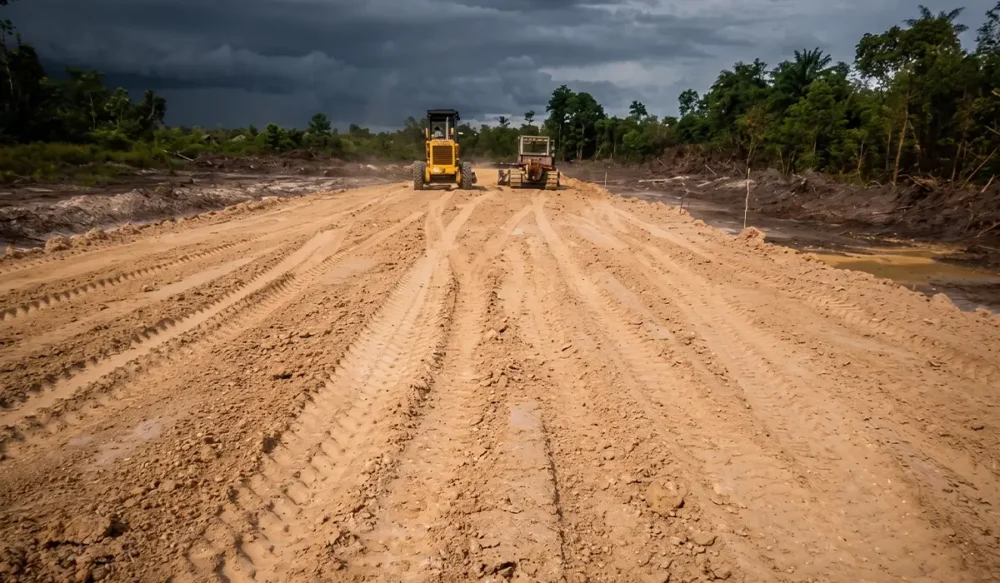
Once the road was in service, technical evaluation showed a significant improvement in construction performance. The Woven Geotextile 250 gsm in Tanjung Batu successfully delivered its 6 main technical functions:
a. Preventing Aggregate from Mixing with the Subgrade (Separation)
This is the first mechanical success. The tight geotextile weave acts as a tough physical separator. The aggregate base course stays free of intrusion by subgrade clay particles, so the aggregate’s structural and drainage value is fully preserved. No more expensive material “wasted” by sinking into the mud.
b. Distributing Vehicle Loads
In soil mechanics, a concentrated wheel load (point load) spreads downwards in a pressure cone (stress bulb). Woven geotextile responds to this vertical pressure and distributes it horizontally over a much wider area. As a result, the specific pressure on the soft subgrade is greatly reduced.
c. Improving Subgrade Stability (Tension Membrane Effect)
When heavy wheels apply load, the aggregate layer and the geotextile beneath deflect slightly. At this moment, the woven geotextile reacts through the Tension Membrane Effect. The high tensile strength of the 250 gsm material actively resists downward pressure, restrains lateral soil movement, and stabilises the entire pavement system.
d. Reducing Rutting (Wheel Ruts)
With loads distributed evenly and aggregate prevented from shifting sideways (thanks to friction between the aggregate and the rough geotextile surface), deformation of the road structure is kept to a minimum. Rutting and waves along truck wheel paths were reduced dramatically.
e. Increasing Road Bearing Capacity
The combination of separation and tensile reinforcement increases the overall Bearing Capacity of the pavement. The Resilient Modulus of the reinforced soil layer is higher. The Tanjung Batu road can now handle logistics traffic volumes and tonnage beyond the original design for an unreinforced road.
f. Extending Road Life (Long-Term Durability)
In the long term, a stable pavement minimises fatigue cracking in the asphalt above. The road’s design life-span increases sharply, maintenance cycles become less frequent, and this of course saves the operator a great deal of infrastructure maintenance budget.
Conclusion
This Tanjung Batu, East Kalimantan case study is real proof that integrating geosynthetics into modern geotechnical engineering is a crucial step. Woven Polypropylene Geotextile 250 gsm not only saved the project from potential soft soil failure, but also delivered efficiency, durability and high road quality.
Other Articles
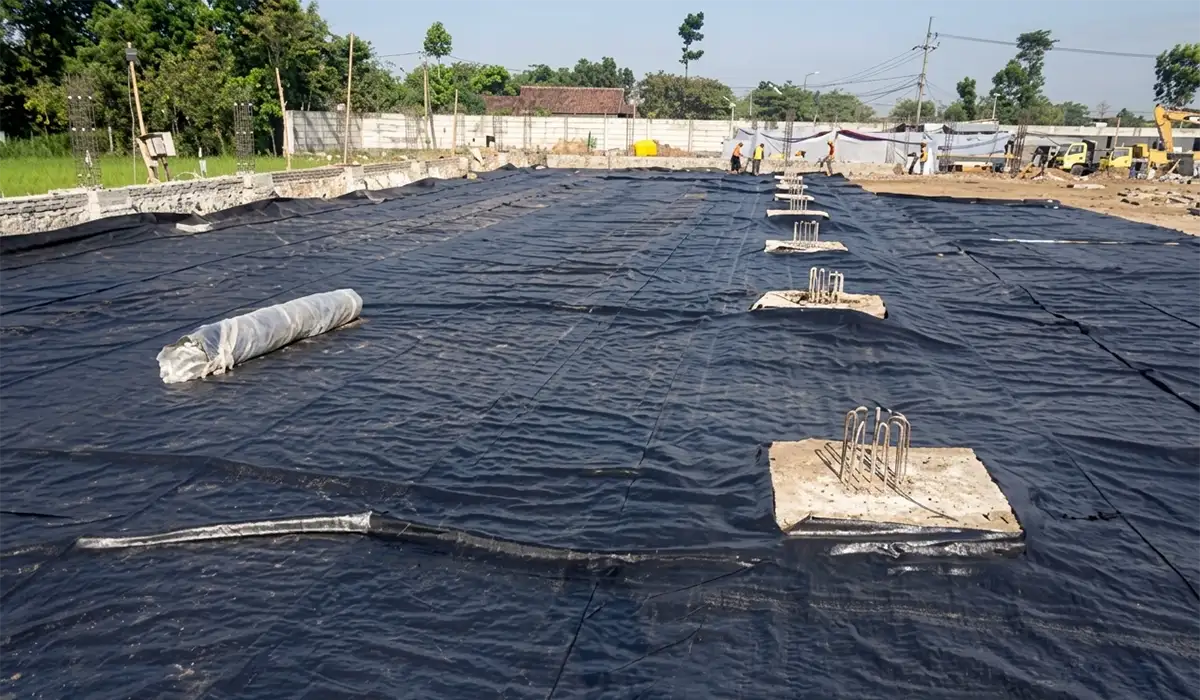
Woven Geotextile for a Settlement-Free Warehouse in Jember
Project Background & Challenges Jember is a fast-growing area with steadily increasing logistics demand. On this woven geotextile warehouse project, the contractor faced an area of 8,400 m² that required very thorough subgrade preparation. The main technical challenge in building a warehouse floor (slab-on-grade) is the extremely high live load and dead load. Fully loaded […]
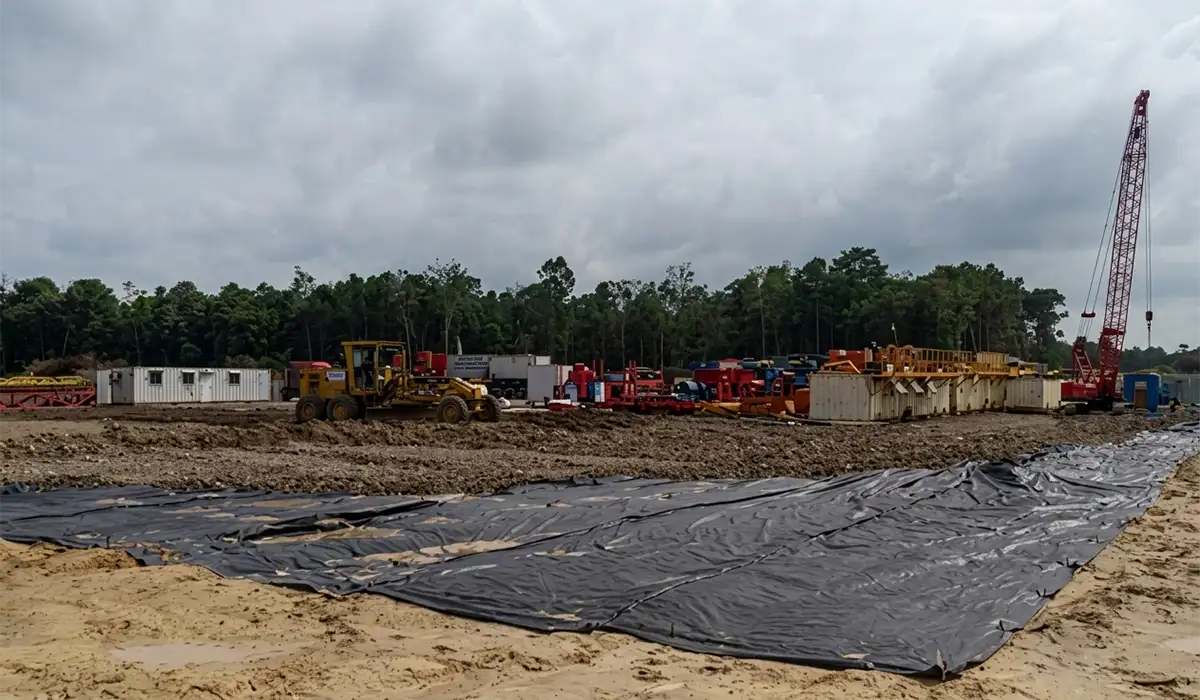
Woven Geotextile Access Road Case Study in Muaro Jambi
Project Background Muaro Jambi is a regency in Jambi Province that plays a strategic role in plantations, industry and inter-regional logistics. Behind its great economic potential, however, the area faces fairly complex geotechnical challenges. Most of the subgrade (subgrade) in Muaro Jambi is soft soil (soft soil) with low bearing capacity, a California Bearing Ratio […]