


Geocell Hauling Road on Soft Soil in East Kalimantan

Project Background and Challenges
A hauling road has one main enemy: concentrated vertical stress, which is exactly what a geocell hauling road is built to handle. When heavy truck wheels pass over a conventional road surface, the stone aggregate risks being pushed sideways (lateral displacement).
On this East Kalimantan project, the contractor faced several critical problems:
- Low subgrade CBR (California Bearing Ratio), so the soil could not carry traffic loads on its own.
- Severe wheel rutting (rutting), drastically slowing the fleet and risking damage to truck axles.
- Ballooning maintenance costs, because road aggregate had to be added continually to fill subsided areas.
Without proper reinforcement, crushed stone aggregate on soft soil keeps spreading sideways and sinking into the mud. This is where geocell comes in as a structural solution.
Technical Solution: Installing 10 cm & 15 cm Geocell
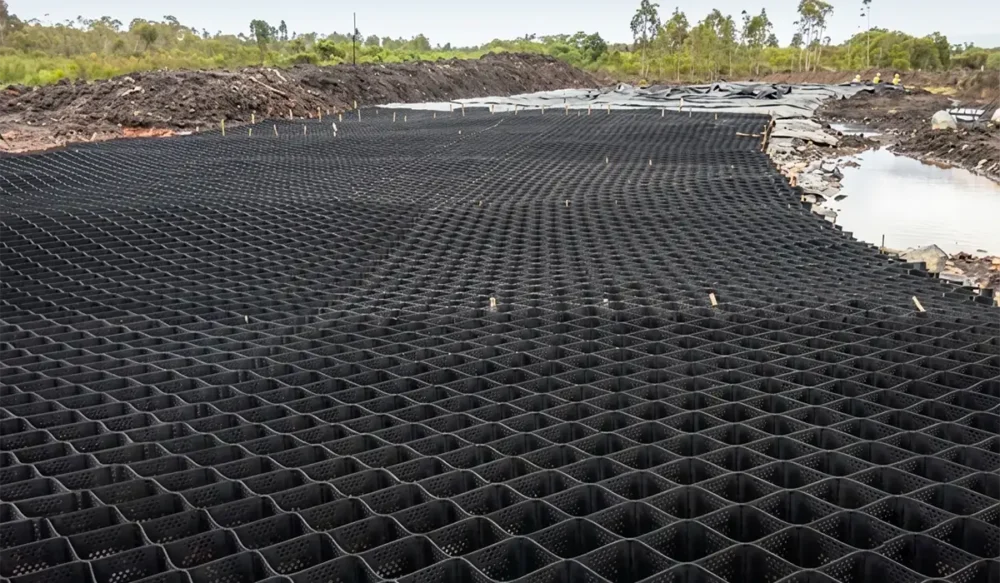
To solve these problems, geocell was laid over the subgrade across an area of 3,192 m². Geocell heights of 10 cm and 15 cm were used to suit the stress contours and subgrade profile on site. The 15 cm geocell was used in zones with very low bearing capacity to provide a thicker “mattress” effect, while the 10 cm geocell was used in transition areas.
When geocell is stretched out and filled with aggregate, a remarkable soil mechanics mechanism comes into play, called 3D Cellular Confinement.
How Does Geocell Work Technically?
From an engineering perspective, geocell does not just cover the soil; it changes the mechanical behaviour of its infill (aggregate). Here are the technical mechanisms at work on site:
- Three-Dimensional Confinement (Tightly Locked Material)
The geocell walls provide passive resistance to the infill. When truck loads press from above, the aggregate does not spread sideways easily because the geocell walls lock it in (creating hoop stress in the cell walls). Friction between the aggregate and the cell walls turns the infill into a single, solid, stiff unit. - Drastically Increased Subgrade Bearing Capacity
Infill that was cohesionless gains high shear strength through confinement. The result? The bearing capacity of the subgrade increases sharply. The system acts like a semi-rigid slab that protects the soft subgrade below. - Load Distribution over a Wider Area
You can think of geocell as working like a snowshoe. Concentrated wheel loads from heavy vehicles are not passed straight down but are spread laterally over a wider area through the interconnected cells. The stress reaching the subgrade becomes much lower than its bearing capacity.
Performance Results and Long-Term Benefits
After the 3,192 m² geocell installation was completed and the hauling road was in full operation, field evaluation showed outstanding performance:
- Zero Rutting (Reduced Wheel Rut Formation)
Because the aggregate is locked in the cells and cannot move sideways, permanent deformation or rutting barely occurs. The road surface stays level despite continuous dynamic loading. - More Uniform Settlement (Uniform Settlement)
The mattress effect of the geocell layer ensures that any settlement happens evenly across the area. The risk of localised subsidence (potholes/punch-outs) is reduced significantly. - Exceptional Stability Under Heavy Vehicles
The combination of 10 cm and 15 cm geocell ensures the road stays stable even under heavy equipment, minimising interruptions to mine logistics operations. - OPEX Efficiency (Less Routine Maintenance)
Without geocell, the contractor might have to re-grade and add stone every month. With the material staying locked in place, repair and infill top-up costs fall drastically.
Conclusion
This 3,192 m² hauling road reinforcement project in East Kalimantan is clear proof that geocell is not just a plastic liner but a functional engineering material. By harnessing soil mechanics through 3D cellular confinement, geocell protects hauling operations from soft soil, road subsidence and crippling maintenance costs.
Other Articles


Geocell Critical Slope Protection in Serpong
Background: The Threat of Erosion Amid Development Serpong is one of the areas with the most aggressive pace of development. However, changes in land use often alter the original ground contours. On this geocell critical slope project, there was a man-made cut and fill slope with a fairly steep gradient. The soil on the slope […]
