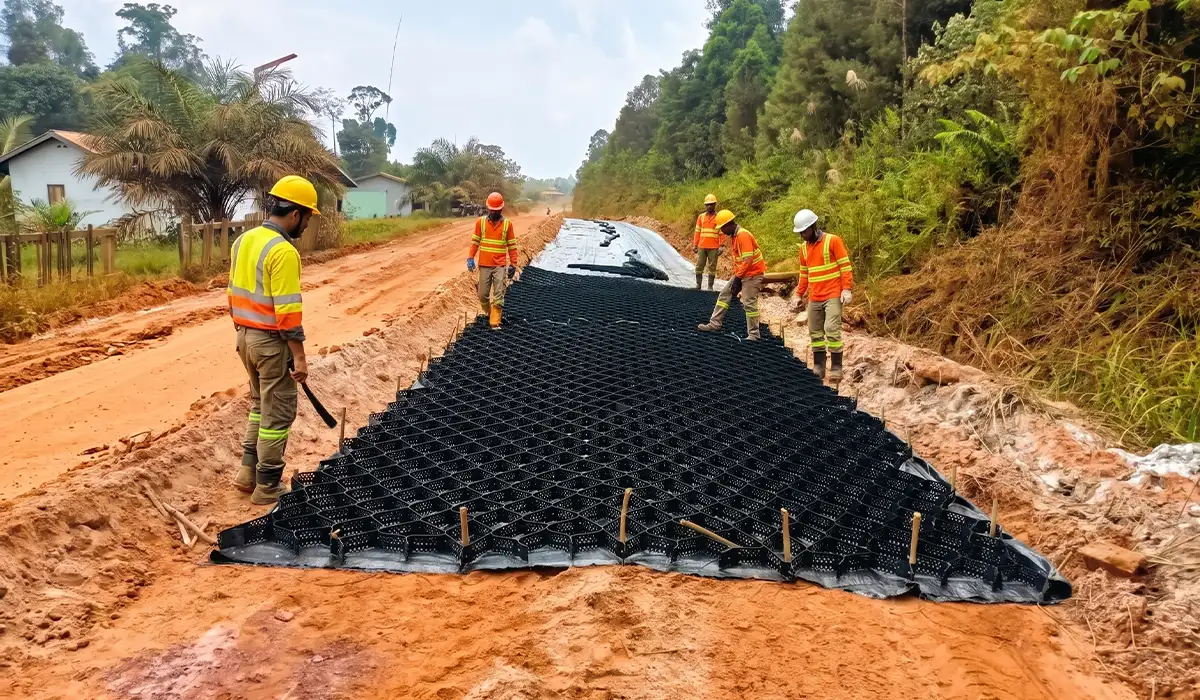
Geocell Critical Slope Protection in Serpong

Background: The Threat of Erosion Amid Development
Serpong is one of the areas with the most aggressive pace of development. However, changes in land use often alter the original ground contours. On this geocell critical slope project, there was a man-made cut and fill slope with a fairly steep gradient.
The soil on the slope was dominated by cohesive material that is highly vulnerable to surface runoff. When heavy rain falls, which is very common in the Tangerang area, water flowing down from the top of the slope carries soil particles with it. Left unchecked, this surface erosion creates gullies that slowly but surely reduce the soil’s shear strength.
The project’s needs were very clear: we needed a slope protection solution that could not only hold the soil structurally but was also environmentally friendly and allowed green vegetation to grow back. Conventional methods such as concrete reinforcement (shotcrete) were considered less than ideal because, besides being costly, concrete does not allow water infiltration and spoils the look of the environment.
Technical Solution: Why 15cm Geocell?
After analysing the slope geometry, soil type and local hydrology, the material recommended and installed was Geocell with a depth of 15cm.
If you are not yet familiar with it, geocell is a three-dimensional (3D) geosynthetic shaped like a honeycomb, made from High-Density Polyethylene (HDPE). When stretched out, it forms a network of interconnected cells.
The 15cm depth was chosen for sound technical reasons. It provides an optimal depth for confinement of the infill (topsoil) at the gradient of the Serpong slope. Here are the technical details of how 15cm geocell performs on site:
1. Controlling Surface Erosion and Water Flow Velocity
When rainwater flows over the slope, the geocell cell walls act as a series of mini dams (check dams). This structure significantly reduces surface flow velocity. As the water slows down, the kinetic energy that normally scours the soil is dissipated, so slope surface erosion is controlled to the maximum.
2. Three-Dimensional Confinement Effect (3D Confinement)
The key to geocell stability is its ability to hold infill material on the slope. The topsoil placed in the 15cm geocell cells cannot go anywhere. The cell walls apply lateral pressure that keeps the soil compact. This mechanism dramatically reduces soil movement on the slope surface, even under constant gravity.
3. Load Distribution and Improved Stability
The honeycomb system works like a semi-rigid slab. When loads are applied (from water volume or the weight of the soil itself), they are not concentrated at one point but are distributed evenly over a wider area. This directly improves overall slope stability and prevents shallow slope failure.
4. An Ideal Base for Long-Term Vegetation
Geocell has perforations (small holes) in its cell walls. These holes serve a dual purpose: they allow lateral drainage (preventing hydrostatic pressure) and let plant roots spread from one cell to the next. Roots binding together within the HDPE structure support vegetation growth as long-term natural protection. Soil, roots and geocell combine into a very solid bio-mechanical reinforcement system.
Execution on Site
Installation in Serpong was carried out with great precision. Here are the technical stages:
- Subgrade Preparation: The slope surface was cleared of debris, levelled and compacted so the geocell would sit fully on the native soil.
- Anchor Trench: An anchor trench was dug at the top of the slope (crest) to hold the upper end of the geocell and stop it sliding down.
- Deployment: The 15cm geocell was stretched down the slope. Panels were joined with special connectors to keep their structural integrity intact.
- Anchoring: J-shaped stakes (J-pins) were driven strategically along the cells to hold the geocell in position.
- Infilling: The firmly installed cells were then filled with fertile topsoil using heavy equipment, working from top to bottom.
- Hydroseeding: The final step was spreading grass seed (hydroseeding) over the soil surface.
Results
Within just a few months of completing the installation in Serpong, the once barren, landslide-prone slope had changed dramatically. Green vegetation thrived and completely covered the geocell structure.
A technical evaluation after heavy rain showed very satisfying results: no erosion gullies were found, no infill had washed into the drains below the slope, and the slope structure remained one hundred percent stable. This project proves that 15cm geocell is not only a reliable geotechnical engineering solution but also an ecologically smart approach to sustainable infrastructure.
Other Articles

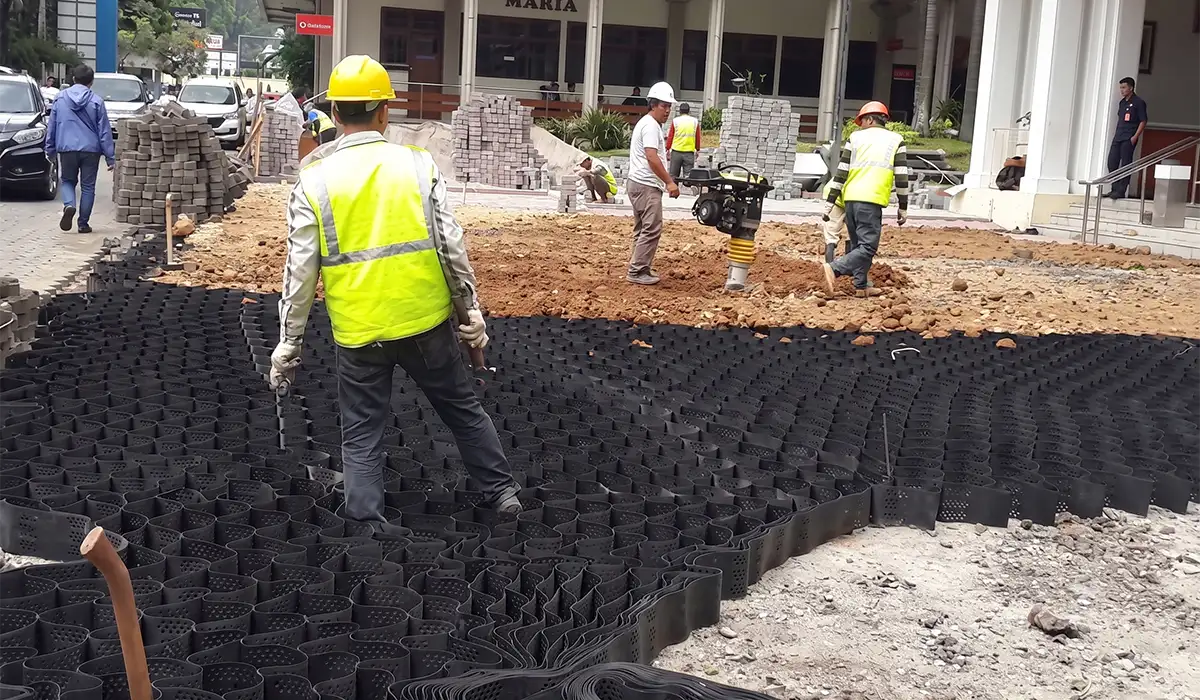
Geocell Parking Lot and Paving Block Road in Bandung
Project Background & Challenges Bandung is known for fairly high rainfall and varied topography. On this geocell parking lot project, the team worked on an area to be turned into a car park and access road using paving blocks. However, there were major challenges on site: Soft Subgrade: The CBR (California Bearing Ratio) of the […]