


Guide to Choosing Geopipe Material
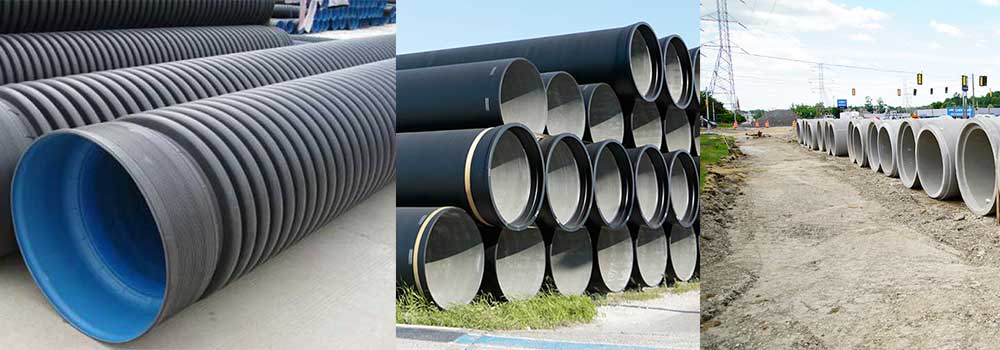
Most projects need a channel that can carry liquids such as infiltration water, wastewater, leachate and so on. Sometimes a protective layer is also needed for cables below the ground surface. These needs are usually met with pipes, which can be made from various materials such as plastic, iron and concrete. This guide to choosing geopipe compares those options.

Pipes are generally laid in excavated trenches and then backfilled so that they are not exposed at the surface. Below are the advantages and disadvantages of each pipe material:
HDPE Pipe
HDPE pipe, often called Geopipe, is a geosynthetic product made from high density polyethylene (HDPE). Geopipe is usually made with a corrugated profile, and it can also be made perforated or non-perforated. Geopipe is divided into 3 types: Single Wall, Double Wall and Spiral.

The differences between these three types of HDPE geopipe are:
- Single wall pipe – a standard HDPE geopipe that is corrugated both inside and outside. It can be used for drainage systems (with perforations) and to protect underground cables.
- Double wall pipe – an HDPE geopipe that is corrugated on the outside, with an additional inner layer so the inside is not corrugated. It is generally used for drainage systems (with perforations) and to convey water (wastewater, leachate, etc.)
- Spiral pipe – an HDPE geopipe similar to double wall pipe; the difference is its larger size. It is therefore often used on large projects where heavy vehicles pass over the pipe backfill.
Iron Pipe
Iron pipe, usually called Ductile Iron Pipe, is made from iron. The iron used has fairly good elasticity. Ductile Iron Pipe is a development of Cast Iron Pipe.

Advantages of Ductile Iron Pipe:
- Ductile Iron Pipe has a moderate (medium) weight
- Does not break when bent
- Service life of around ≥ 100 years
- Minimal corrosion (requires an additional coating)
- No abrasion from water flow
- Fairly quick installation
- Not affected by weather
Disadvantages of Ductile Iron Pipe:
- Flexibility is not as good as HDPE geopipe
- Backfill requirements are less favorable than for HDPE geopipe
- Chemical resistance is not as good as HDPE geopipe
- Not easy to perforate
- Does not provide structural support
Concrete Pipe
Concrete pipe is made from concrete. It is usually reinforced with steel bars inside to strengthen the structural frame of the pipe.

Advantages of Concrete Pipe:
- Concrete Pipe has a moderate (medium) weight
- Does not deform or bend
- Service life of around ± 75 – 100 years
- Not affected by weather
Disadvantages of Concrete Pipe:
- Concrete Pipe is very heavy
- Requires a deep and large backfill area
- Can crack
- Chemical resistance is not as good as HDPE geopipe
- Prone to corrosion
- Subject to abrasion from water flow
- Not easy to perforate
- Installation takes quite a long time

PT. Petra Nusa Elshada supplies Geopipe made from HDPE in 3 types: single wall corrugated pipe, double wall corrugated pipe and spiral pipe. Geopipe is available in a range of diameters to suit project needs.
To determine the right geopipe for your project, please contact us via the following link:
Other Articles

Latest Woven and Non-Woven Geotextile Price List 2026
Geotextile has long been known in Indonesia, and today’s geotextile price is competitive. Many construction applications already use this material. Geotextile is easy to use in construction projects, and it is also cheap and affordable from suppliers and online stores compared with concrete or similar materials, which is why many people choose geotextile as a […]

How to Calculate Geomembrane Quantity for a Pond
Geomembrane is a plastic liner, often called HDPE tarpaulin, commonly used to line aquaculture ponds, water storage ponds, artificial lakes, landfill projects, biogas covers and more. Before you calculate geomembrane quantity, note that it comes in several thicknesses: 0.3 mm, 0.5 mm, 0.75 mm, 1 mm, 1.5 mm and 2 mm. Let’s take a shrimp […]

How to Weld Geomembrane: Extrusion and Fusion
How to weld geomembrane. Geomembrane can be made from several materials, but the most common and popular types in Indonesia are High Density Polyethylene (HDPE) and Low Density Polyethylene (LDPE). They are impermeable (waterproof) and are commonly used to protect bases or slopes and to contain liquids or water. For example, geomembrane is used to […]