


Fire Hydrant Tank Geomembrane in Tangerang

Problem Background: An Invisible Threat to the Water Tank
This project is located in a strategic area of Tangerang that needed a large-capacity water reservoir dedicated to its hydrant system. Building an open or semi-open water storage tank in direct contact with the soil carries a high risk, because soil has a certain permeability (ability to let water through). Without the right protective layer, such as a fire hydrant tank geomembrane, water keeps seeping into the soil pores.
For facility managers, this is a nightmare. Soil infiltration means the firefighting water reserve never stays at the ideal level of its original design capacity. This situation demands a lining solution that is not only 100% waterproof, but also strong enough to withstand hydrostatic water pressure, flexible enough to follow the tank’s contours, and resistant to long-term environmental exposure.
Technical Solution: Why Choose a 0.5mm Fire Hydrant Tank Geomembrane?
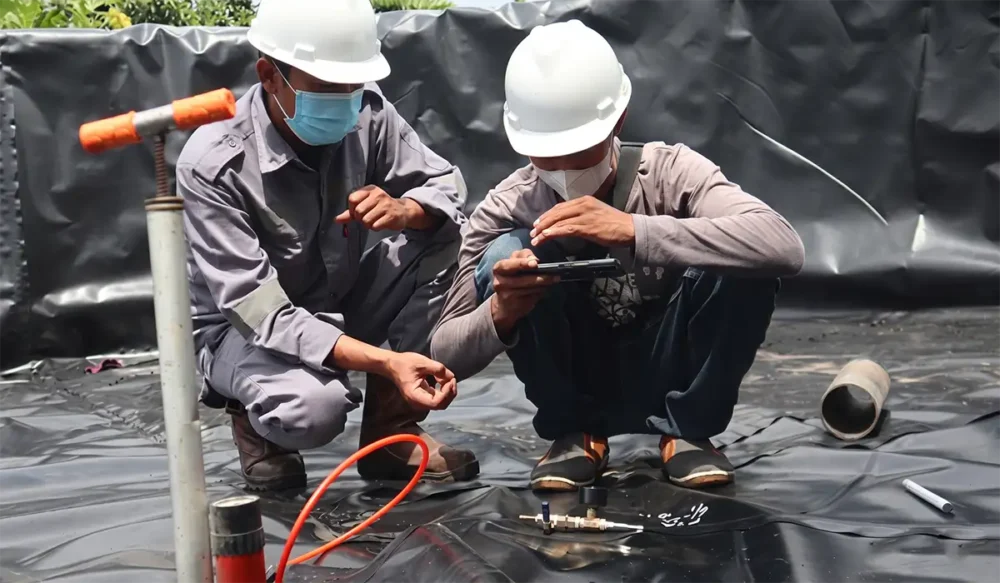
To meet this challenge, the engineering team decided to use 0.5mm Geomembrane (generally made from High-Density Polyethylene or HDPE) as the main liner. But why was a 0.5mm thickness chosen for this project?
In geosynthetic engineering, the choice of thickness depends heavily on water depth, subgrade conditions and mechanical exposure. For a medium-depth fire hydrant tank with a well-compacted subgrade free of sharp rocks, a 0.5mm thickness offers an optimal combination of installation flexibility and waterproof strength. The material is pliable enough to fold at the tank corners, yet has enough tensile strength to hold the volume of stored water.
Technical Installation Process on Site: Installing a geomembrane is not just “rolling out a carpet”. There are strict technical rules to follow so its waterproofing works to the full:
- Subgrade Preparation: Before the geomembrane is laid, the base and walls of the tank must be compacted and cleared of sharp gravel, tree roots or any material that could cause a puncture.
- Digging the Anchor Trench: An anchor trench is dug around the top rim of the tank. The edge of the geomembrane is placed into this trench, then backfilled and compacted. This keeps the geomembrane from sliding down when the tank is filled and placed under tension.
- Panel Deployment: The geomembrane panels are laid out carefully. Because 0.5mm material is quite flexible, the team must make sure there are no excessive wrinkles that could become a weak stress point in the future.
- Thermal Welding (Seaming): This is the most crucial stage. The seams between geomembrane panels are joined with a hot wedge welder, which uses heat and pressure to melt and fuse two layers of material. At corners and around the hydrant inlet/outlet pipes, the team uses extrusion welding to make sure every detail is perfectly sealed.
- Quality Control: Every seam is rigorously tested, using both an air pressure test on the double seam welds and a vacuum test, to ensure there is not even a pinhole-sized leak.
Results and Long-Term Benefits
Once the 0.5mm Geomembrane installation was completed and the tank began operating, the client immediately gained a series of significant technical and economic benefits, including:
- Drastically Reduced Water Loss: The 100% impermeable HDPE material completely cuts off water infiltration into the subgrade.
- Maintaining the Reserve Water Volume: The firefighting water volume is now always on standby and available at the emergency design capacity, with no fear of running out during an incident.
- Ensuring a Stable Water Level: Because no water is lost through seepage, the water level in the tank is very stable, making it easier to monitor the hydrant system.
- Preserving the Tank’s Dimensions Long Term: The soil around the tank stays dry. This prevents ground movement or soil slips caused by waterlogged soil, so the shape and dimensions of the tank are maintained.
- Minimizing Repair Needs: This lining is highly resistant to UV exposure and mild chemicals, minimizing the risk of the cracks and leaks that often occur in conventional concrete tanks.
- Much Lower Maintenance Costs: With no need to patch structural leaks or keep pumping in extra water to make up for losses, the facility’s Operational Expenditure (OpEx) efficiency rises sharply.
Conclusion
With the right geosynthetic engineering approach, leakage in vital facilities such as a Fire Hydrant Tank can be solved efficiently. This Tangerang project proves that investing in a 0.5mm Geomembrane lining system is not just about holding water, but about giving you peace of mind that your safety system will always be ready when you need it most.
Other Articles

Rooftop Lining: Menara Tendean Case Study
The Problem: Why a Concrete Roof Slab Alone Is Not Enough You might wonder: isn’t concrete a very solid material? To the naked eye, yes. But in civil engineering terms, concrete is porous and highly prone to expansion and contraction caused by extreme temperature changes. On the rooftop of a tall building such as Menara […]

