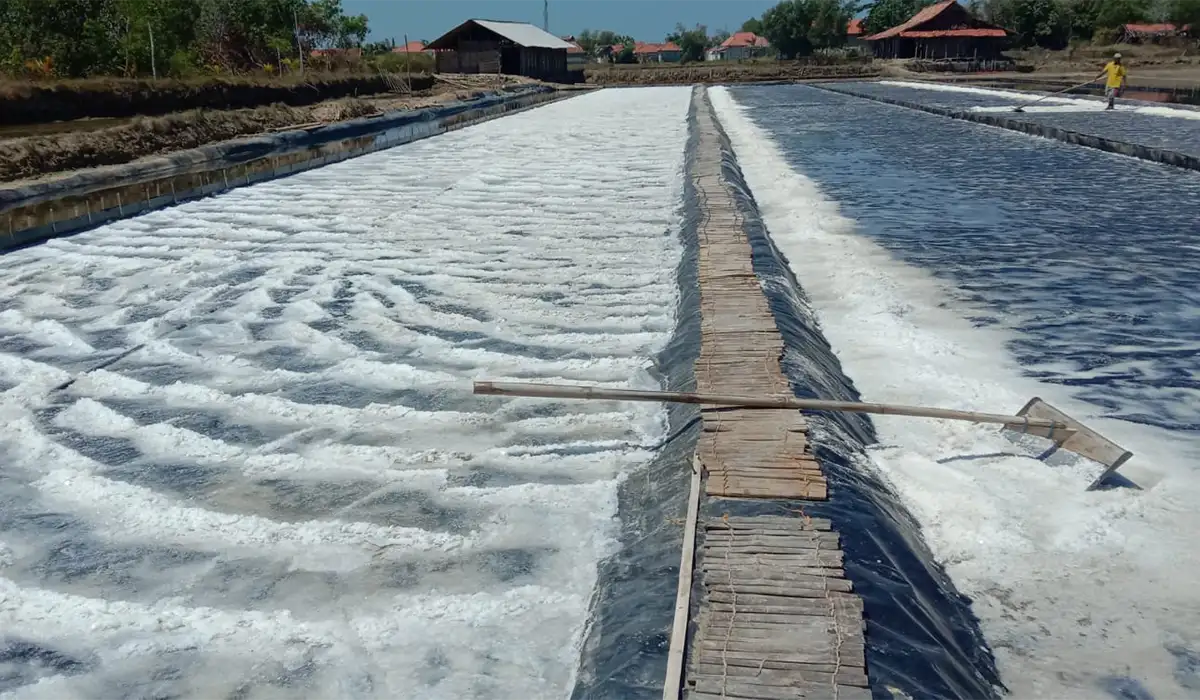
HDPE Geomembrane Installation in Purwakarta

Background & Challenges: The Threat of Soil Permeability
A large plantation in Purwakarta needed a 2,800 m² clean water storage pond to keep its irrigation supply secure through the dry season, making HDPE geomembrane installation the logical choice. However, the biggest challenge lay in the site’s geotechnical conditions.
The soil in that part of Purwakarta is dominated by fairly permeable material, and the excavation contained many sharp, angular rocks (angular rocks). If the team had simply excavated and left the pond on its natural soil base (compacted earth lining), hydrostatic pressure from millions of litres of water would force the water to seep into the ground. The result? Storage efficiency could drop drastically.
As you know, relying on native clay or conventional concrete is very costly and prone to cracking from ground movement. This is where a geosynthetic engineering approach becomes the most logical, economical and technically sound solution.
Technical Solution: Why Combine HDPE and Geotextile?
To achieve 100% watertightness (zero leakage) over a rocky subgrade, we applied a two-layer lining system. Each material has a specific role:
- Protective Layer: Non-Woven Geotextile 300gsm Before the geomembrane was laid, we spread non-woven geotextile weighing 300gsm. Why as heavy as 300gsm? This geotextile acts as cushioning. On rocky excavated ground, the water load from above presses very hard on the geomembrane. Without the 300gsm geotextile, sharp rocks below would puncture the geomembrane. The geotextile spreads these point stresses, keeping the membrane above it safe.
- Waterproof Layer: HDPE Geomembrane 1mm As the main water barrier, 1mm thick HDPE (High-Density Polyethylene) geomembrane is the star of the system. It was chosen for its very dense polymer structure, which gives absolute resistance to water infiltration. HDPE also contains carbon black and antioxidants that make it highly resistant to extreme tropical UV exposure. For a clean water pond exposed directly to the sun, a thickness of 1mm offers the right balance between flexibility during installation and long-term mechanical durability.
HDPE Geomembrane Installation Method on Site

Installation cannot be done carelessly. 90% of lining failures occur at substandard seams (welding). These are the strict stages the field team followed:
Subgrade Preparation (Earthworks)
The excavated surface was levelled and compacted to the specified standard density. The team removed tree roots, debris and any rocks larger than 10mm in diameter left on the surface to minimize mechanical risk.
Laying the Non-Woven Geotextile
The 300gsm non-woven geotextile was laid to follow the excavation contours, covering the entire base and side slopes of the pond up to the anchor trench. Adjacent geotextile panels were sewn or overlapped by at least 15-30 cm so they would not shift.
Deploying the 1mm HDPE
HDPE sheets were deployed carefully over the geotextile so as not to damage the layer beneath. Panels were arranged in a shingling pattern (like roof tiles) from upslope to downslope so that water would not become trapped under a seam if it rained during installation.
Welding (Thermal Seaming)
The main panels were joined using a Double Track Hot Wedge Welder. This machine heats the two HDPE edges and presses them together, leaving a small air channel in the middle of the weld. For detail areas such as around inlet/outlet pipes, we used Extrusion Welding.
Quality Control & Air Pressure Testing
The air channel in each hot wedge welding seam was pressurized with high-pressure air (around 30 psi) for 5 minutes. If the air pressure does not drop, the entire seam is proven 100% watertight with no micro-leaks.
Results and Impact
Once the 2,800 m² installation was complete and the pond began filling, the results proved highly satisfactory. The Purwakarta storage pond now operates at full capacity with no sign of the water level dropping from seepage.
Combining HDPE geomembrane with 300gsm non-woven geotextile not only solved the soil permeability problem immediately but also ensures a service life of more than 15 years. For the plantation, investing in quality geosynthetic materials means major savings on water pumping costs and reliable irrigation regardless of the weather.
Need a similar technical solution for a pond, landfill or soil stabilization project? Make sure you use materials with the right technical specifications and a proven installation method.
Other Articles


1mm Circular Pond Geomembrane in Pasuruan & Sumbawa
Project Background Intensive fish and shrimp farming today is under heavy pressure to produce maximum harvest biomass on limited land. To meet this challenge, the circular pond system lined with a circular pond geomembrane has become a favorite among modern farmers. The round design allows the hydrodynamics, or water circulation, to work far better than […]