


Rooftop Lining: Menara Tendean Case Study

The Problem: Why a Concrete Roof Slab Alone Is Not Enough
You might wonder: isn’t concrete a very solid material? To the naked eye, yes. But in civil engineering terms, concrete is porous and highly prone to expansion and contraction caused by extreme temperature changes. On the rooftop of a tall building such as Menara Tendean, exposed alternately to direct sunlight and heavy rain, the concrete slab undergoes thermal stress, which is why a geomembrane rooftop lining was considered.
Over time, this stress causes micro-cracks. When protected only by an ordinary liquid waterproofing coating, that layer slowly becomes brittle and peels, and eventually rainwater finds its way in through the cracks in the concrete.
In addition, the Menara Tendean rooftop also has water storage and utility ponds. The challenge was not just stopping water from seeping into the floors below, but also protecting water quality from dirt and seepage contamination, and keeping the storage ponds free of the sludge deposits that easily stick to rough, porous concrete surfaces.
The Material: Why a 0.5mm Geomembrane Rooftop Lining?
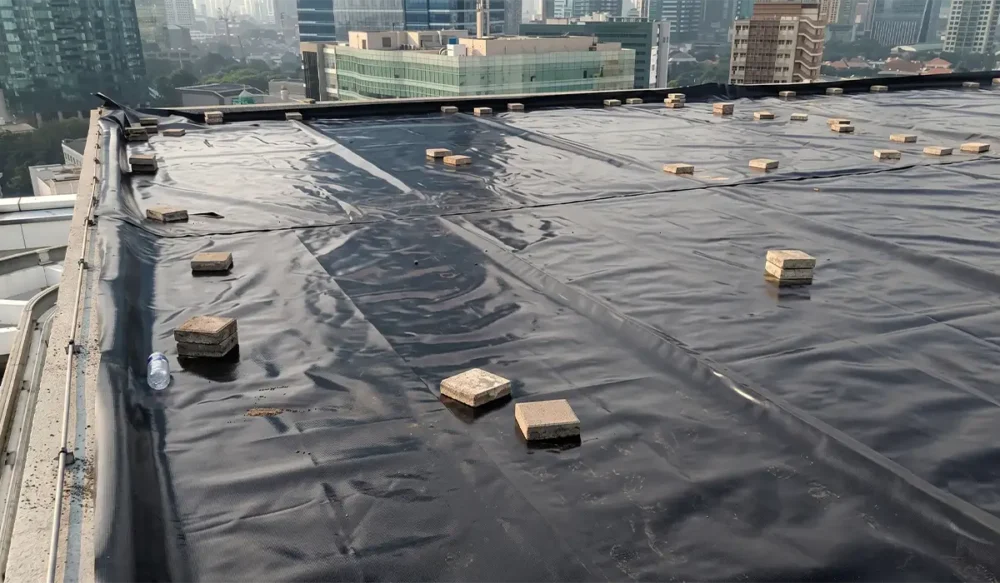
To meet this dual challenge of preventing leaks while keeping the water storage area clean, the engineering team chose a 0.5mm thick Geomembrane.
The 0.5mm thickness was carefully calculated. At this thickness, geomembrane (usually made from High-Density Polyethylene or HDPE / Linear Low-Density Polyethylene or LLDPE) is flexible enough to follow the corners of the roof slab and the pipework, while still offering high tensile strength and puncture resistance.
The impermeable and very smooth geomembrane surface ensures that no water can penetrate the concrete structure below. Its inert (non-reactive) nature also keeps the water above it free from chemical contamination from the concrete, and prevents dust particles from turning into stubborn sludge, because sludge cannot stick to the slick plastic surface of the geomembrane.
Technical Execution on Site: High Precision
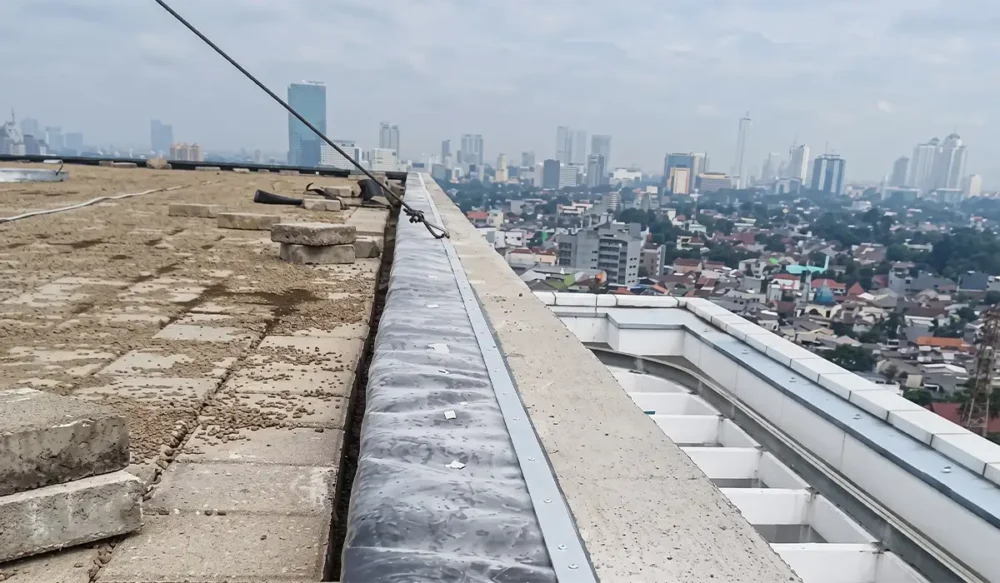
Installing geomembrane on top of a high-rise building cannot be done carelessly. Because of strong winds at height and complex rooftop architectural details, the site team had to follow strict technical procedures:
1. Surface Preparation
Before the geomembrane sheets are rolled out, the concrete slab must be thoroughly cleaned. Our team carried out grinding to level sharp protrusions in the concrete and cleared the area of gravel and debris. If geomembrane is laid over a sharp surface, the risk of leaks from puncture increases. In some critical areas, a layer of non-woven geotextile was laid first as a protective cushion.
2. Deployment and Anchoring
In windy Mampang Prapatan, the 0.5mm geomembrane sheets could not simply be rolled out. We used a mechanical anchoring system on the rooftop parapet walls. The geomembrane edges were turned up the wall, clamped with aluminium batten bars and dynabolt anchors set into the concrete, and then sealed with polyurethane sealant so that water cannot get in through the gaps in the clamping.
3. Watertight Welding Process
This is the core of a successful lining project. To join the geomembrane panels, our technicians used a Hot Wedge Welder. The machine melts the surfaces of both geomembrane edges and automatically presses them together with high-pressure rollers. The technical settings applied were:
- Heating temperature: Adjusted between 350°C – 400°C (depending on humidity and wind at the height of Menara Tendean).
- Machine speed: Kept steady so the melted material fuses (fusion) perfectly without burning it. The process produces a double-track seam with an air channel in the middle.
4. Extrusion Details at Pipe Penetrations
The roof slab is full of floor drains and vent pipes. To seal the geomembrane where it meets PVC or steel pipes, we used Extrusion Welding. Technicians heat plastic resin pellets and extrude them directly around the pipe and geomembrane (known as making a pipe boot), creating a permanent, 100% watertight seal at these most leak-prone points.
5. Quality Control and Air Pressure Test
You certainly don’t want work that hasn’t been tested. After installation, we pumped high-pressure air (around 30 psi) into the air channel formed by the double-track seam. If the pressure does not drop within 5 minutes, that is solid technical proof that the seam is free of leaks, even pinhole-sized ones.
Final Result: Long-Term Protection for Menara Tendean
The 0.5mm Geomembrane installation at Menara Tendean was completed with structural precision. As a result, building management now has a rooftop concrete slab fully isolated from Jakarta’s extreme rainfall. The rooftop water storage facilities also work optimally, with no risk of contamination and free of troublesome sludge build-up.
Through this measured technical approach, the geomembrane rooftop lining project has proven itself a long-term solution that is far more reliable and efficient than conventional waterproofing methods.
Other Articles


Building a Modern Fish Pond with HDPE Geomembrane
Background: Why Switch from Earthen and Concrete Ponds? Inland fish farming today demands high efficiency. In densely planned areas like BSD City, land must be used to the fullest. The project owner realized early on that a conventional earthen pond carries high risks. Soil permeability (its ability to let water through) varies. If the soil […]