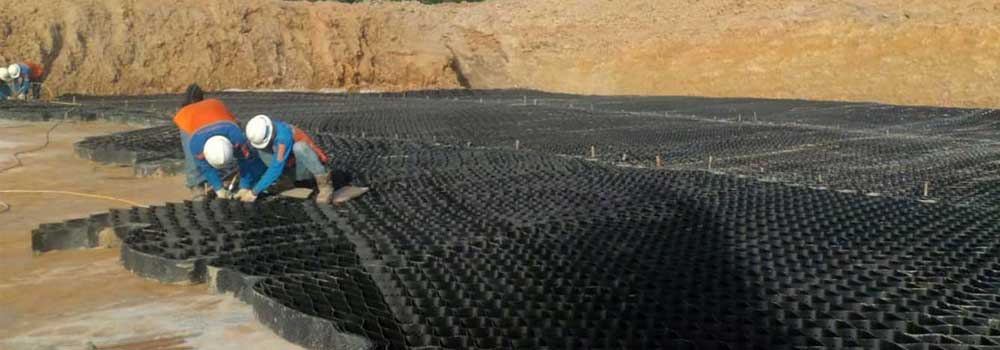
West Kotawaringin Plantation Road Reinforcement

Project Background & Challenges
West Kotawaringin (Kotawaringin Barat) is known for its enormous potential for the palm oil industry. But from a geotechnical engineering (civil engineering) perspective, the topography and soil conditions facing every West Kotawaringin plantation road are a nightmare.
The main challenge is a very soft subgrade with a very low bearing capacity (CBR/California Bearing Ratio). In the rainy season, this subgrade becomes saturated. When heavily loaded trucks pass over it, wheel pressure immediately breaks up the soil structure.
The conventional method of simply piling crushed rock or fill (aggregate) on top of soft soil has proven a total failure. Why? Over time and under dynamic wheel loads, the aggregate slowly “sinks” and is swallowed by the soft mud beneath, a technical phenomenon known as mud pumping. As a result, the road sinks again, deep wheel ruts (rutting) form, and road maintenance costs keep ballooning.
Geotechnical Engineering Solution
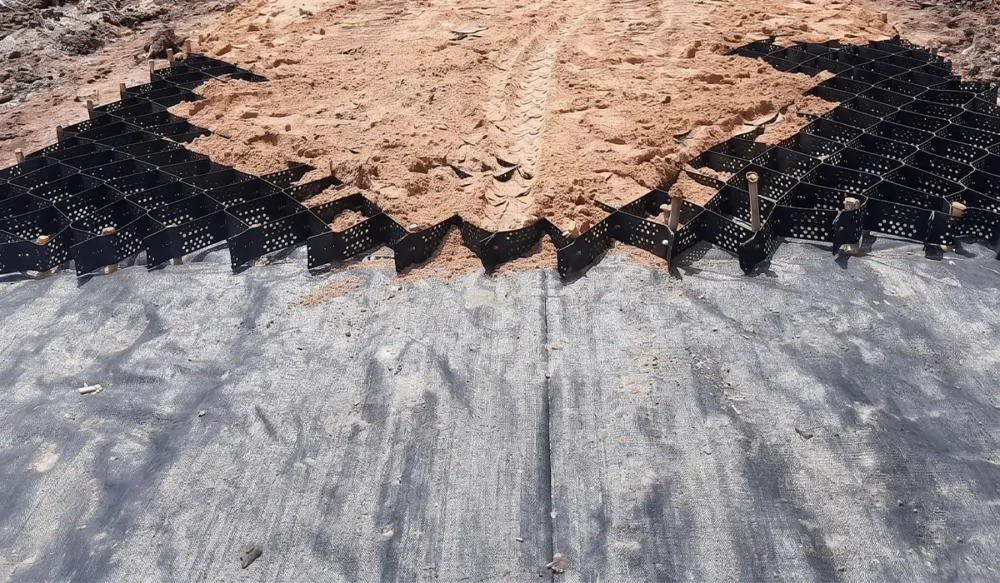
To break this cycle of road damage, PT Petra Nusa Elshada brought in a Geosynthetic Engineering approach. Instead of endlessly dumping stone into a “mud pool”, the solution was to build a road foundation that distributes loads intelligently.
The system uses two main layers of defense: 250 gsm Woven Geotextile at the very bottom (in direct contact with the subgrade), and 10 cm high Geocell laid on top of it before being filled with aggregate.
Why Is This Configuration So Strong?
If you are curious how a sheet of synthetic fabric and a honeycomb-shaped plastic structure can carry loads of dozens of tons, let’s look at their mechanical functions in depth:
1. 250 gsm Woven Geotextile as an Absolute Separator
The first and most crucial function of woven geotextile is as a separator. It prevents the soft (and wet) subgrade from mixing with the good-quality infill (aggregate) inside the geocell. With this separation layer, mud pumping can be stopped 100%. The aggregate stays clean and the road’s design thickness is maintained, with no material wasted by sinking into the ground.
2. Tensioned Membrane Effect
250 gsm Woven Geotextile is made of precisely woven polymer tapes (PP/PET), giving it superior tensile strength. When heavy vehicle wheels press on the road surface, the load is transferred downward. Instead of letting the soil bend and sink, the tensile stress in the woven geotextile counteracts that force. It works like a trampoline (a tensioned membrane), spreading wheel loads that were concentrated at one point more evenly over a much wider subgrade area.
3. 10 cm Geocell Locks the Material (Cellular Confinement System)
On top of the geotextile, we lay geocell with a 10 cm panel height. Its 3D honeycomb shape creates what is known as a Cellular Confinement System.
When aggregate is placed into the geocell cells and compacted, the geocell locks the material in from all sides. On a conventional road, when a truck wheel passes, the stones under the wheel are pushed and shift sideways (lateral displacement), leaving the road dished in the middle and bulging at the edges. The geocell walls physically stop this lateral movement. The aggregate has no room to escape, turning it into a very stiff base layer (stiff mattress).
4. Massive Increase in Soil Bearing Capacity
Thanks to the combination of aggregate confinement by the geocell and tensile load spreading by the woven geotextile, dynamic wheel loads from FFB (fresh fruit bunch) trucks no longer punch sharply into the soft soil. The loads are spread widely (stress distribution). The vertical pressure that finally reaches the subgrade is far below the soil’s failure threshold. Overall, the system radically increases soil bearing capacity, keeping the road flat, solid and free from sinking despite heavy loads every day.
Final Results on the West Kotawaringin Plantation Road
Applying 10 cm geocell and 250 gsm woven geotextile on this plantation access road in West Kotawaringin delivered immediate and long-term results. The deep wheel ruts that used to be an everyday sight are now gone. Logistics fleet speeds have increased significantly, keeping the quality of palm oil FFB optimal when it arrives at the PKS (palm oil mill).
Most important for the plantation? Road maintenance costs (grading, adding stone) dropped drastically, delivering an outstanding Return on Investment (ROI) for the company’s infrastructure.
Other Articles


Geocell Palm Oil Road on Soft Soil in West Kalimantan
Background: Extreme Subgrade Challenges in Kalimantan If you are familiar with the topography and geotechnical conditions of West Kalimantan, you know that mud, peat or soft soil with a very low CBR (California Bearing Ratio) is the main enemy of road construction, and the reason this geocell palm oil road was needed. Every day, this […]