


Geocell Palm Oil Road on Soft Soil in West Kalimantan

Background: Extreme Subgrade Challenges in Kalimantan
If you are familiar with the topography and geotechnical conditions of West Kalimantan, you know that mud, peat or soft soil with a very low CBR (California Bearing Ratio) is the main enemy of road construction, and the reason this geocell palm oil road was needed.
Every day, this plantation access road must carry enormous axle loads from trucks hauling Fresh Fruit Bunches (FFB) and Crude Palm Oil (CPO) weighing tens of tons. Without adequate reinforcement, the damage cycle is very predictable: heavy loads push stone/aggregate into the soft subgrade, rain makes things worse, and eventually the road subsides or forms deep wheel ruts (rutting). Routine repair costs then spiral out of control.
Design Solution: Combining Woven Geotextile and Geocell

To break the damage cycle, the engineering team applied a dual reinforcement system acting as a separation layer and a Cellular Confinement System. The materials used were:
- Woven Geotextile 250 gsm: Used as the base layer.
- 15cm high Geocell: Laid over the geotextile to lock the aggregate in place.
Why is this combination so crucial? Woven geotextile acts as a separator between the soft subgrade and the aggregate above, while providing a tension membrane effect that helps carry the load. Meanwhile, geocell provides a three-dimensional structure that keeps the aggregate from moving.
Technical Mechanism and Performance on Site
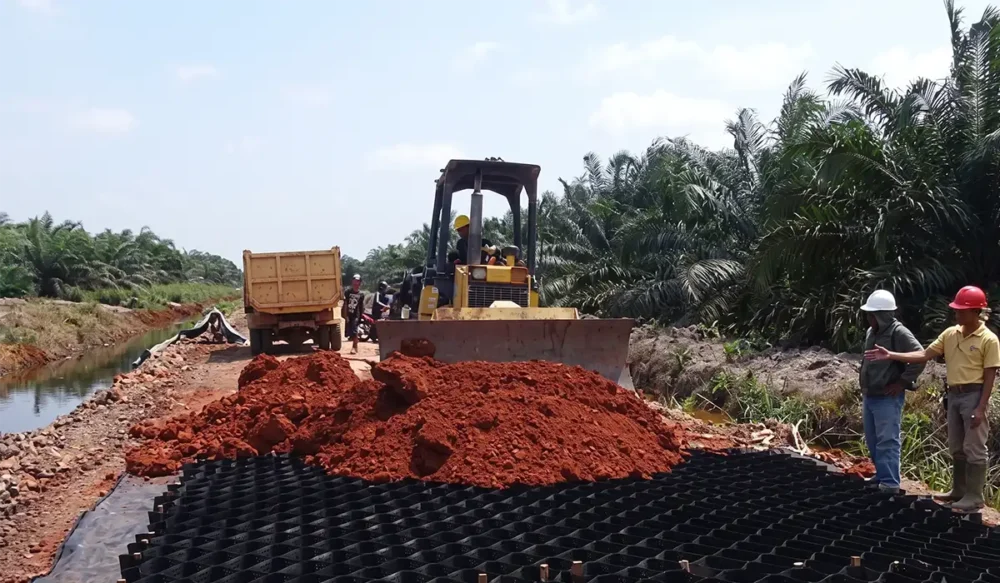
Installing 15cm geocell and 250 gsm woven geotextile over 4,000 m² was not simply a matter of laying and filling. A complex mechanical interaction produces 10 crucial functions for the plantation road:
1. Maximum Confinement
One of the main problems with unreinforced roads is aggregate being pushed to the edges by tyres. With geocell, the infill stays locked inside the honeycomb cells. This ensures the aggregate does not spread sideways (laterally), because it is held by the cell walls (hoop stress).
2. Load Distribution
When plantation trucks pass, geocell acts like a semi-rigid mattress. The system effectively spreads vehicle loads over a wider area. This mattress effect dramatically increases subgrade bearing capacity (subgrade bearing capacity), because the vertical stress reaching the soft soil below is much lower.
3. Deformation Control and Surface Preservation
Because the aggregate is tightly locked and loads are evenly distributed, we can reduce the formation of wheel ruts (rutting) that often trap trucks in the rainy season. As a result, the system keeps the road surface level, so logistics fleets can maintain steady speeds.
4. Stability Under Dynamic Loads
Mining and plantation roads carry constantly repeated dynamic loads. The combination of geocell and compacted aggregate ensures the road stays stable even under heavy vehicles around the clock. The road’s resilient modulus increases significantly.
5. Mitigating Settlement
Soft soil in Kalimantan is highly prone to consolidation settlement. The high tensile strength of the 250 gsm woven geotextile makes settlement more uniform (minimising differential settlement). With this strongly integrated layer, the risk of subsidence is reduced drastically, so the road does not become wavy.
6. Economic Efficiency (Life-Cycle Cost)
The biggest commercial benefit of this geotechnical engineering is lower operating costs. A durable, stable road surface ultimately reduces the need for routine repairs. The plantation company no longer has to keep bringing in heavy equipment and crushed stone just to patch subsided sections every month.
Conclusion
This 4,000 m² palm oil access road project in West Kalimantan proves that the natural challenge of soft soil can be overcome with the right geosynthetic innovation. The combination of Woven Geotextile 250 gsm for separation and filtration with 15cm Geocell for 3D confinement creates a solid road structure, evens out the distribution of CPO truck loads and significantly cuts maintenance costs.
If you manage plantations, mines or infrastructure on soft soil, investing in a geocell system from the early construction phase is not a cost burden but a long-term asset protection strategy.
Other Articles

Geocell Road Construction Project in Surabaya
Geocell road construction project / Geocell project / road construction / geocell installation / geocell laying Geocell application: Road Construction Location: SurabayaMaterial: Project description:

