


Drilling Pond Liner: 1.5mm HDPE Geomembrane in Dieng

Project Background and Challenges
In every drilling activity, water is the lifeblood of operations. A drilling project needs very large volumes of water continuously. At the same time, drilling also produces mixed fluids, or drilling mud waste, containing various drill lubricant chemicals, which is why a reliable drilling pond liner is essential.
The Dieng project faced three main challenges:
- Topography and Soil Conditions
The volcanic soil in Dieng is quite porous. If water or fluids are held in an ordinary earthen pond, the likelihood of leakage (seepage) is very high. - Risk of Environmental Contamination
Fluid from drilling mud must never soak into the ground, because it could pollute shallow groundwater and the surrounding ecosystem. - Stable Water Volume
Drilling operations must not stop simply because the water supply runs out due to a leaking storage pond.
Given these structural and hydrological challenges, an ordinary earthen pond was clearly not an option. The project needed a rugged waterproof liner system with high chemical resistance that could withstand the hydrostatic pressure of millions of liters of water.
Technical Solution: Installing a 1.5mm HDPE Geomembrane Drilling Pond Liner

To meet these challenges, the engineering team decided to use a 1.5mm High-Density Polyethylene (HDPE) geomembrane.
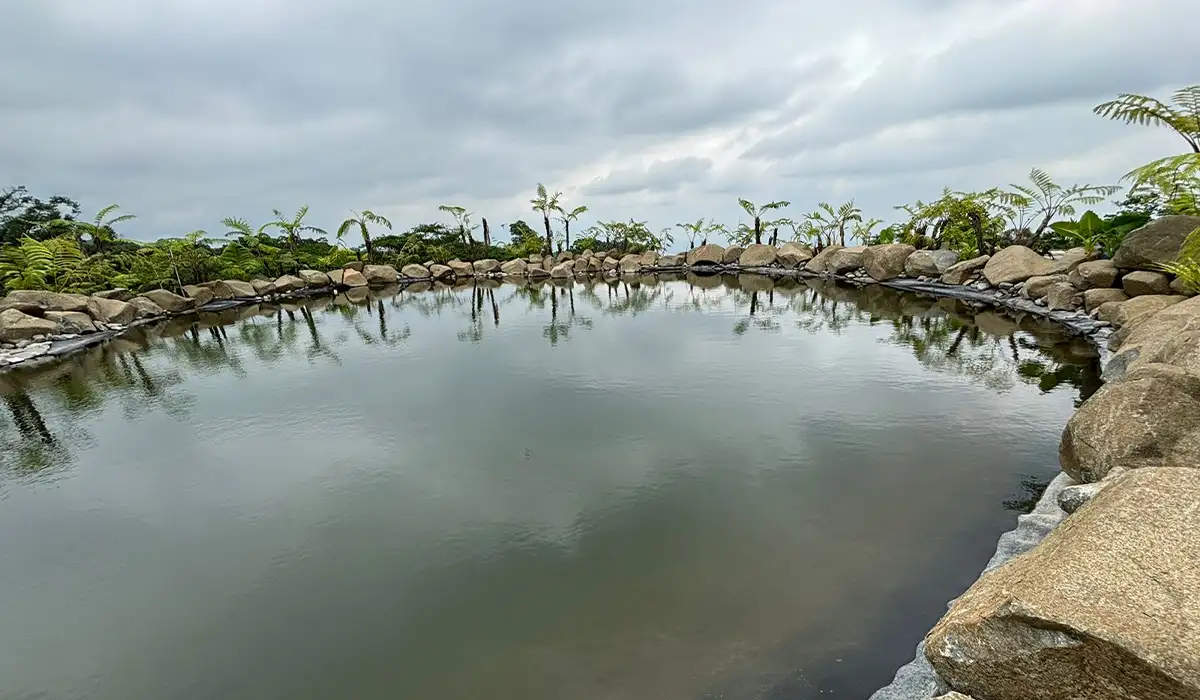
The lined area reached no less than 53,047 m². To picture it, that is roughly equal to 7 to 8 international-standard football fields with their entire surface tightly wrapped in this polymer material.
Why specifically 1.5mm? In geosynthetic engineering practice, 1.5mm is the sweet spot for a drilling pond. This thickness strikes the right balance: flexible enough to follow the contours of the excavated pond, yet with very high puncture resistance against the gravel and rock of the subgrade in the Dieng area.
Technically, the material from PT. Petra Nusa Elshada performs three essential functions in the project:
- High-Level Environmental Protection
The absolute function of this HDPE geomembrane is to hold back water and chemical fluids so they do not seep into the ground. HDPE (High-Density Polyethylene) has a very dense molecular structure, making it an impermeable material (100% waterproof). HDPE also has outstanding chemical resistance. When the pond is used to hold drilling mud waste or hot fluids from deep underground, the geomembrane will not degrade, melt or react chemically. This brings the risk of soil and groundwater pollution around the drilling area down to zero. - A Reliable Operational Reservoir
During drilling, the pond stores the clean water supply. This water is distributed in large volumes for various mechanical needs, from mixing the drilling mud that cools the drill bit, water spraying to keep down dust (dust control) in dry areas and cleaning heavy equipment, to the daily operational utility needs of the workers on site. Covering more than 5 hectares, the geomembrane keeps this entire water supply safely contained without any fear of the pond structure failing due to internal soil erosion. - Maintaining Water Quality and Quantity
At high elevations such as Dieng, maintaining the water supply is often a costly logistical problem. UV-resistant HDPE geomembrane ensures water is not lost through seepage into the soil pores. Keeping the water volume stable means saving on water pumping logistics. The geomembrane also prevents the subgrade from mixing with the stored water, so the water stays clear and free of stray mud sediment that could clog the drilling machine filters.
Installation Method and Quality Control
The success of this 53,047 m² project depended on precise installation technique. The geomembrane sheets were joined using the Hot Wedge Welding method (dual-track thermal welding). The machine creates two weld tracks with an air gap between them (the test channel).
After welding, technicians pump pressurized air into the gap (Air Pressure Test). If the pressure does not drop within the specified time, the weld seam is airtight and confirmed 100% watertight. For corners and inlet/outlet pipes, the Extrusion Welding method is used. All these processes make the pond truly monolithic (a single continuous unit) without even a hairline gap.
Conclusion
The use of 53,047 m² of 1.5mm HDPE Geomembrane in the drilling preparation project in Dieng proves that heavy industrial operations can go hand in hand with environmental sustainability standards.
Through careful technical calculation and well-targeted material specification, the risk of environmental contamination was eliminated. If you are planning a liquid containment project, whether a drilling pond, an aquaculture pond or an industrial Waste Water Treatment facility, ensuring the quality of your geosynthetic materials is the best long-term investment you can make.
Other Articles

0.75mm Geomembrane for a Reservoir Project in Cianjur
Project Background: The Classic Challenge of an Embung (Small Retention Reservoir) This project is located in Cianjur, West Java, an area that relies heavily on water availability for agriculture and plantations. The main need was to build an embung, or retention pond, that could hold as much rainwater and surface runoff as possible, making a […]
