


Artificial Pond Liner in Sentul: Project Study
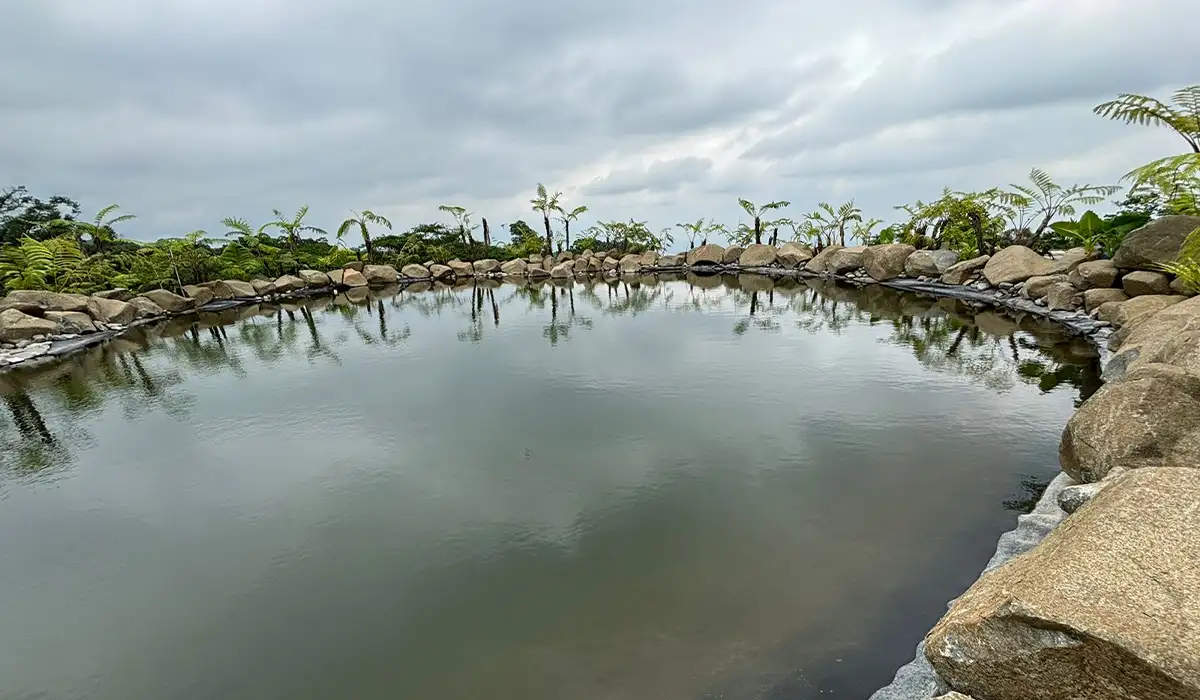
Artificial Pond Liner Project Background
An artificial pond liner is essential because managing water at scale is not simply a matter of digging a giant hole and filling it with water. Today, demand for artificial water storage facilities, from decorative lakes in commercial areas and retention ponds (retention pond) for flood control to reservoirs for agriculture and industry, has risen sharply. Water is a valuable operational asset, and losing it through unnoticed seepage is an efficiency nightmare.
Historically, many artificial pond projects relied on conventional methods such as concrete casting or simple clay compaction. Unfortunately, these older methods have critical structural weaknesses. Clay layers are highly prone to cracking when water levels fall in the dry season, while concrete construction is very expensive and vulnerable to cracking if the subgrade shifts. The result? Unstable water levels, constant leakage and soaring maintenance costs because new water must be pumped in continuously to maintain the volume.
Driven by these efficiency and durability issues, the project had one main objective: find an alternative pond-bottom liner that is completely watertight, flexible enough to follow ground movement and still cost-effective (cost-effective).
The client needed assurance that the infrastructure would not harm the surrounding environment and could withstand extreme water-level fluctuations. A modern civil engineering approach using geosynthetics was therefore essential. PT Petra Nusa Elshada designed and implemented a smart lining system to ensure the artificial pond performs as intended, with zero tolerance for even a single drop of leakage.
Project Challenge: Overcoming Soil Permeability
In every water infrastructure project, whether for landscape aesthetics, a retention pond for flood management or an industrial pond, the main enemy is always the same: soil permeability and hydrostatic pressure.
When ground is excavated for an artificial lake, the subgrade (subgrade) naturally contains pores. Without a waterproof liner, water will seep continuously into the ground (seepage). The problem does not end there. The subgrade often contains sharp materials such as gravel, tree-root remnants or angular rocks that can damage the protective layer above if it is installed carelessly.
The main objective of this project was to create a waterproof lining system (impermeable liner) capable of:
- Completely stopping water leakage into the ground (0% seepage).
- Keeping water elevation and volume stable according to the original design calculations.
- Providing long-term resistance to UV exposure and the pressure of the water volume itself.
Technical Solution: Combining Geotextile and HDPE Geomembrane
Meeting these challenges required uncompromising material specifications. We applied a double-layer lining system (double-layer system) using high-quality geosynthetics materials.
1. 250 gsm Non-Woven Geotextile as a Protective Layer (Cushioning Layer)

Before installing the waterproof material, the compacted subgrade must first be covered with Non-Woven Geotextile 250 gsm. Why is this material crucial?
This non-woven geotextile, made from polyester (PET) or polypropylene (PP) fibers, is not woven but mechanically bonded (needle punching/ needle punching). The result is a thick, carpet-like material with very highpuncture resistance.
In this project, the 250 gsm geotextile serves purely as a protective cushion (cushion). When the geomembrane above is pressed down by the massive water load, the geotextile prevents sharp stones or gravel in the ground from puncturing and tearing the geomembrane.
2. 1.0mm HDPE Geomembrane as the Primary Waterproof Liner

This is the star of the system. Above the geotextile layer, we installed High-Density Polyethylene (HDPE) Geomembrane with a thickness of 1.0mm.
The 1.0mm thickness is the sweet spot (optimal point) for medium- to large-scale artificial pond projects. Technically, 1.0mm HDPE is flexible enough to follow pond contours and slope curves, yet its very high molecular density gives it near-zero permeability.
This HDPE geomembrane is also formulated with carbon black and antioxidants, providing excellent resistance to solar UV radiation. Even when the pond water level falls and the geomembrane is exposed to direct sunlight, the material will not easily become brittle or crack (environmental stress cracking).
Installation Process: Precision Is Key
Excellent materials are of little value without a precise installation method. On-site execution involved several strict technical stages:
- Subgrade Preparation: The team ensured the ground surface was level, compacted and free of sharp materials that could damage the liner.
- Geotextile Deployment: The 250 gsm non-woven geotextile was deployed using a tightly stitched overlap method.
- Geomembrane Deployment: The HDPE geomembrane sheets were spread carefully. Because the material expands in heat and contracts in cold, deployment included awrinkle allowanceso the material would not be pulled taut when temperatures fell.
- Thermal Welding (Thermal Welding): This is the most critical stage. Geomembrane sheets were joined using a Hot Wedge Welder. The machine heats both sides of the material and presses them together until they fuse into a single unit (double seam). For corners, pipes or complex contours, we used an Extrusion Welder.
- Quality Testing (Quality Control): You cannot simply guess whether a weld leaks. Every seam was tested using the Air Pressure Test (injecting pressurized air into the gap between the double seams) and the Vacuum Box Test to confirm that 100% of the seams were airtight and watertight.
Project Results and Impact
After the entire liner was installed and the pond began filling, the results matched the expected engineering design. Using 1.0mm HDPE Geomembrane combined with 250 gsm Non-Woven Geotextile successfully created stable water storage.
The system prevented leakage, so the project owner no longer needs to keep pumping in extra water to replace volume lost through ground seepage. Besides reducing long-term water maintenance costs, the pond slopes became much more stable because the subgrade was protected from internal erosion.
If you are planning a retention pond, wastewater pond or recreational lake project, investing in the right geosynthetics from the start is key to avoiding escalating repair costs in the future.
Other Articles


Rooftop Lining: Menara Tendean Case Study
The Problem: Why a Concrete Roof Slab Alone Is Not Enough You might wonder: isn’t concrete a very solid material? To the naked eye, yes. But in civil engineering terms, concrete is porous and highly prone to expansion and contraction caused by extreme temperature changes. On the rooftop of a tall building such as Menara […]