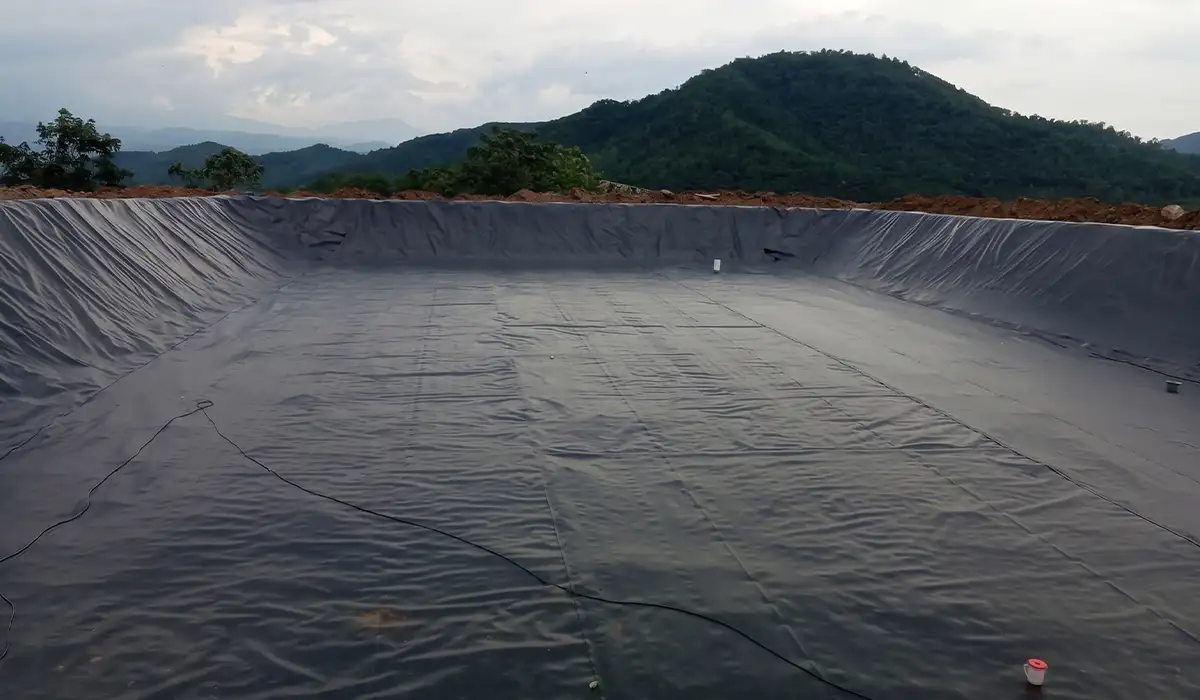
0.3mm Infiltration Pond Liner in Pontianak

Project Background & Challenges
Pontianak is known for its unique ground conditions, dominated by peat and soft soil with a fairly shallow water table (groundwater table). In conditions like these, an infiltration pond built without a proper infiltration pond liner faces two major risks:
- Exfiltration (Water Loss)
Water that should be held in the pond can easily seep away into the porous soil layers, making the storage pond ineffective at its main job. - Groundwater Contamination
If the stored water carries sediment or certain substances, its seepage can pollute the shallow groundwater aquifer, which is often a vital water source for the surrounding ecosystem.
Our client needed a containment solution that was tough, durable and highly impermeable, yet still cost-efficient for an area of 2,320 m².
Technical Solution: Why 0.3mm HDPE Geomembrane?
After analyzing the workload and field conditions, the best solution was High-Density Polyethylene (HDPE) Geomembrane with a thickness of 0.3mm.
You may be wondering, “Why use 0.3mm? Aren’t there thicker options?”
For an infiltration pond (seepage pond) that is used purely to hold water (not for heavy B3 hazardous and toxic waste, which requires 1.5mm – 2.0mm), 0.3mm is the ideal sweet spot. Here are the technical reasons:
- Superior Impermeability: HDPE has extremely low permeability (close to zero), so it effectively blocks the movement of liquids and gases.
- Flexibility and Strength (Tensile Strength): The 0.3mm thickness gives extra flexibility to follow the ground contours or the slight subgrade settlement common in soft soil such as Pontianak’s, without tearing.
- UV & Oxidation Resistance: Exposure to equatorial sunlight all year round is not a problem. The HDPE material we supply contains carbon black and antioxidants that prevent degradation from UV radiation.
Infiltration Pond Liner Installation Standards on Site
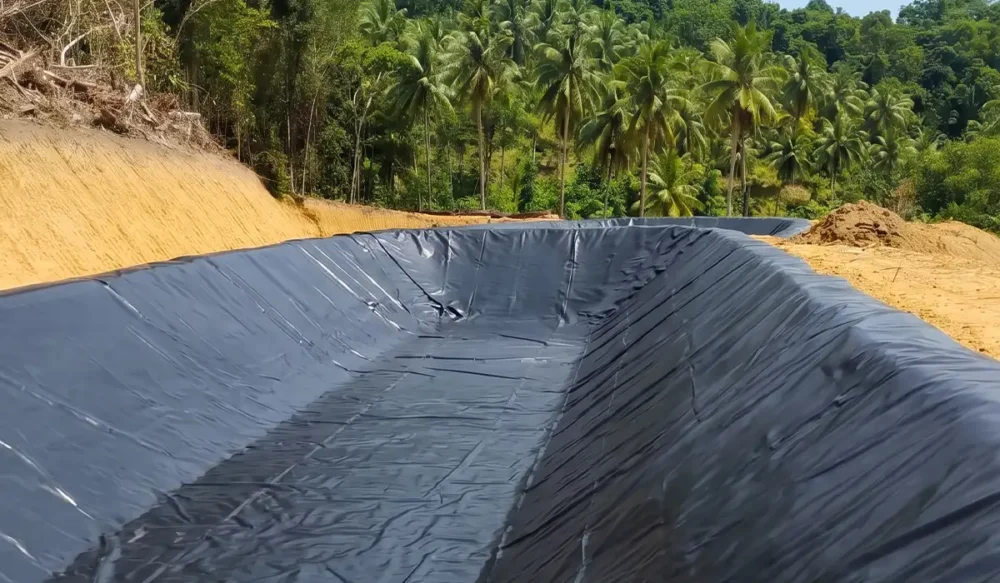
A geomembrane’s performance depends not only on material quality but entirely on installation precision. Here are the technical stages of the 2,320 m² lining work we carried out:
1. Subgrade Preparation
The first and most crucial step. The ground surface of more than two thousand square meters had to be compacted and leveled. We made sure there were no sharp stones, coarse gravel or leftover tree roots. Why? Because at 0.3mm thick, the material is very vulnerable to puncture leaks from below if the subgrade is not perfectly prepared.
2. Panel Layout & Deployment (Unrolling)
The geomembrane sheets are rolled out down the pond slope, not across it. This is a basic principle of geosynthetic engineering that minimizes stress on the seam areas. Each panel is laid out with an overlap of about 10 to 15 cm in preparation for welding.
3. Welding Method (Hot Wedge Welding)
To join the panels, technicians use a Double Hot Wedge Welder. This automatic machine melts the surfaces of both geomembrane layers in the overlap and presses them together at the same time. The advantage of this method is that it creates a double seam (dual weld track) with an air gap (air channel) in the middle. This air channel later becomes crucial for the Quality Control (QC) process.
4. Anchoring System (Anchor Trench)
To keep the geomembrane from sliding down to the pond bottom when it is filled, the top edge of the geomembrane is locked in an anchor trench (excavated trench) around the pond rim. The geomembrane is placed into a trench of about 50×50 cm, which is then backfilled with soil and compacted.
5. Quality Testing (Air Pressure Test)
This is the final stage that must never be skipped. We pump pressurized air into the air channel between the welded double seam. If the air pressure stays stable and does not drop over a set period, it proves that the seam is 100% tight with no leaks of any size.
Final Result
Installation of 2,320 m² of 0.3mm HDPE Geomembrane in Pontianak was completed on schedule with a zero leakage result. The infiltration pond now operates optimally. Water loss through seepage into the subgrade (seepage loss) has been stopped completely. At the same time, groundwater quality in the surrounding area remains pure and protected from potential cross-contamination. This project is clear proof that with well-targeted geosynthetic material selection and precise installation methods, environmental protection and infrastructure efficiency can be achieved together.
Other Articles

Rooftop Lining: Menara Tendean Case Study
The Problem: Why a Concrete Roof Slab Alone Is Not Enough You might wonder: isn’t concrete a very solid material? To the naked eye, yes. But in civil engineering terms, concrete is porous and highly prone to expansion and contraction caused by extreme temperature changes. On the rooftop of a tall building such as Menara […]

1mm Circular Pond Geomembrane in Pasuruan & Sumbawa
Project Background Intensive fish and shrimp farming today is under heavy pressure to produce maximum harvest biomass on limited land. To meet this challenge, the circular pond system lined with a circular pond geomembrane has become a favorite among modern farmers. The round design allows the hydrodynamics, or water circulation, to work far better than […]