Geobag Types and Geobag Installation Steps
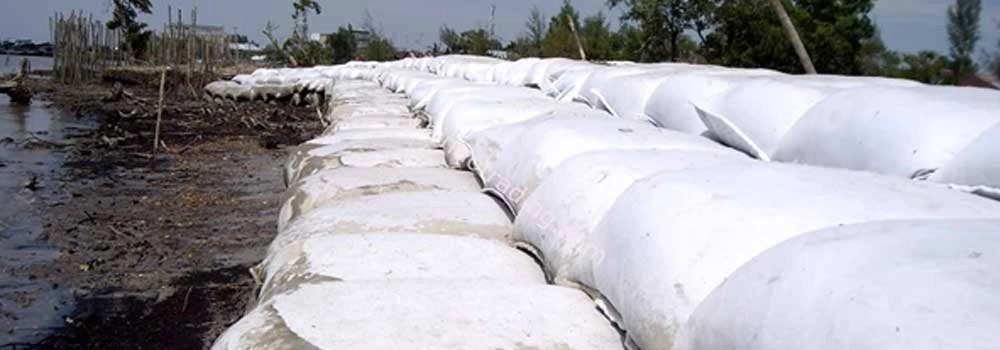
A geobag is a sack-shaped geotextile product. Made of quality, weather-resistant material, geobags are often used as an alternative to rock for protecting coastlines, rivers and erosion-prone areas. So how is geobag installation carried out?

The right installation method is essential for geobags to perform at their best, because they are used to retain soil and break waves so that scouring is kept to a minimum. Read the discussion below for the complete information.
Types of Geobags
As mentioned at the start, a geobag is a type of sack made of woven or non-woven geotextile. The material is composed of polypropylene (PP) or PET (polyester). Based on the material, geobags can be divided into several types:
Woven Geobag
As the name suggests, this type of geobag is made of woven geotextile, produced by weaving. Physically, woven geobags are black and are usually used as breakwaters, temporary dikes, slope reinforcement and more.
Non-Woven Geobag
Another type is the non-woven geobag, made of geotextile that is not woven. This type is usually white and is widely used to prevent coastal abrasion, as temporary dikes, and to handle tidal flooding, river problems and landslides.
Composite Geobag
The next type of geobag is the composite geobag, made of a combination of woven and non-woven geotextile. This type is usually used in the construction of river dikes, coastal revetments, dike repairs, permanent dikes and more.
How Is Geobag Installation Done?
Using and installing geobags is actually quite simple. The fill material can be loaded into the geobag sacks mechanically or even manually.

1. Filling the Geobag with Sand
In Indonesia, geobags are usually filled with sand using an excavator bucket and a funnel. Each geobag is filled with sand up to a certain level according to its capacity.
2. Sewing the Geobag
Once filling is complete, the next step is sewing so that the geobag is fully closed. The thread used must be polypropylene or polyester, because these resist UV exposure.
Read Also: Geotextile and Sack Sewing Machines Explained
3. Placing Geobags with a Crane
The geobag installation procedure can be adapted to project needs. Geobags can be installed using a crane fitted with a lifting frame. They must be placed carefully and precisely to avoid damaging the material.
Geobags placed on riverbanks must follow a specific, tight stacking configuration, so that the soil on the riverbank is not scoured away by the river current.
4. Installing Geobags to Fill Scour Holes
If geobags are used to fill scour holes, they can be dropped into place using a split bottom barge or a side stone dumper. Before doing so, make sure there are no sharp objects nearby that could damage the geobags.
Read Also: Functions and Benefits of Geobags for Slope Reinforcement
With the right installation procedure, geobags can perform at their best, for example as riverbank protection, breakwaters, protection against coastal abrasion, emergency dikes and many other uses.
Geobag installation on riverbanks can be done with a crane fitted with a lifting frame, or with a side stone dumper that drops the geobags to fill scour holes. To order top-quality geobags, please contact https://petrane.co.id/.
Other Articles

Uniaxial Geogrid: Complete Guide and Benefits
The term geogrid may sound unfamiliar to laypeople. Geogrid is a perforated, raft-like sheet used to strengthen soil structure. There are two types of geogrid: uniaxial geogrid and biaxial geogrid. Uniaxial geogrid has an elongated shape and is manufactured as an integral unit. This type of geogrid is more often installed on steep slopes that […]

What Is a Geobag? Uses and Installation
What is a geobag? A geobag is a bag made from Non-Woven Geotextile or woven geotextile that is sewn and then filled with sand or soil. Geobags are often seen along coastlines, where they are used to protect against coastal erosion. One effect of coastal erosion is the shrinking width of beaches, which narrows the […]