


How to Prevent Road Slope Landslides with Geocell

Road slope landslides often feel like a “disaster that strikes suddenly,” yet they usually result from a chain of causes: erosion, excess moisture, poor drainage and soil that has lost its bearing capacity. Finding the right solution is therefore an important part of road infrastructure work.
Why are road slopes prone to landslides, and how does geocell prevent them?
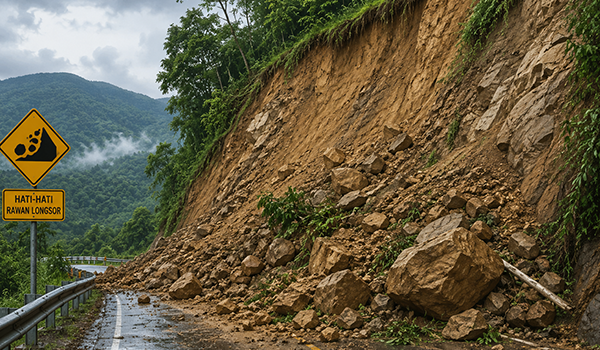
A road slope landslide is not simply a matter of “sloping ground,” but the result of an imbalance between driving and resisting forces. When rain falls, water infiltrates the soil and increases pore-water pressure. This reduces the soil’s “natural strength,” which had previously allowed it to carry loads. If the slope is then exposed to vehicle vibrations, a gradual process begins that eventually leads to a collapse or large-scale landslide. In field practice, I often see the same pattern: projects focus on treatment once cracks have appeared while overlooking the root problems in the soil layers, drainage and erosion pattern.
Geocell, on the other hand, offers a different perspective: instead of simply covering the surface, it builds a “flexible wall” of interlocking cells. Geocell generally consists of a grid- or honeycomb-shaped polymer sheet installed along the slope contour. Once filled with granular material such as aggregate, the cells restrict lateral movement of soil particles, reinforce the structure and improve the slope’s shear resistance. I see this as a combination of structural engineering and material management—geocell helps direct soil behavior toward greater stability rather than merely delaying damage.
Interestingly, how to prevent road slope landslides with geocell is also relevant to situations often considered impossible to normalize through simple methods. Examples include slopes with heterogeneous soil, clay layers that weaken easily or difficult access that requires efficient treatment. A geocell system allows reinforcement to be designed around actual slope conditions, making its flexibility suitable for dynamic sites.
Slope-failure mechanisms: from erosion to pore-water pressure
Slope failure generally begins with surface erosion, especially around the slope toe and poorly arranged drainage channels. When rainwater flows uncontrollably, it carries away soil grains, creates voids and weakens interparticle bonds. Over time, a weak preferential flow path develops and accelerates the damage. At this stage, signs such as small cracks, changes in soil color or traces of mudflow are often visible but frequently not addressed promptly.
The process then enters the pore-water pressure phase. Water infiltrating the soil increases pressure between the grains, reducing effective friction. Soil that was previously stable enough becomes “more slippery” and shifts easily when triggered by extreme rainfall, waves of vehicle vibration or additional loads above the slope. In my experience, many landslides occur not during the heaviest rain, but some time afterward—because water needs time to infiltrate and reach a potentially sliding layer.
In the final phase, the slope loses its global equilibrium. This often appears as planar sliding or the collapse of a large volume of material. This is where geocell plays a role: it helps restrain lateral movement of fill or reinforcement material while creating a more “interlocked” structure, making a slip plane more difficult to form. Of course, geocell does not replace every other component—drainage must still be considered, and planning must suit the soil conditions.
Why geocell is more than a “slope cover”
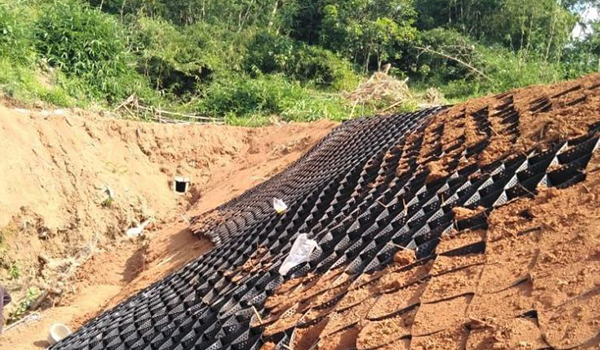
A common misconception is that geocell functions only as a cover to prevent soil from being washed away directly. In fact, geocell acts as a reinforcement system: its cells confine the fill material so stresses are distributed more evenly. Under shear forces, particles within the cells remain relatively confined in place, increasing slope stability compared with an unreinforced slope.
I also see geocell’s benefits from the perspective of “quality control over material behavior.” Many slope failures result from inconsistent fill material or poorly managed aggregate mixtures. In practice, geocell forces the work to become more structured: its compartments guide the material, its geometry provides boundaries, and it offers a visual indication that the cells must be completely filled. This simplifies field supervision and reduces variation in results.
Geocell can also be arranged in multiple layers, according to design requirements, to create a layered reinforcement effect. From an engineering perspective, a layered approach is more “resistant to change” than single-layer treatment that often restrains only the surface. If you want to apply how to prevent road slope landslides with geocell, it is important to view it as a system rather than a single product.
Connecting slope stability with detailed planning
Focusing only on geocell installation without detailed planning can produce disappointing results. Geocell must be installed at the correct inclination and over a prepared foundation. The slope surface must be cleared of loose material and graded, and the need for further treatment such as soft-soil replacement or foundation improvement must be determined. Without a sound foundation, geocell cannot restrain material that should have been repaired first.
The relationship between geocell and the drainage system must also be considered. People sometimes expect geocell to “dry” a slope, even though water management remains the decisive factor. Geocell can help drainage or reduce erosion, but if water continues to collect without an outlet, pore-water pressure can still increase. In many cases, I see field success when geocell is combined with toe drains, drainage pipes or a rock layer that allows water to move as designed.
Finally, the design must also account for loads and environmental conditions. Road structures carry dynamic vehicle loads, while seasonal changes can worsen soil conditions. The right geocell provides a “flexible response” to minor changes without immediately tearing or losing function. This is why an approach based on geotechnical studies and field inspections is important.
Correct geocell installation principles for stable slopes
After understanding why slopes are prone to landslides, the next question is how to ensure geocell actually works. In infrastructure projects, the difference between installation that is “merely completed” and installation that is “designed to work” is very noticeable. Geocell is not a decorative slope element; it must be installed according to the correct stages, elevations and fill-material quality.
Many failures occur not because the geocell is poor, but because field procedures are inconsistent. For example, the slope surface may remain uneven and contain voids, the aggregate fill may not reach the required density, or the geocell may not be tied or anchored and its cells shift when subjected to force. I have always believed that the best quality results not from “momentary ingenuity,” but from process discipline. When process discipline is high, the outcome is often far more stable than one that relies on the product alone.
In the context of how to prevent road slope landslides with geocell, installation principles cover slope preparation, arranging geocell along the contours, and proper filling and compaction. For long-lasting results, do not underestimate small details, because they are usually the weak points when heavy rain returns.
Slope preparation: clearing, grading and initial stabilization
The first step is to ensure the condition of the base where the geocell will work. The slope surface must be cleared of loose soil, fragile plant roots—unless they are planned as part of the system—and material prone to collapse. At some locations, I have seen projects install geocell directly over soil that remained “soft” without first improving it. As a result, although the geocell was interlocked, the foundation continued to move and reinforcement was less effective.
After clearing, the slope generally needs to be graded and reshaped to match the installation geometry. This is important because the geocell will hold the fill material and add stiffness. If the slope shape does not match the design, the geocell will work inefficiently. Imagine installing a safety net: if it is tensioned incorrectly, it cannot perform its main function optimally.
Where the soil is very weak or the surface layer detaches easily, initial stabilization may be required through partial material replacement, regrading with selected material or local reinforcement. This approach may feel like “extra work,” but it generally saves long-term costs by reducing the risk of repeated repairs after small landslides.
Anchoring geocell: truly locking the system in place
Anchoring is essential for keeping geocell in position under shear forces. Without anchoring, geocell can shift, slide downward or form folds that reduce its confinement capacity. In the field, anchoring commonly uses pins, anchors, ties or methods suited to the design and slope characteristics. I believe these details must be adapted to the soil conditions, including soil type, density and inclination.
Geocell must also follow the contour so every layer works together. A common mistake is installing it either too “tight” or too “loose” based on visual estimates. In fact, tension and conformity affect load distribution. If you want to apply how to prevent road slope landslides with geocell, make sure the connections between adjacent sections leave no gaps that could become erosion channels.
Also check the installation orientation and direction against the product specifications. Some geocell systems have configurations that affect how the cells confine fill material. Understanding the manufacturer’s specifications and combining them with the geotechnical design makes results more predictable. In my experience, projects that cross-check the design drawings, installation guide and field conditions generally require far less “rework.”
Filling and compaction: aggregate quality determines performance
Geocell is only as strong as the fill material inside it. Aggregate filling must therefore follow the specified gradation, particle size and quality requirements. Aggregate that is too fine can impair drainage and increase the risk of pore-water pressure. Conversely, aggregate that is too coarse and poorly arranged can reduce density and leave voids that cause deformation.
Compaction is also important. Insufficient compaction leaves the cells filled with material that can still move. Excessive compaction under certain conditions can cause segregation or damage the geocell structure. In the field, the compaction method is generally adapted to the layer thickness and equipment used. I personally prefer a “measured” approach: density testing or evaluation as required, rather than simply assuming the material is dense enough.
In many cases, the combination of suitable aggregate and correct compaction produces much more stable slope behavior during rain. The cells are tightly filled, making shear more difficult. Thus, how to prevent road slope landslides with geocell is not only about installing sheets, but ensuring the “contents” perform as intended in the design.
Integrating geocell with drainage, vegetation and surface protection
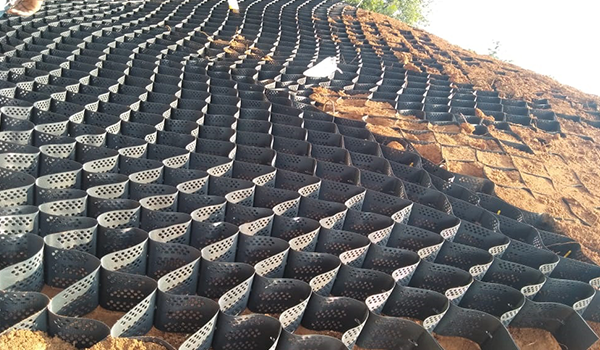
Many people assess slope stability solely from geotechnical reinforcement. Yet landslides are often triggered by water—and water follows the routes we create or leave open in the field. To maximize geocell’s benefits, it must therefore be integrated with drainage, surface-erosion control and an appropriate vegetation plan. I see this holistic approach as designing a “living system”: soil, water and the surface must work together.
Geocell helps restrain material displacement, but the slope surface still needs protection from direct rain erosion. Without surface protection, particles above can be carried away before the internal structure has time to “adapt.” Meanwhile, retained or accumulated water increases pore-water pressure. Integration thus creates a kind of “layered shield”: geocell as internal reinforcement, drainage as water control and the surface layer as erosion protection.
My creativity generally comes into play when choosing a combination suited to the context. At certain sites, vegetation is important for stabilizing the surface and improving controlled infiltration. At others, vegetation may cause roots to penetrate unplanned areas or retain excess moisture if poorly managed. I therefore always encourage local evaluation before selecting a strategy.
Coordinated drainage: conveying water without damaging the slope
Good drainage does not mean “drying everything out,” but directing water away safely. On a road slope, water must not be allowed to concentrate at one point. Runoff from the road surface, for example, should be directed into a planned conveyance system rather than falling directly onto the slope. Free-falling water has high kinetic energy and can damage the surface and scour material.
When integrated with geocell, water routes can be controlled better through fill-material selection and layer design. To a certain extent, geocell cells can help distribute water more evenly so it does not all load a single weak plane. Still, without edge drains or a collection system, water will find its own outlet—and the route it finds is usually destructive.
I also recommend inspection after the first rainy season. Sometimes the initial drainage design is correct, but field conditions change: sediment accumulates in channels, pipes become blocked or mud settles. This kind of monitoring ensures you do not rely solely on plans, but verify real-world performance. Ultimately, how to prevent road slope landslides with geocell becomes more effective when drainage functions at all times.
Surface protection: stopping erosion before it becomes a slip plane
Erosion is a “subtle villain” that often goes unnoticed. Small surface cracks may look insignificant, but repeated erosion widens weak paths until a slip plane forms. Since geocell works within the structure, the surface layer must protect the area above the cells from direct rain impact and runoff.
Surface protection may take the form of a thin pavement layer, geotextile matting or a finish using a particular aggregate, depending on the design. Layer selection must consider permeability so water is not trapped instead. In some cases, I find the better solution is not simply to “cover” the surface, but to combine it with material that reduces flow energy and directs water to the drainage system.
Details at joints between segments are also important. Erosion often begins at joints because gaps become water channels. Make sure geocell installation leaves no empty spaces that could become small channels and scour the material. When the surface is treated as part of the same system as the geocell, the risk of degradation becomes lower.
Vegetation and long-term stability: aesthetics that also serve engineering
Vegetation is often viewed as an aesthetic element, even though it can serve as a natural “binder” at the soil surface. Plant roots can help retain soil against erosion, while foliage reduces direct rain energy. Vegetation must, however, be designed around plant species, growth patterns and maintenance requirements.
I have seen projects plant vegetation immediately without ensuring that soil and moisture conditions were suitable. The plants failed to grow, while the surface layer continued to erode. Conversely, plants that are too aggressive at a particular site can penetrate the system and interfere with long-term performance. A vegetation strategy must therefore consider reinforcement timing: whether rapid-growing vegetation is needed for initial protection or non-disruptive groundcover grass is more suitable.
With geocell, vegetation can become a “covering” layer that reduces the risk of surface erosion while geocell maintains internal stability. This combination makes the approach more sustainable: it not only restrains current landslides, but also prepares the slope to be more “environmentally friendly” and durable. Within the framework of how to prevent road slope landslides with geocell, vegetation is an added benefit that strengthens the system when properly designed.
Maintenance, evaluation and practical case studies to prevent recurring landslides
A good solution does not end when construction is complete. Road slopes exist in a changing environment: rainfall intensity varies, surface runoff may change because of nearby activity, and vehicle loads may increase over time. Maintenance and evaluation are therefore part of a landslide-prevention strategy. I often emphasize to field teams that the “final result” is not the project’s last week, but the system’s performance in the following season.
Properly installed geocell should be more resistant to shear, but it still requires inspection for mechanical damage, surface erosion or drainage disruption. Weaknesses generally develop progressively, so routine inspection helps detect them earlier. In project terms, this also means planning a realistic maintenance budget from the outset.
This section discusses how to evaluate geocell performance, common maintenance steps and lessons from failure patterns so that applying how to prevent road slope landslides with geocell becomes more mature from one project to the next.
Inspection routine: what to look for after the rainy season
An inspection does not always need to be long or complicated, but it must focus on relevant indicators. Look for new cracks, changes in slope shape, traces of unintended water flow or material that appears to have lifted or shifted. At the slope toe, check for signs of scour or small holes developing into channels.
I generally recommend visual observations supplemented by simple records: location, condition and severity. If possible, use photo documentation for comparison over time. With this data, minor stable problems can be distinguished from developing problems. Inspections after heavy rain quickly reveal whether the drainage and surface systems are performing properly.
Also consider information from road users and nearby communities. They often know when particular rainfall produces the same conditions or when crackling sounds emerge from the slope. Such information does not replace technical analysis, but it can provide an early lead for a more detailed audit.
Maintenance: addressing minor erosion and keeping drainage functional
Many road-slope problems begin with minor erosion that is left untreated. If ignored, it becomes a water path and enlarges the damage. Maintenance should therefore target the root cause: inspect channels, ensure they are unobstructed and remove deposits when necessary. In a geocell system, make sure no surface sections are missing or exposed in a way that directs water onto more vulnerable material.
Surface protection must also be maintained. If a cover layer or vegetation is used, keep it in good condition. Uneven vegetation growth may indicate an area that is too dry or too wet, pointing to a drainage problem or unsuitable soil layer. Evaluation becomes a diagnostic tool here.
When repairs are needed, use a patching approach consistent with the original design. Do not simply patch the surface without understanding how water moves underneath it. I have seen patches applied too quickly without analyzing drainage, causing the problem to shift elsewhere. Repairs to geocell should support the system: preserve fill integrity, maintain joints and prevent new water paths.
Learning from the field: refining designs for future projects
Every site has unique soil characteristics and water-flow patterns. Lessons from previous projects are therefore essential. One location may struggle with intense rainfall and strong runoff, while another has clay soil sensitive to moisture. By collecting data on minor failures—cracks, scour or local settlement—you can improve the geocell design, layer thickness, fill-material choice or drainage details.
My preferred approach is a “design-versus-behavior audit.” This means comparing design predictions with field observations. If they differ, ask why. Did erosion alter the slope before installation? Did compaction fail to reach the target density? Was the existing drainage left unimproved, allowing water to keep loading the slope? Answers to these questions help create a more precise strategy.
Thus, how to prevent road slope landslides with geocell becomes a continuous process: from initial study, design and execution to evaluation and improvement. Carrying these lessons into the next project improves landslide-prevention systems and reduces rework costs. Ultimately, geocell is not only a technical solution, but also a tool for building a more reflective, data-driven work culture.
Other Articles
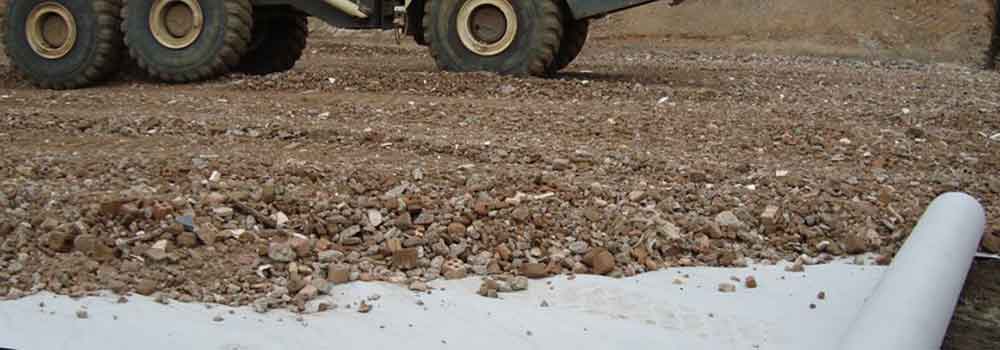
Class A and Class B Geotextile Specifications
Class A geotextile is used as a separation layer beneath 1 m of aggregate/rock fill, while Class B geotextile is used as a filtration layer placed beneath dikes. Class A and Class B geotextiles can be woven or non-woven, made of UV-resistant polypropylene or polyester. Class A and Class B geotextiles must be protected against […]

